
Maintenance & problems · Augusta, GA

Clogged Downspouts: How to Clear and Prevent Them

A gutter is only as good as the downspout draining it. Most clogs sit at the top outlet or the bottom elbow, some sit underground in red clay, and nearly all of them can be prevented.

  • Sign of a clog: dry downspout while the gutter overflows
  • Check the top outlet first — pine straw packs there
  • Buried lines in Augusta clog with clay silt, not just leaves
  • 3x4 downspouts have twice the opening of 2x3
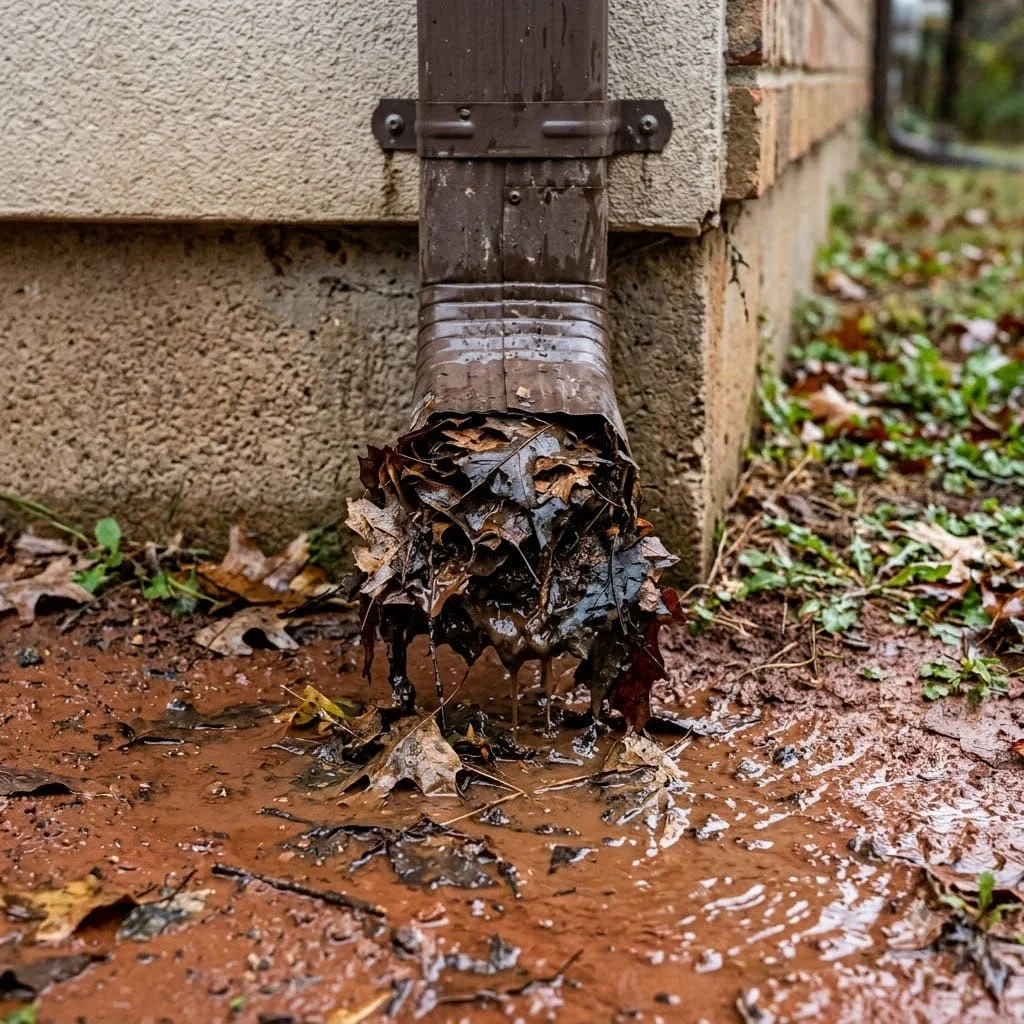
Bottom of a brown downspout packed with wet leaves, with muddy red clay soil pooled at the base of a house foundation
Free EstimatesAugusta & Richmond CountySeamless Gutter SpecialistsWritten PricingNo-Pressure Quotes

The Short Answer

To clear a clogged downspout, clear the top outlet from the gutter, remove the bottom elbow and empty it, then flush the downspout with a garden hose. If water still backs up, break the clog up with a plumber's drain snake. Most clogs are gone after those three steps.

Buried downspout lines are a different job. In Augusta they often fill with red clay silt as well as leaves, and they need to be flushed or snaked from the pipe itself.

Stopping clogs from coming back comes down to downspout size, elbow count, and how much pine is over the roof. This guide covers all of it.

Signs of a Clogged Downspout

  • Little or no water coming out the bottom during rain
  • The gutter overflowing near the downspout, even after it has been cleaned
  • Water spraying out of a seam or elbow partway down the wall
  • Gurgling or bubbling sounds inside the downspout during rain
  • Water standing in the gutter long after the rain stops
  • A dull, solid sound when you tap one section of the downspout
  • A downspout pulling away from the wall — a packed one gets very heavy
  • A pop-up emitter in the yard that never opens, or a wet patch along the buried line

The first one is the giveaway. If the gutter is overflowing and the downspout is dry, the downspout is the problem. The overflowing gutters guide covers what else causes overflow if the downspout is running freely.

Where Downspouts Clog

Clogs form wherever debris has to change direction or squeeze through a narrow spot.

Location Why it clogs How common
Top outlet where the gutter meets the downspout Pine straw bridges the opening and catches everything behind it Most common, especially under pine
Bottom elbow (the kick-out at ground level) Debris that gets past the top drops the whole length and packs into the bend Very common
Upper elbows under the eave Two tight bends close together trap sticks and clumps Common
Buried drain line Clay silt settles, roots enter joints, pipe sags and holds water Common in Augusta
Pop-up emitter at the end of a buried line Lid seizes with clay and grass, or sits higher than the pipe Common

How to Clear a Clogged Downspout

You will need a ladder, work gloves, a garden hose with a spray nozzle, a screwdriver or drill, and ideally a hand-cranked plumber's drain snake. On a single-story home this is a manageable DIY job.

  1. Clear the top outlet. From a ladder, pull out any debris packed into the opening where the gutter drains into the downspout. Under pine this is where most clogs sit. Clean the gutter nearby so the clog does not re-form straight away.
  2. Open the bottom. Remove the screws holding the bottom elbow and pull it off. Empty it out. A lot of debris will often drop out of the downspout when the elbow comes off.
  3. Flush from the top. Put the hose into the outlet and turn it on. Water should run freely out the bottom. If it backs up, the clog is still inside.
  4. Flush from the bottom. Push the hose up from the bottom opening as far as it goes, then turn it on at full pressure. This often pushes a clog back up and out of the top.
  5. Use a drain snake for stubborn clogs. Feed it in from the top or bottom, crank it to break up the clog, then flush again.
  6. Put the elbow back. Refasten it with screws, reattach any loose wall straps, and run the hose once more to check for leaks at the joints.
Two things to avoid

Do not use a pressure washer inside a downspout. The force can split seams and blow crimped joints apart. And do not bang on the downspout to shake a clog loose — aluminum dents easily, and every dent is a new place for debris to catch.

If the downspout is crushed, split, or badly dented, clearing it will not last. It needs replacing. See the downspout installation and repair page for what that involves.

Clearing a Buried Downspout Line

Many Augusta homes have downspouts that connect to a pipe running underground, ending at a pop-up emitter in the yard or an open outlet on a slope. These clog differently.

  1. Disconnect the downspout from the pipe. Most connect with an adapter at ground level that lifts off or unscrews.
  2. Check the outlet end. Open the pop-up emitter and clear out grass, clay, and roots. Many "clogged" lines are just a seized emitter.
  3. Flush the line. Run a hose into the pipe from the downspout end. Watch the outlet. Water should arrive steadily.
  4. Snake the line if it backs up. Feed a drain snake in from either end to break up silt or roots, then flush again.
  5. Look for signs of a broken pipe. A soggy patch or sinkhole along the line while you flush means the pipe has cracked, separated, or sagged. That section needs digging up.

Lines that fill with silt again and again, or that were laid with corrugated pipe that sags and holds water, are usually better replaced than repeatedly cleared. Smooth-wall pipe laid with steady fall carries silt out instead of trapping it.

Some lots have nowhere for a buried line to empty. On low ground with a high water table, the pipe fills from the outlet end. The Beech Island page covers that problem.

Why Augusta Downspouts Clog

Downspouts clog everywhere, but three local conditions make it happen more often in the CSRA.

Loblolly pine straw

Pine needles are long and stiff. They wash into the downspout outlet sideways, lodge across it, and catch everything that follows. A single clump can seal a small outlet. Leaves tend to fold and slide through. Pine straw locks together.

Small builder-grade downspouts

Many homes built in the last few decades have 2x3 downspouts. A 2x3 has about 6 square inches of opening. A 3x4 has about 12. That difference decides whether a wad of wet pine straw passes through or stops. The Grovetown page covers how common undersized downspouts are in newer subdivisions.

Red clay in buried lines

Augusta's red clay is fine and sticky. Splash from roof runoff, grit washed off shingles, and soil getting in at loose joints all settle in buried pipe as silt. Over time that silt narrows the pipe and finally blocks it. Clay also packs around pop-up emitters until they cannot open.

How to Stop It Happening Again

  • Clean the gutters on schedule. Most downspout clogs start as debris in the gutter. Under pine, that means three or four cleanings a year — see how often to clean gutters in Augusta.
  • Upgrade to 3x4 downspouts. Double the opening means far fewer clogs. It is one of the most effective changes on a pine lot.
  • Cut down on elbows. Every bend is a place for debris to stop. Route downspouts as straight as the house allows.
  • Add a cleanout at the base of buried lines. A cleanout fitting where the downspout meets the pipe lets you check and flush the line without disconnecting anything.
  • Use strainers carefully. Basket strainers help on leaf-only lots. Under pine they can mat over and stop water entering the downspout, which makes overflow worse.
  • Consider gutter guards on heavy pine lots. Keeping debris out of the gutter keeps it out of the downspout too. The gutter guard cost guide covers when guards are worth it.
  • Flush buried lines once a year. A hose run through the line after the winter leaf drop shows whether it is still draining.

When to Repair or Replace

Most clogs only need clearing. These are the cases where something needs replacing, with typical ranges in the Augusta market.

Situation Fix Typical Augusta cost
Downspout clogged but undamaged Clear and flush Usually part of a gutter cleaning, $150 – $250 single-story
Downspout crushed, split, or badly dented Replace the downspout $150 – $350 single-story, $250 – $500 two-story
2x3 downspouts clog every season under pine Upgrade to 3x4 $150 – $350 per drop, single-story
Water pooling at the base with no buried line Add an extension or splash block $30 – $120
Buried line silted, cracked, or sagging Replace the buried line $12 – $25 per ft

Where the water goes after the downspout matters as much as the downspout itself. On Augusta clay, water released right beside the house sits against the foundation. Our downspout service covers extensions and buried lines that carry it well clear.

Getting Help With a Stubborn Clog

Clear the top outlet, empty the bottom elbow, and flush. If that does not work, snake it. If the clog keeps coming back, the fix is usually a bigger downspout, fewer elbows, or a buried line that drains properly.

Augusta Gutters Pros clears and replaces downspouts and buried drain lines across Augusta, Evans, Martinez, Grovetown, Hephzibah, North Augusta, Aiken, and the rest of the CSRA. Call (706) 441-1723 and tell us which downspout is giving trouble. We will find the clog and give you a written price if anything needs replacing. You can also read how our free estimates work first.

About the prices on this page

Every range here describes what gutter work generally sells for in the Augusta and CSRA market rather than a national average. They show what to expect, not a final offer — your exact price comes from measuring your roofline. The figures were last checked in September 2026; see our terms of service for the full disclaimer.

Straight answers

Frequently Asked Questions

How do I know if my downspout is clogged?

The clearest sign is a downspout with little or no water coming out during rain while the gutter above it overflows. Other signs are water spraying from a seam partway down, a gurgling sound, or a gutter that stays full after rain stops.

On a dry day, tap along the downspout. A clogged section sounds dull and solid where the rest sounds hollow.

How do you unclog a downspout?

Start at the top outlet where the gutter drains into the downspout, since that is where pine straw packs most often. Clear it by hand, then remove the bottom elbow and empty anything caught in the bend.

Run a garden hose down from the top. If water still backs up, feed the hose up from the bottom or use a plumber's drain snake to break up the clog. Avoid pressure washers, which can split seams and blow joints apart.

How do I unclog an underground downspout drain?

Disconnect the downspout from the buried pipe and run a hose into the pipe. If water backs up, feed a drain snake in from the downspout end, or from the outlet end if you can reach it.

In Augusta, buried lines often fill with red clay silt rather than leaves. A snake breaks it up, but a heavily silted line may need jetting or, if it has settled or cracked, replacement.

Are downspout strainers a good idea?

They help with leaves on a lot with no pine. Under loblolly pine, a basket strainer can clog within weeks, because needles and pollen mat over the top and stop water entering the downspout at all.

If you use strainers, check them after every heavy storm. On pine lots, larger 3x4 downspouts or gutter guards usually work better.

Why does my downspout keep clogging?

The usual reasons are a small 2x3 downspout, too many elbows, heavy pine cover, or a buried line that has silted up and backs water into the downspout.

A 3x4 downspout has twice the opening of a 2x3 and passes clumps of pine straw that would plug the smaller size. Cutting out unnecessary elbows also helps.

How much does it cost to fix or replace a clogged downspout?

Clearing downspouts is normally part of a gutter cleaning. Replacing a crushed or split downspout runs $150 to $350 per drop on a single-story Augusta home and $250 to $500 on a two-story.

Replacing a failed buried drain line runs roughly $12 to $25 per foot, depending on how hard the clay and tree roots are to trench through.

Get Every Downspout Draining Again

We’ll clear the downspouts and buried lines, find out why they keep clogging, and give you a written price for anything that needs replacing. No obligation.

Call Us Now (706) 441-1723