
Gutter Guards in Augusta, GA — What Survives Pine Straw and How It Gets Fitted
Not every leaf guard survives a Georgia pine season, and several make clogs worse. Here is what actually holds up on Augusta rooflines, what it costs installed, and how the fitting is done so it still performs in year three.
- Straight comparison of every guard type on pine straw
- Full clean-out and inspection before anything is fitted
- Nothing goes under the shingles — roof warranties intact
- Real installed pricing, not a pressure presentation
- We will tell you if your home does not need them
Frequently Asked Questions
Do gutter guards actually work with Georgia pine needles?
Fine micro-mesh guards do. The openings in a quality stainless micro-mesh are smaller than the diameter of a loblolly needle, so straw sits on top and blows or washes off instead of dropping into the trough.
Wide plastic screens, foam inserts, and brush guards do not work well here. Needles wedge into all three, and once they do the guard itself becomes the clog — which is harder to clear than an open gutter.
How much do gutter guards cost installed in Augusta?
Installed pricing generally runs $8 to $12 per linear foot for aluminum screen, $15 to $25 for quality stainless micro-mesh, and $25 to $40 for premium branded reverse-curve systems.
On a typical Augusta home with 180 feet of roofline, that puts micro-mesh somewhere between $2,700 and $4,500. It is a real investment, which is why it only makes sense on homes with genuine tree cover.
Do the gutters need to be cleaned before guards go on?
Always, and it is included. Fitting a guard over a trough with pine straw still in it seals the debris inside permanently, where it holds moisture against the aluminum and blocks the outlet you can no longer reach.
The clean-out is also the inspection. It is when we find loose hangers, failing miters, and pitch problems that have to be corrected before guards add weight to the run.
How long does a gutter guard installation take?
Most Augusta homes are finished in a single day. A typical 180-foot roofline takes four to six hours including the cleaning and inspection that has to happen first.
Two-story homes, steep pitches, and rooflines with a lot of valleys and dormers take longer, mostly because of ladder repositioning rather than the fitting itself.
Will I still need to clean my gutters?
Less often, but not never. Guards stop the trough filling, which is the part that causes overflow and hanger failure. The mesh surface itself still collects pollen film and fine grit and benefits from a rinse once a year.
Anyone promising you will never touch the gutters again is overselling. What is realistic in Augusta is going from three or four cleanings a year to one light maintenance visit.
Do gutter guards void a roof warranty?
Some systems can. Guards that slide up under the shingle course lift the shingle slightly and, on certain manufacturer warranties, count as an alteration to the roof system.
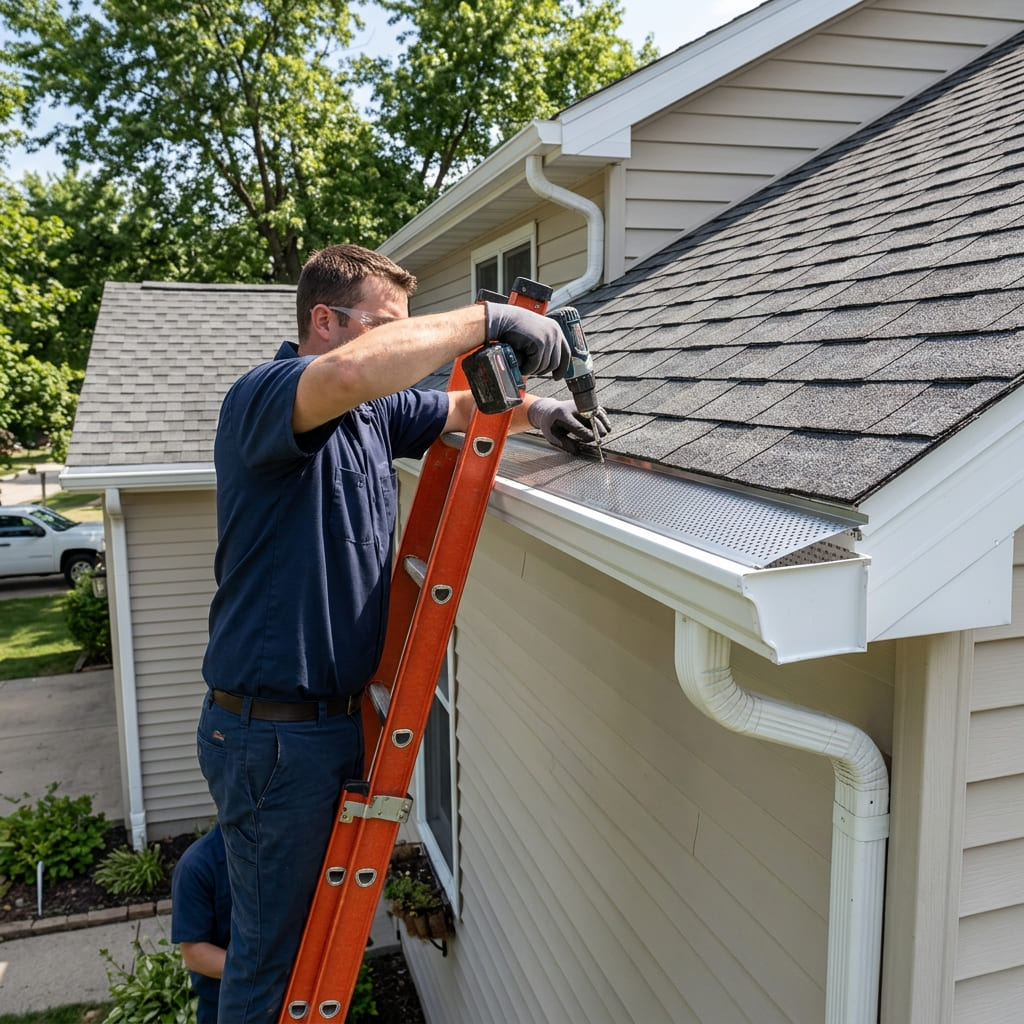
Guards that fasten to the gutter trough and the front lip avoid that entirely because nothing is inserted under the roofing. In Augusta, where a lot of roofs were replaced after Helene and are still under warranty, this matters — trough-mounted systems are the safer default for that reason.
Can guards be fitted to my existing gutters?
In most cases yes, provided the trough is sound, hung on hidden hangers, and correctly pitched. Guards add weight and wind load, so a run that is already sagging needs to be rehung first.
If the gutters are near the end of their life, it is usually better value to replace the trough and fit guards in the same visit than to put a 25-year product on aluminum with five years left.
Are gutter guards worth it on a house with no trees?
Usually not. If your roofline is open and you are getting through the year on a single cleaning, guards will take a very long time to pay back.
The homes where the math works in the CSRA are the ones under loblolly and hardwood canopy — wooded lots in Forest Hills, older streets around Monte Sano, and the tree-heavy properties out toward Hephzibah, where three or four cleanings a year is normal.
What happens if a guard fails or comes loose?
Guards are fastened to the trough at intervals along their length rather than relying on friction or snap-fit, so movement is uncommon. Where it does happen it is nearly always at a valley, where concentrated water flow puts real force on the panel.
That is why we add extra fasteners at valleys and, where the water volume calls for it, a diverter to spread the flow before it reaches the gutter.
Find Out If Guards Are Worth It On Your Roofline
We look at the tree cover, the pitch, and the condition of the existing trough — then give you a number and an honest answer about payback.
Other Services for Augusta Homes
From cleaning to full replacement, we handle every part of your gutter system.
New Installations
New seamless aluminum gutters formed on site to fit your roofline exactly — sized for Augusta rainfall, not a national spec sheet.
Learn more →Gutter Repair
Sagging runs, split seams, pulled spikes, leaking miters and pitch problems fixed properly instead of patched with caulk.
Learn more →Cleaning & Pine Straw Removal
Full hand-clearing of troughs and downspouts — the only thing that actually moves packed loblolly pine straw and pollen sludge.
Learn more →Gutter Replacement
Tear-out and full replacement when repair stops making financial sense — including fascia checks most crews skip.
Learn more →Seamless Gutters
Continuous runs rolled on a truck-mounted machine at your curb — no sectional joints to split open in a summer downpour.
Learn more →Downspout Installation & Repair
Downspouts, extensions and underground drain lines that move water away from Augusta clay instead of into your crawlspace.
Learn more →