
Types & materials · Augusta, GA

Best Gutter Materials for Georgia Weather

Most material guides were written for a climate with hard winters and one leaf drop a year. Georgia has neither. Here is how the four common gutter materials actually behave under CSRA sun, humidity and loblolly pine.

  • Aluminum, 5-inch: $8 – $14 per ft installed
  • Galvanized steel: $12 – $20 per ft installed
  • Copper: $30 – $50 per ft installed
  • Vinyl: $4 – $8 per ft in materials, and not recommended here
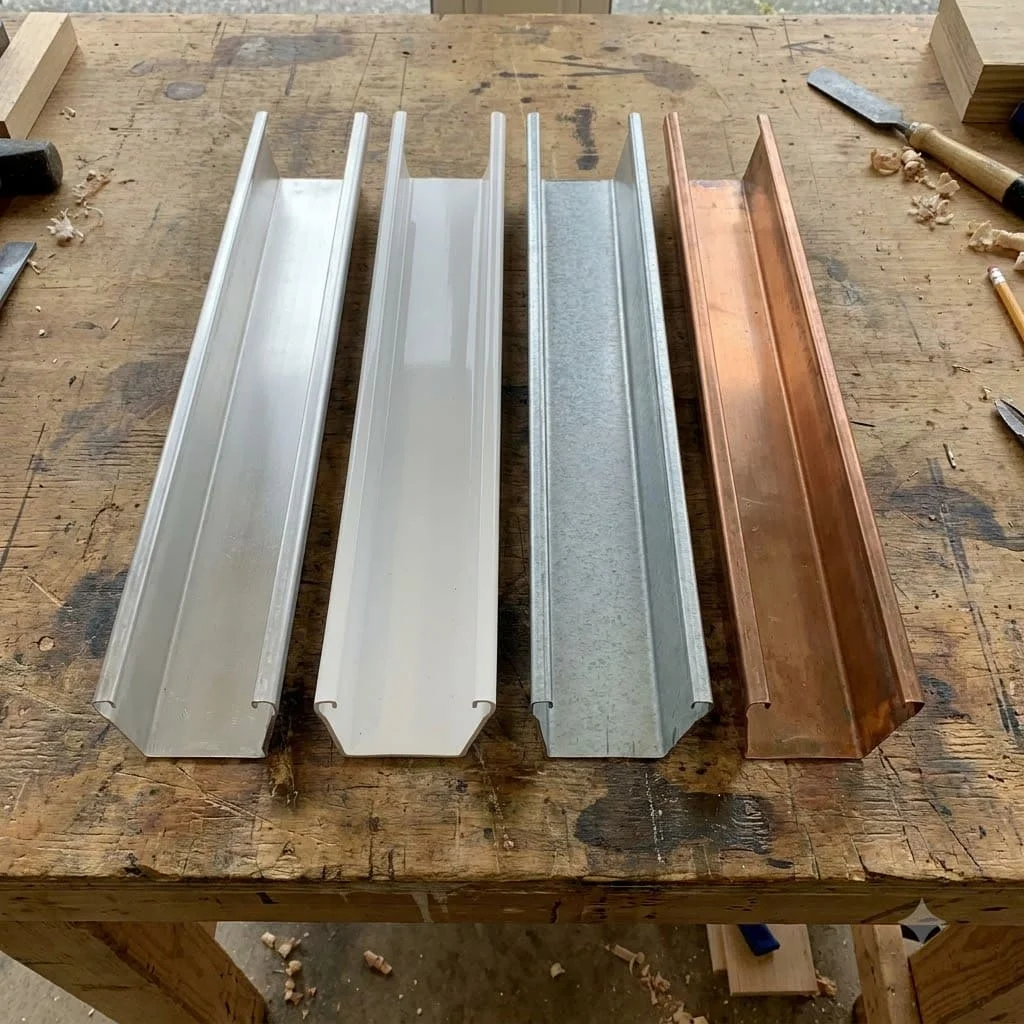
Offcut sections of aluminum, vinyl, galvanized steel and copper gutter laid side by side on a workbench
Free EstimatesAugusta & Richmond CountySeamless Gutter SpecialistsWritten PricingNo-Pressure Quotes

The Short Answer

For almost every home in Augusta and the CSRA, baked-finish aluminum is the right material. It does not rust in humidity, it holds colour under sustained UV, it can be roll-formed on site into continuous lengths, and at $8 to $14 per linear foot installed for 5-inch it is also the cheapest of the genuinely durable options.

That is an unusually easy recommendation, and it is worth saying plainly rather than manufacturing a debate. The interesting decisions on a Georgia roofline are not which metal — they are trough size, gauge, hanger spacing and profile.

The two exceptions are real, though. Copper belongs on a small number of Augusta houses for architectural reasons that have nothing to do with performance. And vinyl, which is the material most homeowners are actually weighing against aluminum, is the one genuinely poor fit for this climate.

What Georgia Actually Does to Gutters

Material advice only makes sense once you know what is attacking the material. Four things drive gutter wear in the CSRA, and one very well-known fifth thing does not.

  1. Sustained UV. Long, bright summers with high sun angles. This is what degrades polymers and chalks finishes, and it runs for months rather than weeks.
  2. Thermal cycling. A south or west-facing gutter gets genuinely hot on an August afternoon and cools sharply overnight. Every one of those cycles works the sealant at a joint and works any material with a high expansion coefficient.
  3. Year-round humidity. The variable that decides the steel question. Bare steel at a cut edge is exposed to moisture almost continuously here rather than seasonally.
  4. Continuous organic load. Loblolly pine sheds needles all year, with heavy drops in late spring and again in autumn. Wet pine straw is heavy, it interlocks into a mat, and it holds moisture against the trough permanently.

The fifth factor — the one that dominates most gutter material advice online — is freeze-thaw cycling and ice loading. Sustained ice damming is not a normal part of a CSRA winter. Hard freezes happen and are worth preparing for, but the repeated freeze-thaw that splits seams and tears gutters off fascia in the Midwest is not what ends a gutter here.

That single difference is why a national "best gutter material" article can be actively misleading in Georgia. It weights cold-weather brittleness and ice weight heavily, and it under-weights UV, humidity and a debris load that never stops.

The Four Materials Compared

Installed rates for the Augusta market, including hangers, miters and end caps. Downspouts run $8 to $14 per foot and are priced separately on every system.

Material Installed price Service life here Main weakness in Georgia
Aluminum, 5-inch seamless $8 – $14 per ft 20+ years Dents from ladders and limbs
Aluminum, 6-inch seamless $12 – $18 per ft 20+ years As above
Half-round aluminum $16 – $26 per ft 20+ years Less capacity per nominal inch
Galvanized steel $12 – $20 per ft 15 – 20 years Rust at every cut edge and fastener
Copper $30 – $50 per ft 50+ years Cost, and galvanic corrosion if mixed
Vinyl, sectional (materials) $4 – $8 per ft 7 – 12 years UV brittleness and heat sag

Read the service life column against the price column and aluminum's position becomes obvious. It costs roughly twice what vinyl materials cost and lasts roughly twice as long, before accounting for the fact that the vinyl figure does not include anyone hanging it.

Aluminum: The Default, and Why

Aluminum accounts for the overwhelming majority of residential gutter installed around Augusta. That is not inertia — four specific properties make it right for this climate.

It does not rust. Aluminum forms a self-limiting oxide layer rather than progressive corrosion, which is the property that matters most in year-round humidity. A cut end on aluminum is not a failure point the way a cut end on steel is.

It takes a baked finish that survives Georgia sun. Factory-applied enamel bonded to the coil is rated for decades of UV exposure, and it is the reason a twenty-year-old aluminum gutter can still be the right colour.

It can be formed on site. Aluminum coil is soft enough to roll-form through a machine into continuous lengths, which is what makes seamless gutter possible at all. Steel and copper can be formed too, but aluminum is the material the whole seamless supply chain is built around.

It is light. Lighter trough means less dead load on the hangers before any debris arrives, which matters on a roofline that carries wet pine straw for months at a stretch.

The trade-off is softness. Aluminum dents where steel would not — from a ladder leaned wrong, from a limb, from hail. That is the entire case against it, and it is usually a cosmetic complaint rather than a functional one.

Vinyl: The One to Avoid Here

Vinyl deserves a proper explanation rather than dismissal, because the case for it is genuinely attractive: $4 to $8 per foot in materials, no cutting tools beyond a hacksaw, sections that snap together, and no crew to schedule.

Two properties of PVC undo all of that in Georgia.

The first is UV degradation. PVC chalks, fades and embrittles under sustained ultraviolet exposure. In a northern climate that process takes long enough not to dominate the decision. Under Georgia summers it is the defining failure mode, and a brittle gutter cracks at the fastener holes rather than flexing.

The second is thermal expansion. PVC moves considerably more than aluminum for the same temperature change. On a hot afternoon a vinyl run visibly sags between hangers, and after enough cycles it stops fully recovering — which changes the pitch of the run and puts standing water in the trough.

Compounding both, vinyl is only sold sectional. Every ten feet there is a joint absorbing all of that movement, which is the failure sequence set out in the seamless versus sectional comparison.

Where vinyl is genuinely fine

A shed, a detached workshop, a chicken coop, a shaded north-facing outbuilding run. Anywhere the consequence of a sagging joint is a damp patch on the ground rather than a rotted fascia board, and where nobody is looking at it. The objection to vinyl is not that it is cheap — it is that on a house, the thing it fails into is expensive.

Galvanized Steel: Strong, But Rusting

Steel gutter is meaningfully stronger than aluminum. It resists denting from ladders and falling limbs, and it holds its shape under a heavy standing debris load. On paper, under pine, that sounds like exactly what the CSRA needs.

Humidity is the problem. Galvanizing is a zinc coating over steel, and it protects the faces of the sheet well. It does not protect what the fabricator exposes: every cut end, every miter, every screw penetration, every outlet punched for a downspout.

In a dry climate those exposed edges take a long time to matter. In the CSRA, with humidity year-round rather than seasonally, rust starts at the cut edges and works inward. It usually shows first as staining below a miter, then as pinholes at the seam.

Galvalume — an aluminum-zinc alloy coating — performs noticeably better than plain galvanized and is what to specify if steel is the choice. Even then, expect 15 to 20 years against 20-plus for aluminum, at a higher installed price of $12 to $20 per foot.

Steel earns its place in a narrow set of cases: under mature hardwoods that drop heavy limbs, on a commercial elevation taking constant ladder traffic, or where a structural spec calls for it. On an ordinary house it is paying more for strength you do not need and accepting a corrosion risk you did not have.

Copper: Architecture, Not Performance

Copper is the best-performing gutter material available. It will not rust, it does not need a finish, it is easily fifty years of service life, and it patinas from bright metal through brown to green rather than degrading.

None of that is why people buy it, and pretending otherwise leads to bad advice. At $30 to $50 per foot installed it is three to four times aluminum. On a 180-foot roofline that is a gap of roughly $4,000 to $7,000 — and the aluminum system was not going to fail during the period most owners hold a house.

Copper is an architectural decision. It is right on a period-correct restoration in Summerville, Olde Town or the Hill, and on the historic-district homes across the river in Aiken, where a bright white K-style profile looks wrong against the building and a design review may have opinions about it.

There is also a technical trap worth knowing before anyone quotes it: copper in contact with aluminum or galvanized steel sets up galvanic corrosion and destroys the less noble metal. Brackets, fasteners, straps and flashing all have to be copper or stainless. The full arithmetic, the patina timeline in Georgia humidity, and the houses where copper is pure expense are worked through in the copper gutters guide.

Gauge and Finish Matter More Than the Metal

Once aluminum is chosen — which it will be, on most houses — the decisions that actually change how the system performs are the ones buried in the specification rather than the material line.

Specification Ask for What the cheaper version costs you
Aluminum gauge 0.032 in 0.027 in dents easily and deforms between hangers
Finish Factory baked enamel Field paint chalks and peels under Georgia UV
Hanger type Hidden hangers, screwed Spikes and ferrules work loose and split fascia
Hanger spacing 24 in 36 in sags under wet pine straw by year four
Downspout size 3x4 under pine 2x3 clogs first and overflows at the corners

Every row in that table is invisible from the driveway once the ladders come down, and every one of them is a place a lower quote can find its saving legitimately. That is why they belong on the written quote by name rather than being assumed.

Hanger spacing deserves particular attention in the CSRA. Twenty-four inches versus thirty-six is a real cost difference to the installer, and under a climate that puts a standing mat of wet pine straw in the trough for months, it is the difference between a run that holds its line and one that develops a belly.

Choosing for Your Specific House

Four questions settle the material on nearly every Augusta roofline.

  • Is the house architecturally period, or is it a conventional build?
  • How long do you intend to own it?
  • What is above the roof — loblolly pine, mature hardwood, or open sky?
  • Does anything regularly hit the gutters — limbs, ladders, basketball?

A conventional build you plan to keep, under pine: 6-inch baked-finish aluminum at 0.032, hidden hangers at 24 inches, 3x4 downspouts. That specification covers a large share of houses in Richmond and Columbia County and is the right answer far more often than anything more exotic.

A period house in a historic district: half-round aluminum at $16 to $26 per foot gets most of the correct look, and copper if the building and the budget genuinely justify it. The profile question is covered in the half-round versus K-style guide.

Anything with heavy limb drop above it: this is the one case where steel is worth pricing, though heavier-gauge aluminum solves most of it for less money and without the corrosion trade.

A rental you are turning over, or a house you are selling within a year or two: aluminum still, but 5-inch rather than 6-inch, and put the saving into a proper clear-out instead. Material upgrades do not return at sale; a system that visibly works does.

Getting a Number for Your Own Roofline

Material is the easy half of this decision and it is where most of the online attention goes. The half that actually determines whether your gutters work is sizing, hanger spacing and downspout count — and those depend on your roof area, your pitch and what is growing above you.

Augusta Gutters Pros installs baked-finish seamless aluminum across Augusta, Richmond County and the wider CSRA, and quotes gauge, hanger spacing and downspout sizing by name so the quote can be compared against anyone else's. Call (706) 441-1723, or read how our estimates work first.

Next in this cluster: what size trough you need, which profile suits the house, and what the whole job costs. If you are outside Augusta, the service areas page lists every town covered, from Evans and Martinez across to North Augusta.

About the prices on this page

Every range here describes what gutter work generally sells for in the Augusta and CSRA market rather than a national average. They show what to expect, not a final offer — your exact price comes from measuring your roofline. The figures were last checked in September 2026; see our terms of service for the full disclaimer.

Straight answers

Frequently Asked Questions

What is the best gutter material for Georgia weather?

Baked-finish aluminum, for the large majority of Augusta homes. It does not rust in high humidity, it holds its colour under sustained Georgia UV, it can be formed on site into continuous lengths, and at $8 to $14 per linear foot installed for 5-inch it is the cheapest of the durable options.

Copper outlasts it and looks better on the right house, but at $30 to $50 per foot it is an architectural decision rather than a performance one. Steel is stronger but rusts at every cut edge in this humidity. Vinyl is the one material actively unsuited to the climate.

Are vinyl gutters a bad idea in Georgia?

On a house, generally yes. Vinyl is inexpensive — $4 to $8 per foot in materials — and it is genuinely easy to hang, which is why it dominates the big-box aisle.

The problem is that PVC has a high coefficient of thermal expansion and low UV tolerance. Under sustained Georgia sun it becomes brittle, chalks, and loses colour; in summer heat a run sags visibly between hangers and then does not fully recover. Every ten feet there is also a joint that has to absorb all of that movement.

Do galvanized steel gutters rust in Augusta humidity?

Eventually, and they start at the cut ends. Galvanizing protects the face of the sheet, but every cut, every screw penetration and every miter exposes bare steel, and the CSRA supplies humidity year-round.

Steel is worth considering where impact resistance genuinely matters — under limbs that drop, or where ladders are constantly leaned against the trough. Galvalume holds up better than plain galvanized. For most homes the strength is solving a problem they do not have.

How long do aluminum gutters last in Georgia?

Twenty years or more for the metal itself. The finish typically outlasts that — a baked-on enamel on aluminum holds colour for decades in Georgia sun, which is the main reason it is worth paying for over mill finish.

What actually ends an aluminum system is rarely the aluminum. It is sealant at joints, hangers pulling out of soft fascia, or damage from a limb. All three are repairable long before the trough itself is finished.

What gauge aluminum should gutters be?

Ask for 0.032 inch. Much of the market runs 0.027 inch, which is meaningfully thinner and is one of the quiet places a cheaper quote finds its saving.

The difference shows up as denting from ladders and falling limbs, and as deformation between hangers under a wet debris load. It is invisible on day one and obvious by year five, which is exactly why it is worth naming in the quote rather than assuming.

Does pine straw damage aluminum gutters?

It does not corrode aluminum, but it causes damage indirectly and it is the dominant maintenance factor in the CSRA. Loblolly pine sheds year-round rather than once in autumn, and wet pine straw is heavy.

A trough carrying a standing mat of it puts continuous load on the hangers and holds moisture against the back of the gutter and the fascia behind it. The material choice that matters under pine is less about the metal and more about trough size, hanger spacing, and whether guards make sense.

Is it worth paying extra for a baked-on finish?

Yes, and it is usually standard rather than an upgrade. A factory-applied baked enamel is bonded to the aluminum and is rated for decades of UV exposure.

Field-painted gutter is a different thing entirely. Paint applied over an existing finish chalks and peels in this climate, and it is worth establishing which you are being quoted — the word "painted" in a quote can mean either.

Talk Through the Material for Your House

Roof area, tree cover, architecture and how long you plan to stay all change the answer. We will walk it with you and put the recommendation in writing, with no obligation.

Call Us Now (706) 441-1723