
Types & materials · Augusta, GA

Copper Gutters: Are They Worth the Investment?

Copper is the best-performing gutter material available, and on most Augusta houses it is still the wrong purchase. Here is the arithmetic, the patina timeline, the mistake that ruins installs, and the short list of homes where it genuinely earns its price.

  • Copper: $30 – $50 per linear foot installed
  • Aluminum, 5-inch: $8 – $14 — three to four times less
  • Brown patina in 1 – 3 years; green in 15 – 30
  • Every fastener in contact must be copper or stainless
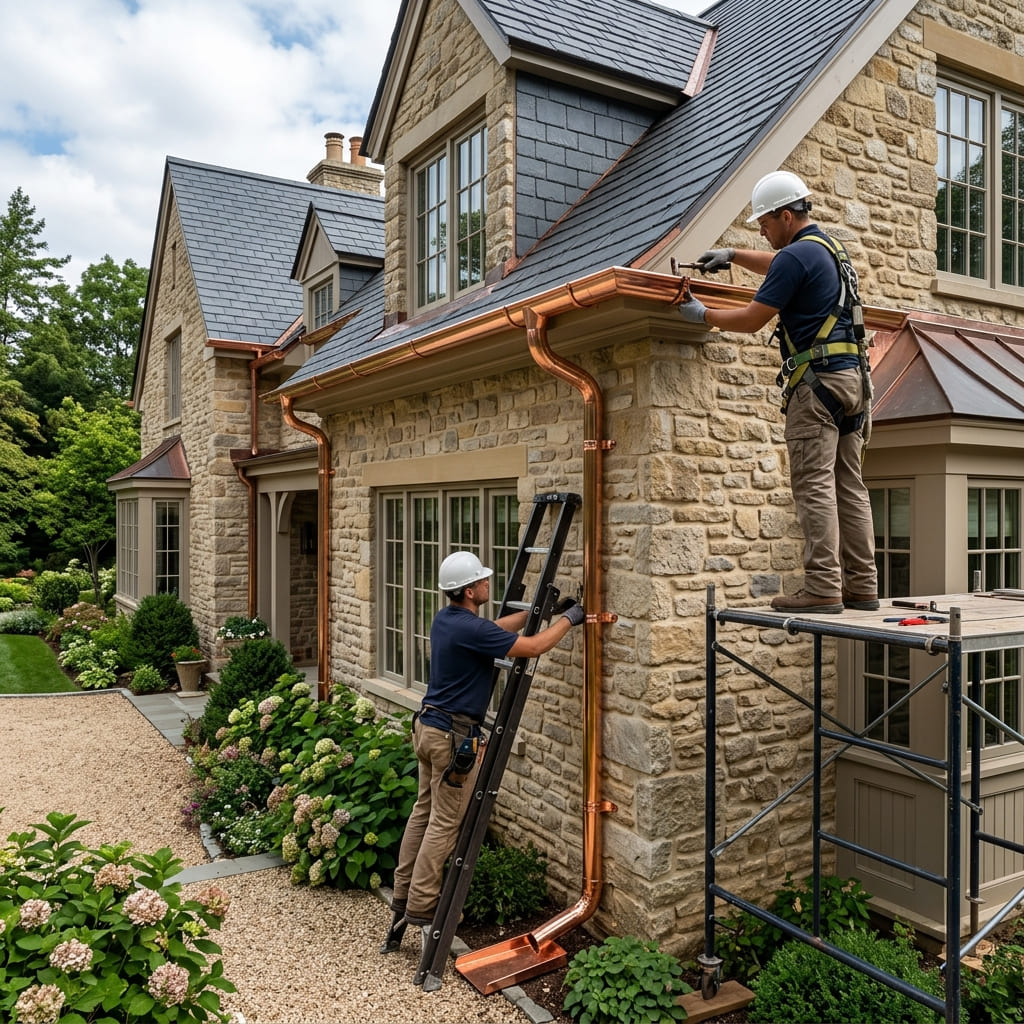
Copper gutter and round copper downspout installed along the eave of a stone home
Free EstimatesAugusta & Richmond CountySeamless Gutter SpecialistsWritten PricingNo-Pressure Quotes

The Short Answer

Copper costs $30 to $50 per linear foot installed in Augusta, three to four times aluminum, and on most houses it is an architectural purchase rather than a performance one.

That is not an argument against it. It is an argument for being clear about what you are buying, because the case usually made for copper — that it lasts fifty years — is true and mostly irrelevant to the decision.

A properly installed aluminum system lasts twenty years or more and is unlikely to fail while you own the house. Paying four times as much to avoid a replacement you probably would not have paid for is not a return; it is a preference. On the right building it is a preference well worth having.

Where copper genuinely belongs: period-correct restorations in Summerville, Olde Town and the Hill, and the historic-district homes across the river in Aiken, where a bright white K-style profile looks wrong against the building and a design review may take a view on it.

What Copper Actually Costs Here

Augusta-market rates, installed, including hangers, miters and end caps. Downspouts are priced separately on every system.

System Installed price Typical 180 ft roofline
5-inch seamless aluminum $8 – $14 per ft $1,440 – $2,520
6-inch seamless aluminum $12 – $18 per ft $2,160 – $3,240
Half-round aluminum $16 – $26 per ft $2,880 – $4,680
Copper $30 – $50 per ft $5,400 – $9,000

Three things explain the range within copper itself, and they are worth knowing because they make copper quotes harder to compare than aluminum ones.

The metal is a traded commodity. Copper moves on world markets in a way aluminum coil stock does not at this scale. A quote from six months ago is not a reliable guide to today.

The fabrication is more skilled. Copper is normally soldered at joints rather than sealed, and soldering a watertight miter on a ladder is a trade skill. It is slower work and it is priced accordingly.

Everything touching it has to change. Brackets, straps, screws, rivets, outlets and often flashing all move to copper, brass or stainless. That is not a rounding error on the materials bill.

Running the Arithmetic Honestly

Take the 180-foot roofline above. Copper at the midpoint of its range is around $7,200. Aluminum at the midpoint of 5-inch is around $1,980. The gap is roughly $5,200.

The usual argument is that copper lasts 50-plus years against 20-plus for aluminum, so you replace aluminum twice in the time copper serves once. Run that out and it looks like copper wins.

It does not, for three reasons.

  1. You almost certainly will not be there. The relevant horizon is how long you own the house, not how long the metal lasts. Over a ten or fifteen year hold, both systems simply work, and the only difference is the $5,200.
  2. Aluminum rarely fails as aluminum. What ends most aluminum systems is sealant at joints, hangers pulling out of soft fascia, or limb damage — all repairable, and all things that also affect copper installations.
  3. Copper does not return at sale as a line item. It contributes to how a period house presents, which is real but diffuse. No buyer pays a measurable premium for the gutters specifically.

So the honest framing is this. If the reason for copper is that you want the house to look right and you will enjoy looking at it, that is a good reason and the money is well spent. If the reason is that someone told you it pays for itself, the arithmetic does not support that on an Augusta house.

The comparison that actually matters

For most people weighing copper, the real alternative is not 5-inch K-style aluminum — it is half-round aluminum at $16 to $26 per foot. That is the profile copper is usually chosen for, and it closes most of the visual gap for roughly half the price. Compare copper against half-round aluminum rather than against the cheapest thing on the list, and the decision gets a lot clearer.

How Copper Weathers in Georgia

Patina is the reason people choose copper and the thing they most often misjudge, because the green in the photographs is decades away.

Stage Appearance Typical timeline in the CSRA
New Bright pink-orange metal Installation day
Dulling Loses shine, warm bronze Weeks to a few months
Brown Chocolate to near-black 1 – 3 years
Verdigris The familiar green 15 – 30 years, longer if sheltered

Georgia humidity moves the early stages along faster than a dry climate would. It does not meaningfully accelerate the green, which depends on sustained exposure rather than moisture alone.

Two practical points follow. The first is that weathering is uneven: south and west elevations darken visibly ahead of shaded north faces, so the house goes through a period of mismatched copper. It evens out, but it surprises people in year two.

The second is runoff staining. Water coming off new copper carries dissolved copper salts and will stain light masonry, painted brick, concrete and limestone below the discharge point. On a house with pale stonework it is worth planning the downspout discharge with that in mind.

Lacquered copper is sold as a way to hold the bright finish. It is worth avoiding on gutters — the lacquer degrades unevenly under Georgia UV and the result is a patchy finish that has to be stripped before the copper can weather normally.

The Galvanic Mistake

This is the single most common way a copper installation goes wrong, and it is worth understanding before anyone quotes the job.

When two dissimilar metals are in contact and moisture is present, an electrical cell forms and the less noble of the two corrodes rapidly. Copper is highly noble. Aluminum and zinc-coated steel are not.

In practice that means an aluminum bracket holding a copper gutter does not last. Neither does a galvanized screw through copper, a steel strap on a copper downspout, or aluminum flashing lapped under a copper trough.

The failure is not slow and it is not subtle. The aluminum component corrodes through while the copper beside it looks perfect.

It also works at a distance. Water running off a copper roof onto an aluminum gutter carries dissolved copper and attacks the aluminum below. The reverse pairing — copper gutter beneath an exposed galvanized metal roof — has the same problem, which is a live consideration in an area where metal roofs are common. That is the roofing angle covered on the Harlem page.

Ask this before work starts

"Are every bracket, screw, strap, rivet and flashing detail in contact with the copper also copper, brass or stainless?" Any installer who works in copper regularly answers that instantly. Hesitation is the answer to a different question.

The Houses Copper Belongs On

There is a real list, and it is shorter than the marketing suggests.

  • Period-correct restorations. A house being returned to its original specification, where half-round copper is what was there and what belongs there. Summerville, Olde Town and the Hill have genuine examples.
  • Historic-district homes under design review. Where a review body has a view on materials and profiles visible from the street, as in the Aiken historic overlay. Copper is rarely mandated, but it is never the thing that causes a problem.
  • Houses where the gutter is architecture. Exposed rafter tails, decorative brackets, a visible eave detail that a plain white K-style trough visually flattens.
  • Buildings with existing copper. A copper roof, copper flashing, or copper standing seam already present. At that point matching is both aesthetically right and galvanically necessary.
  • A forever house with the budget. If you are genuinely staying and the cost is not a stretch, the soldered joints and the absence of a finish to maintain are real, ongoing benefits.

The Houses It Does Not

Equally real, and more common. Copper is the wrong buy on:

  • Conventional builds. A 1990s or 2000s subdivision house in Evans or Grovetown. Copper on a vinyl-sided contemporary reads as expensive rather than as correct, and the money does better in 6-inch trough and proper drainage.
  • Houses you are selling within a few years. The spend does not come back at sale, and a buyer who does not want copper sees it as a maintenance unknown.
  • Rentals and turnover properties. Higher value on the wall, no aesthetic payoff to the owner, and a theft consideration during vacant periods.
  • Houses under heavy pine. Copper does not shed debris any better than aluminum. Spending four times as much on a trough that still needs the same clearing schedule puts the money in the wrong place — trough size and whether guards make sense matter far more here.
  • Anywhere the fascia is questionable. Copper on soft board is an expensive system hung on a failing one. The board comes first, always.

Getting the Look for Less

If the appeal of copper is the profile and the warmth rather than the metal itself, there are two honest options and one to be careful with.

Half-round aluminum, $16 to $26 per foot. The strongest alternative. It is the profile that reads as period-correct from the street, it can be finished in a warm tone, and it costs roughly half of copper. On most historic-district houses this is the recommendation.

Copper on one elevation only. Front elevation in copper, the rest in matched half-round aluminum. Galvanically this needs care where the two meet, but it is a legitimate way to put the money where it is seen.

Copper-finish aluminum — with a caveat. A baked finish imitating new copper does not patina. Real copper on the same street will be brown within three years while yours stays bright, so the imitation grows more obvious over time rather than less. It works better as a warm neutral than as a copper substitute.

The profile question — half-round against K-style, capacity against cleanability — is worked through fully in the half-round versus K-style guide.

What to Ask Before You Sign

  • Are the joints soldered or sealed?
  • Are all brackets, screws, straps and rivets copper, brass or stainless?
  • Is there aluminum or galvanized steel anywhere in contact with the copper?
  • What weight or gauge of copper is being used?
  • Where will runoff discharge, and what masonry sits below it?
  • Is the fascia sound enough to carry the system?
  • Is the price fixed, or subject to metal cost at the time of order?
  • What workmanship cover comes with the fitting, in writing?

The first question is the one that separates copper work from copper-coloured work. Sealed copper joints carry the same maintenance schedule as aluminum, which removes one of the main reasons to have bought copper in the first place.

Getting a Number for Your Own Roofline

Copper is one of the few gutter decisions where the right answer depends more on the building than on the roofline. Age, style, what the eave detail is doing, and whether there is existing copper on the house all matter more than footage.

Augusta Gutters Pros prices copper and half-round aluminum side by side across Augusta, Richmond County and the wider CSRA, and will say plainly when a house does not need copper — including when that means quoting the cheaper option. Call (706) 441-1723, or read how our estimates work first.

Related reading: the full materials comparison, the profile guide, and what a complete installation costs. Outside Augusta, the service areas page lists every town covered, including Aiken and North Augusta.

About the prices on this page

Every range here describes what gutter work generally sells for in the Augusta and CSRA market rather than a national average. They show what to expect, not a final offer — your exact price comes from measuring your roofline. The figures were last checked in September 2026; see our terms of service for the full disclaimer.

Straight answers

Frequently Asked Questions

How much do copper gutters cost in Augusta, GA?

Copper runs $30 to $50 per linear foot installed in the Augusta market, against $8 to $14 for 5-inch seamless aluminum. On a 180-foot roofline that is roughly $5,400 to $9,000, against $1,440 to $2,520 for aluminum.

The spread within that range is wide because copper is priced on a commodity metal that moves, and because the fabrication is more skilled. Two copper quotes months apart can differ legitimately in a way two aluminum quotes would not.

Are copper gutters worth the money?

As an architectural purchase on the right house, often yes. As a performance purchase on an ordinary house, almost never — and that is the honest framing.

Copper will outlast aluminum by decades. But an aluminum system installed properly will not fail during the period most owners hold a house, so you are paying three to four times the price to avoid a replacement you were unlikely to pay for anyway. What you are actually buying is how the building looks.

How long does it take copper to patina in Georgia?

Bright copper dulls within weeks and darkens to a chocolate brown over roughly one to three years in CSRA humidity. The green verdigris most people picture takes far longer — commonly fifteen to thirty years, and often longer on sheltered elevations.

It also arrives unevenly. South and west faces weather faster than shaded north elevations, so expect a period where the house has two different colours of copper on it. That is normal, and it evens out.

What is galvanic corrosion and why does it matter with copper gutters?

When copper touches aluminum or galvanized steel in the presence of moisture, an electrical cell forms and the less noble metal corrodes rapidly. Copper wins that exchange every time.

It means every bracket, screw, strap, rivet and flashing detail in contact with the gutter has to be copper, brass or stainless. It also means copper gutters under an exposed galvanized roof, or discharging onto an aluminum surface, will damage what they touch. This is the single most common way a copper installation goes wrong.

Is there a cheaper way to get the copper look?

Half-round aluminum at $16 to $26 per foot gets most of the correct profile for a period house at roughly half the price. It reads correctly from the street, which is where the architecture is judged from.

Copper-coloured aluminum exists too, but it is worth being clear-eyed about it: a baked finish imitating copper will not patina, so over a decade it drifts further from the real thing rather than closer. On a genuine restoration it usually looks wrong to anyone who knows what they are seeing.

Do copper gutters get stolen?

It is a real consideration on vacant or unoccupied properties, and scrap value moves with the copper market. On an occupied home in a normal street it is not a common problem.

Where it matters, the usual mitigations are concealed fixings, security fasteners on accessible downspout sections, and not leaving a property visibly empty for extended periods during a renovation.

Can copper gutters be repaired?

Yes, and well — copper is soldered rather than sealed, so a properly made joint is a permanent metal joint rather than a bead of sealant with a service life. That is a genuine advantage over every other material.

The constraint is finding someone who solders. It is a different skill from hanging aluminum, and it is worth asking directly whether joints will be soldered or sealed before work starts. Sealed copper is copper with an aluminum system’s maintenance schedule.

Weighing Copper Against Half-Round Aluminum?

On a period house the profile often matters more than the metal. We will price both against your actual roofline and tell you plainly which one the building needs — in writing, with no obligation.

Call Us Now (706) 441-1723