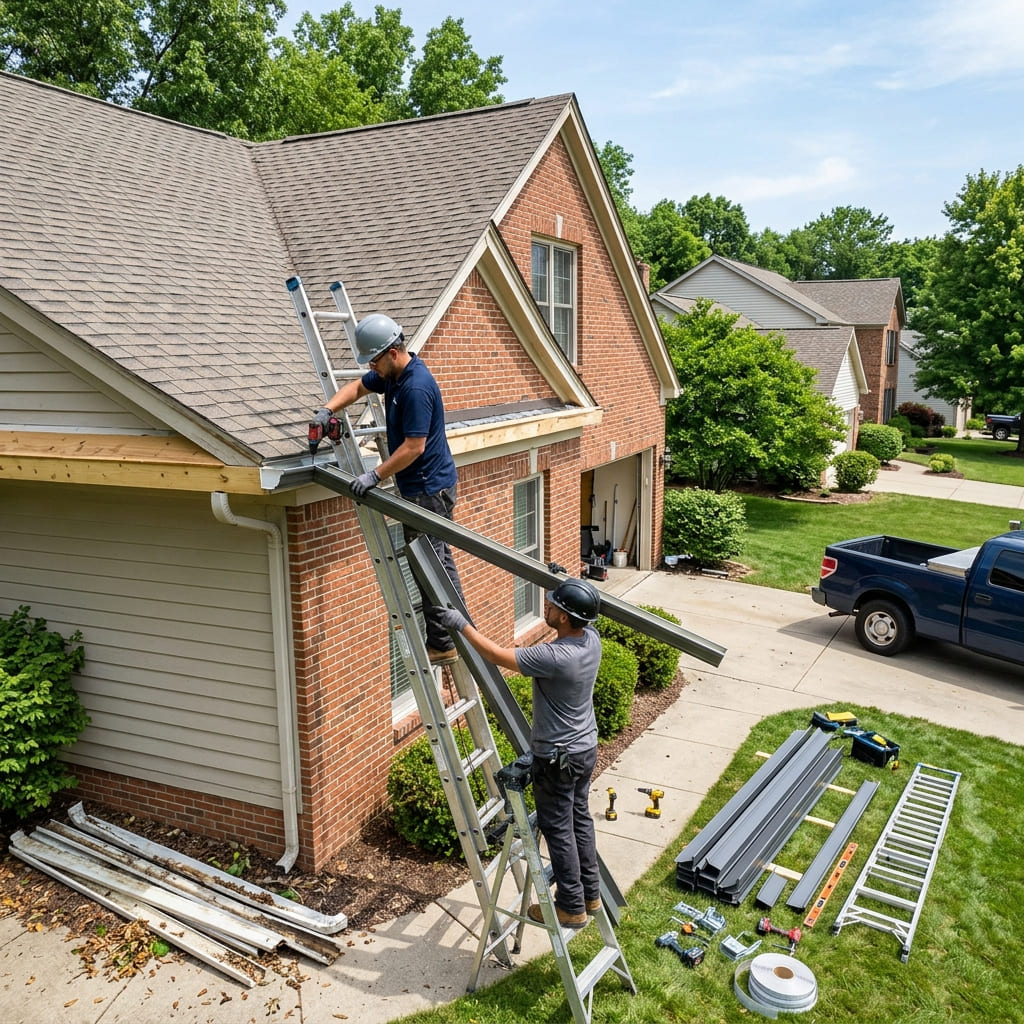
Full tear-out · fascia inspected

Complete Gutter Replacement for Augusta, GA Homes

When the aluminum is cracking, corroding, or failing faster than you can patch it, replacement stops being the expensive option. Old system out, fascia checked, new seamless run in — usually in a day.

  • Old system removed carefully, not ripped off
  • Fascia probed and reported before you commit
  • Sized for Augusta rainfall, not builder default
  • Old aluminum hauled off and recycled
Old damaged gutters being removed and replaced on an Augusta Georgia house
Free EstimatesAugusta & Richmond CountySeamless Gutter SpecialistsWritten PricingNo-Pressure Quotes

There is a point where fixing gutters stops making financial sense. Usually it arrives quietly: the third repair invoice in two years, or a run that leaks in a new spot every time the last one gets sealed. Gutter replacement in Augusta is worth doing properly once rather than chasing a failing system through another storm season.

The replacement is also the only time the fascia board behind the gutter is fully accessible. On a Georgia home that has had water backing up over the trough edge for years, what is behind the aluminum matters at least as much as the aluminum itself.

When Replacement Beats Another Repair

These are the conditions where we will tell you to replace rather than patch:

  • Cracking along the back edge. Aluminum that has been flexing at the hanger line for two decades develops hairline splits. Sealant does not hold on a moving crack.
  • Corrosion pinholes in multiple sections. One pinhole is a repair. A dozen means the coating has failed across the whole run.
  • Sectional gutters leaking at most joints. Resealing eight joints on a 60-foot elevation costs a meaningful fraction of replacing it with one seamless run that has none.
  • Chronic undersizing. If the trough overflows every hard rain while completely clear, no repair fixes it — the system is too small for the roof feeding it.
  • Widespread fascia damage. Once the board has to come off, the gutter comes off with it. Reinstalling old aluminum over new fascia is false economy.
  • Storm damage across several runs. After Helene, a lot of CSRA homes ended up with three or four patched lengths in mismatched profiles. Replacing the elevation costs less than it looks and ends the patchwork.

How a Replacement Day Runs

  1. Protect the ground. Beds, shrubs, and hardscape get covered before anything comes down. Old gutters shed twenty years of grit and needle sludge when they are moved.
  2. Section the old run out. Trough comes down in lengths, hangers and spikes are pulled individually, and the fascia is exposed rather than torn.
  3. Inspect and repair the board. Every foot of fascia is checked. Soft sections are cut out and replaced, and drip edge is corrected where it is missing or bent back.
  4. Roll the new trough. Continuous aluminum comes off the machine at the exact length of each elevation, so a 45-foot side gets one piece with no joints in it.
  5. Hang on hidden hangers and set pitch. Fasteners every 24 inches, or 18 inches under heavy pine, with about a quarter inch of fall per 10 feet toward each drop.
  6. Rework the downspouts. Replacement is the moment to move a badly placed drop or add one where a long run has been struggling. Extensions carry water clear of the foundation.
  7. Water test and clear the site. Every run is flooded with a hose while you watch, then the old aluminum is hauled off and the ground gets a magnet sweep.

Upgrades Worth Making While the Gutters Are Off

Replacement is the cheapest moment to fix everything the original installer got wrong, because the labour is already happening.

Move up to 6-inch trough. On steep roofs, long runs, or big roof planes draining to one corner, this is the single most valuable change. Six-inch holds around 40 percent more water, and paired with 3x4 downspouts it roughly doubles drainage capacity. In a market where two inches of rain can fall in an hour, that headroom is the difference between draining and overflowing.

Add or relocate downspouts. Builder-grade layouts frequently put one drop where a run needs two. Adding a drop is inexpensive during replacement and awkward afterward.

Fix the discharge. Augusta clay makes downspout termination genuinely important. Extensions, splash blocks, or buried drain lines that carry water 8 to 10 feet out will do more for a damp crawlspace than anything happening at roof level. This is the right time to sort downspouts and drainage properly.

Decide on leaf protection now. Guards fit best on new trough, and retrofitting later means a second trip and a second setup. If you are under loblollies, price gutter guards into the same job.

Replacement Costs in the Augusta Market

Scope Typical Augusta range
Single-story, 5-inch seamless, full replacement $1,600 – $2,900
Single-story, upgraded to 6-inch $2,300 – $3,800
Two-story, 5-inch seamless $2,800 – $4,800
Two-story, upgraded to 6-inch $3,600 – $6,200
Single elevation only $600 – $1,400
Fascia replacement, per linear foot $9 – $18

Tear-out and haul-away are included in our replacement pricing rather than added as a line item afterward. Fascia carpentry is always quoted separately so you can see the split clearly.

Why Augusta Systems Reach End of Life Early

A gutter here works harder than the same gutter in a drier climate. Roughly 45 inches of annual rain arrives in concentrated bursts, so the system is repeatedly loaded to capacity rather than trickling along. Pine straw adds constant standing weight through the fall and winter. And Georgia's humidity keeps fascia damp long enough that any water getting behind the trough has time to do damage.

Neighbourhood age matters too. A lot of the housing stock through Harrisburg, Turpin Hill, and the older parts of Sand Hills still carries original sectional gutter on spikes — a system that was never designed for a 40-year service life. Meanwhile the 1990s and 2000s builds out through National Hills and West Lake tend to have adequately hung aluminum that is simply undersized for the roof pitch above it.

Replacing Gutters Across Augusta and the CSRA

We replace gutter systems throughout Augusta and Richmond County, including Summerville, Olde Town, Forest Hills, National Hills, West Lake, Monte Sano, Harrisburg, Sand Hills, and Daniel Village — plus Evans, Martinez, Grovetown, Hephzibah, Harlem, Thomson, and Waynesboro, and across the river in North Augusta and Aiken.

Not sure yet whether you are replacing or repairing? That is exactly what the site visit is for. Book a free assessment and you will get both numbers, plus a straight recommendation on which one we would spend our own money on.

Straight answers

Frequently Asked Questions

How much does it cost to replace gutters on an Augusta home?

A complete tear-out and replacement in 5-inch seamless aluminum typically runs $1,600 to $2,900 on a single-story Augusta home, and $2,800 to $4,800 on a two-story with more corners and taller downspout runs.

Moving up to 6-inch trough adds roughly $3 to $5 per foot. Any fascia that has to be replaced is quoted separately so you can see exactly what is gutter work and what is carpentry.

How long do gutters last in Georgia?

Seamless aluminum installed on hidden hangers with correct pitch generally gives 20 to 25 years in the Augusta climate. Copper lasts far longer. Galvanized steel corrodes here and rarely makes it past 15 to 20.

Older sectional systems age much faster because every joint is a failure point. Plenty of the sectional gutters we replace in Richmond County are leaking noticeably by year 12.

Can you replace just one side of the house?

Yes, and it often makes sense. The north and west elevations of Augusta homes usually fail first because they stay damp longer and take the brunt of storm-driven rain.

The one caveat is appearance. If your existing color is discontinued, a new elevation may not match exactly. We will hold a sample against the old run and tell you honestly how visible the difference will be.

Do I need to replace the fascia at the same time?

Only where it has gone soft. Replacing the gutter is the one moment when the board behind it is exposed and accessible, so it is genuinely the cheapest time to deal with rot.

We probe the full length before quoting and mark any sections that need to come out. Hanging new aluminum on compromised fascia is how a 20-year system fails in five.

What is involved in tearing out the old gutters?

The old run comes down in sections rather than being pulled, which protects the fascia and drip edge underneath. Spikes and hangers come out, and the board is inspected as it is exposed.

Old aluminum gets hauled away for recycling rather than left in the yard. The beds and driveway should get a magnet sweep afterward too, because old spike systems shed nails you will otherwise find with a tire.

Will new gutters help with water in my crawlspace?

Frequently, yes — as long as the downspouts discharge far enough from the house. Augusta red clay sheds water rather than absorbing it, so a downspout emptying two feet from a foundation just sends that water sideways underneath.

A replacement is the right time to correct drop placement and add extensions or buried drain lines that carry runoff well clear of the footing.

Stop Paying to Patch a Failing System

A free on-site measure tells you what replacement actually costs — including an honest note on whether repair would still get you a few more years.

Call Us Now (706) 441-1723