Diagnosed at the cause · CSRA-wide

Trusted Gutter Repair in Augusta, GA

Sagging sections, split seams, pulled spikes, overflowing corners, and storm-torn runs — fixed at the cause instead of smeared with another bead of caulk.

  • Sagging, leaking, overflowing, and separated runs
  • Storm and fallen-limb damage documented for claims
  • Pitch corrected properly, not shimmed
  • Honest repair-versus-replace advice
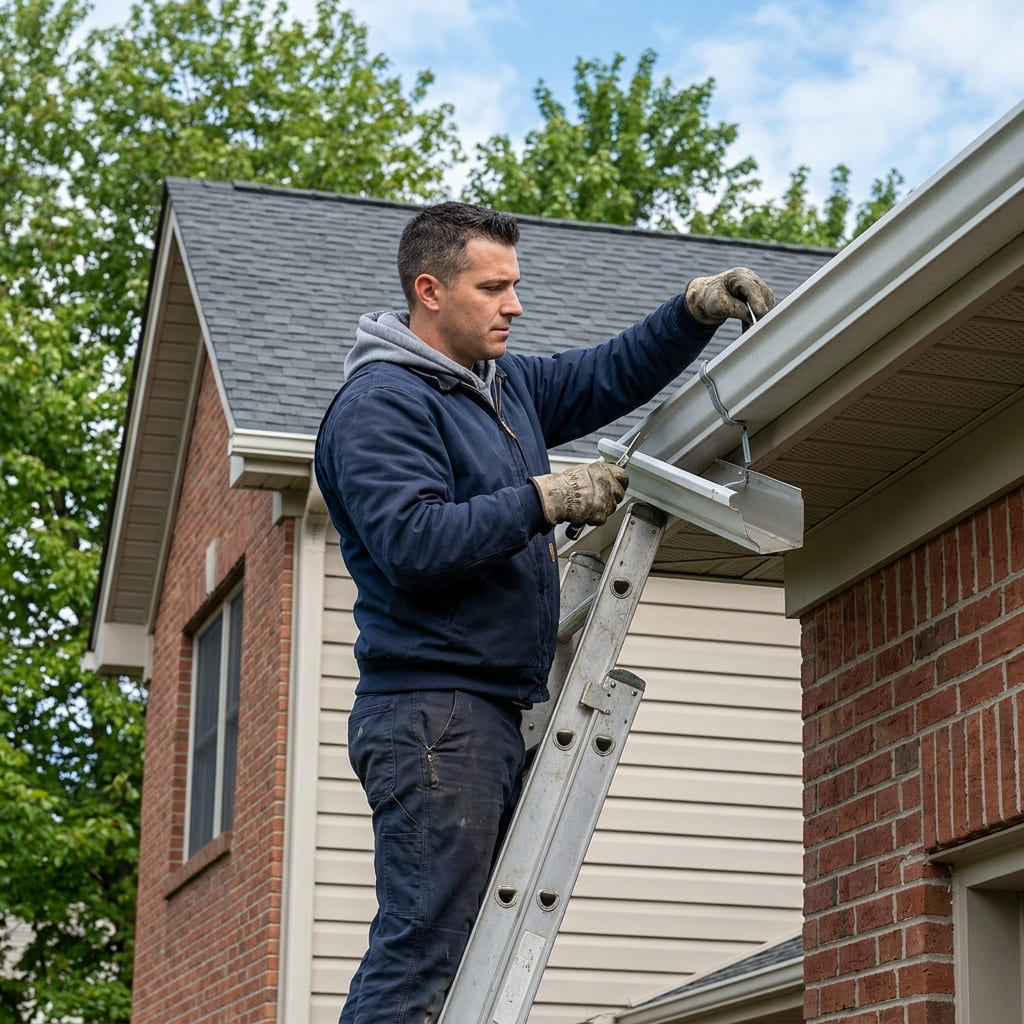
Technician repairing a sagging gutter section on a home in Augusta, Georgia
Free EstimatesAugusta & Richmond CountySeamless Gutter SpecialistsWritten PricingNo-Pressure Quotes

A gutter almost never fails all at once. It starts with one corner that overflows in a hard rain, a section that has dropped half an inch, or a drip that only shows up at the same miter every time. Left alone through a couple of Augusta summers, that small problem becomes soft fascia, stained siding, and a mulch bed that washes into the driveway every storm.

Good gutter repair means finding out why the run failed. A resealed seam on a gutter that is pitched backward will leak again by next spring. Most of the repair calls we take in Richmond County come down to four causes, and each one has a different fix.

What Actually Goes Wrong With Augusta Gutters

Sagging and pulling away from the house

Nearly always a fastener problem. Older Augusta homes were hung with spike-and-ferrule, and Georgia's humidity swings make fascia swell in July and shrink in January until the spikes back out. Once one lets go, the neighbouring ones carry extra weight and follow.

The correct repair is not driving the spike back in — that hole is already oversized. We rehang the run on hidden hangers with screws that bite into fresh wood, reset the pitch, and check the board behind it while the trough is down.

Leaking at corners and end caps

Miters and end caps are the only real joints in a seamless system, and they are where movement concentrates. Failure usually means the original bead was silicone rather than butyl gutter sealant, or the joint was never cleaned before sealing.

We strip the old sealant back to bare aluminum, clean it with solvent, and reseal with a butyl-based product that stays flexible through the temperature range Augusta actually sees.

Standing water and slow drainage

Water sitting in a trough after the rain stops means the pitch is wrong or a low spot has developed between hangers. Standing water adds serious weight, breeds mosquitoes through an Augusta summer, and accelerates corrosion at every seam it touches.

Overflowing during heavy rain

If the gutter is clear and still overflows, it is a capacity or velocity problem rather than a blockage. Steep roofs throw water outward hard enough to jump a narrow trough, and a single 2x3 downspout cannot clear what a large roof plane delivers in an Augusta thunderstorm. The fix is a larger outlet, an added drop, or moving up to 6-inch trough on that elevation.

How a Repair Visit Runs

  1. Walk the perimeter. We look at every run from the ground first — sag, pitch, staining on the fascia and siding, and where the ground has washed out below.
  2. Get on the ladder. The inside of the trough tells the real story: debris line, corrosion, sealant condition, hanger spacing, and whether water has been running behind the gutter rather than into it.
  3. Probe the fascia. Soft board behind a gutter changes the whole conversation, and finding it after the work starts is how surprise invoices happen.
  4. Quote in writing. You get the diagnosis, the fix, and the price before anything is touched — including an honest note if replacement is the smarter spend.
  5. Repair and water test. A hose goes down the repaired run so you can see it drain properly before we pack up.

Why Augusta Gutters Fail Faster Than Most

Three local conditions stack up against a gutter system here. Pine straw is the first. Loblolly needles do not wash through a downspout — they knit into a mat that holds standing water for weeks. That constant weight is what pulls hangers loose across whole neighbourhoods in Forest Hills and out toward Hephzibah where the tree cover is heaviest.

Heat cycling is the second. Aluminum expands measurably between a 98-degree August afternoon and a 28-degree January morning. Every one of those cycles works at sealant joints and fastener holes. Sectional gutters, with a joint every eight or ten feet, feel it most, which is why so many older Augusta homes leak at regular intervals along a run.

Storms are the third. Helene took gutters off houses across the CSRA in September 2024, and a lot of that work was rehung fast without anyone checking the fascia underneath. Those are the runs failing again now. If your gutters were repaired quickly after a storm, it is worth having the board behind them checked.

Repair or Replace? The Honest Test

What you are seeing Usual answer
One section sagging, rest of the run solid Repair — rehang on hidden hangers
Leaking at one or two corners Repair — strip and reseal with butyl
Water standing after rain stops Repair — reset pitch on that run
Overflow in every storm, gutter is clean Upsize trough or add a downspout drop
Cracks along the back edge, multiple sections Replace that elevation
Pinholes or corrosion in several places Replace — patches will chase each other
Third repair on the same run Replace — the money is better spent there

If your system falls in the bottom rows, replacing the run is usually the better value. We will tell you that on site rather than selling a repair we know will not hold.

Repair Pricing in the Augusta Market

Repairs are quoted per job, not per hour, so you know the total before we start. Typical Augusta-area figures:

  • Reseal a leaking miter or end cap: $150 – $250
  • Rehang and re-pitch a sagging section: $200 – $400
  • Replace pulled spikes with hidden hangers, per run: $180 – $350
  • Reattach or replace a downspout: $150 – $300
  • Replace a damaged length of trough: $250 – $600
  • Fascia board repair behind the gutter, per section: $200 – $500

Two-story access, steep pitch, and awkward roof geometry add to those figures. So does finding rot — which is exactly why we probe the board before quoting rather than after.

Fixing Gutters Across Augusta and the CSRA

We take repair calls throughout Augusta and Richmond County, including Summerville, Olde Town, National Hills, Forest Hills, Harrisburg, Monte Sano, Sand Hills, and Daniel Village. We also cover Evans, Martinez, and Grovetown, run south to Hephzibah, west to Harlem and Thomson, and across the river into North Augusta and Aiken.

Not sure whether what you are seeing needs a repair at all? Sometimes a thorough clear-out of the troughs and downspouts solves it. Tell us what is happening and we will point you to the cheaper answer if there is one — or book a free assessment if there is not.

Straight answers

Frequently Asked Questions

How much does gutter repair cost in Augusta?

Most single-issue repairs in the Augusta area run $150 to $400 — resealing leaking miters, rehanging a sagging section, replacing a pulled hanger, or reattaching a downspout.

Larger jobs like replacing a full run, correcting pitch across an entire elevation, or repairing rotted fascia behind the gutter typically land between $400 and $900. You get the number in writing before the work starts.

Is it worth repairing gutters or should I replace them?

Repair makes sense when the aluminum itself is sound and the problem is mounting, pitch, sealant, or a single damaged length. That describes most of the calls we take.

Replace when you see cracking along the back edge, corrosion pinholes across multiple sections, or when you have paid to fix the same run more than twice. At that point repairs stop being cheaper than replacement.

Why do my gutters overflow even though they are clean?

Three usual causes. The pitch is wrong, so water pools instead of running to the drop. The trough is undersized for the roof area feeding it — very common on steep two-story roofs in Evans and West Lake. Or the downspout is blocked below the visible opening.

A fourth possibility on older Augusta homes: missing drip edge letting water run behind the gutter entirely rather than into it.

Can you match my existing gutter color and profile?

In most cases yes. K-style 5-inch and 6-inch aluminum in standard baked-enamel colors is straightforward to match, and we roll new sections on site so the profile is identical.

Older half-round, copper, and galvanized steel systems are harder. We can usually source a match, but on discontinued colors the honest answer is sometimes that a full elevation should be redone so it looks uniform.

Do you repair storm and fallen-limb damage?

Yes, and it is a large share of our work in the CSRA. A limb that lands on a gutter usually does three things at once: crushes the trough, tears hangers out of the fascia, and dents the drip edge above it.

We straighten or replace the damaged length, repair the board behind it, and reset the pitch. Photographs of the damage before repair are provided if you are filing an insurance claim.

How quickly can someone come look at it?

It depends on the season and how urgent the problem is. If water is actively running into a crawlspace or against a foundation, say so when you get in touch — that is a different category of job to a run that has sagged for a year.

After a significant storm every gutter company in the CSRA books out fast. Calling early rather than waiting for the next rain makes a real difference to how long you wait.

Stop Patching the Same Gutter Every Season

We find why the run is failing — pitch, hangers, sizing, or the fascia behind it — and fix that, so the repair holds.

Call Us Now (706) 441-1723