Keg Creek · Pollards Corner · Clarks Hill Lake

Gutter Installation and Gutter Cleaning in Appling, GA

Gutter installation and gutter cleaning in Appling cover the rural north of Columbia County, from wooded acreage out to the lots running down toward Clarks Hill. The distinguishing feature here is fall. There is plenty of it, and a downspout that simply discharges downhill does not solve a drainage problem — it relocates it into the slope, where it becomes erosion.

  • Discharge energy broken at the outlet before it reaches the fall
  • Flow split and spread rather than concentrated down a grade
  • Walkout and daylight basement elevations treated as the priority side
  • Cleaning scheduled to what actually overhangs the roof
  • Regular north Columbia County route
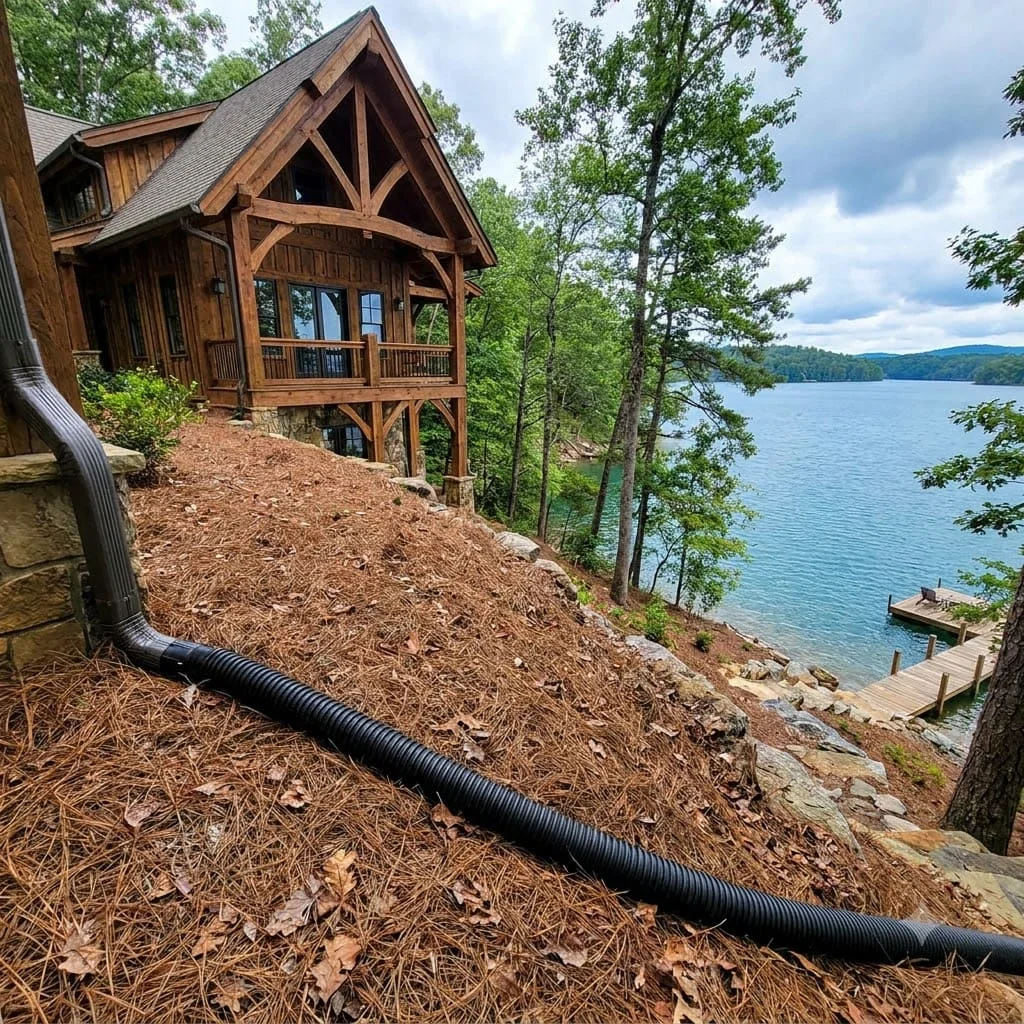
Downspout drain line running downhill from a lakeside home toward the water
Free EstimatesAugusta & Richmond CountySeamless Gutter SpecialistsWritten PricingNo-Pressure Quotes

Appling is the county seat and the rural half of Columbia County, which surprises people who only know Evans and Martinez. Lots are measured in acres rather than feet, tree cover is genuine rather than ornamental, and the ground runs down toward Clarks Hill Lake and the Savannah River with real gradient on it.

That gradient is the whole story. Everywhere else in the CSRA the drainage problem is getting water to move; in Appling the problem is that it moves too well. A downspout emptying onto a slope is not draining the property — it is aiming a stream at it. The difference between a discharge that disappears and one that carves a channel is entirely in how it was detailed.

Too Much Fall, Not Too Little

It is worth stating the contrast plainly, because most gutter advice is written for the opposite situation. On flat ground — the situation covered on the Waynesboro page — the hard part is finding anywhere downhill to send the water. In Appling downhill is everywhere, and that makes the discharge design a question of control rather than of destination.

The physics is simple enough. Water on a grade accelerates, and moving water carries soil in proportion to how fast it is going. A gentle spread across a lawn soaks in. The same volume concentrated into a stream on an eight percent slope picks up speed the whole way down and takes the topsoil with it.

The volumes make it worse than it sounds. A thousand square feet of roof sheds roughly 620 gallons in one inch of rain, and it all leaves through a handful of outlets. Point one of those at a slope and you have built a small seasonal creek that runs for twenty minutes several times a year, always in the same line.

How a Gully Starts, and Why It Never Stops

Erosion from a downspout follows a predictable sequence, and the reason it is worth catching early is that every stage makes the next one faster.

  • Bare patch. The stream kills the grass at the landing point. Nothing dramatic, and easy to blame on shade.
  • Rill. With the roots gone, the next storm cuts a shallow line down the fall line. Still fixable with a rake.
  • Channel. The rill concentrates the following storm more tightly than the open slope did, so it deepens itself. This is the point at which most people notice.
  • Head cut. The channel starts eating backwards uphill toward the house, because the drop at its top end is where the energy is greatest. On a lake lot the same process works the bank back from the water.

Moving the discharge further down the hill does not help — it simply starts the sequence lower. The energy has to come out of the water before it reaches ground that can be cut.

Detailing a Discharge That Works on a Slope

The goal is sheet flow, not stream flow

Water leaving as a wide, shallow spread across stable ground does no damage. Water leaving as a concentrated jet does damage in proportion to the fall below it. Every technique below is a different way of converting the second into the first.

  • Break the energy at the outlet. A riprap pad or rock apron at the discharge point absorbs the drop and spreads the flow before it reaches soil. This is the single most effective thing on a sloped lot and it is not expensive.
  • Split the flow. Two outlets each carrying half the volume are dramatically less erosive than one carrying all of it, because erosive power rises faster than volume does. Adding a downspout is often cheaper than any downstream remedy.
  • Run buried pipe to a chosen point. Where there is a flatter shelf or a stable vegetated area, a solid buried line to daylight there beats letting the water find its own route. Fall is never the constraint in Appling, so these lines drain properly.
  • Keep the outfall back from steep banks. Discharging near the top of a bank running down to the lake is the fastest way to lose the bank.

How those lines are built and what they cost per foot is covered on the downspout and drainage page.

Walkout Basements and the Uphill Side

Sloped lots produce walkout and daylight basements, and they are common through the lake communities here. That geometry means one elevation of the house is effectively underground while the opposite one is fully exposed.

The buried side is the one that matters, and it is the one people think about least because there is nothing to see. Ground on that elevation is already handling everything running downhill from above; adding a roof plane's worth of concentrated discharge is what pushes the foundation drainage past what it can take.

The standard to aim for on that side is discharge carried a genuine distance clear of the wall rather than simply directed away from it — which usually means a buried line, since a surface extension on the uphill elevation just gets buried by mulch and forgotten.

Trenching Near the Shoreline

One thing worth raising before any digging happens near water. Georgia maintains buffers along state waters, and the ground near a shoreline or a creek bank is both where a trench is least welcome and where disturbed soil most easily ends up in the lake.

For an ordinary residential downspout line well back from a bank this rarely becomes a question. Close to the water it can, and Columbia County is the place to confirm what applies to a particular parcel. Asking first costs a phone call; asking afterwards can cost considerably more.

Wooded Acreage and the Cleaning Calendar

Much of Appling sits under genuine mixed cover — loblolly pine alongside oak and sweetgum, particularly through the ground around Mistletoe and the lake. That combination produces both gutter problems simultaneously.

Pine straw is thin, stiff, and three to six inches long. It threads through screens, packs solid at an outlet, and does not wash through — a flow problem. Hardwood leaf is heavy once saturated, and a blocked trough across a long lake-facing roofline carries several hundred pounds — a weight problem. Getting both means three clearings a year on wooded acreage, and it means the fastenings have to be right.

It also makes Appling one of the better cases in the county for micro-mesh guards, with the usual precondition: the runs have to be sound first, because guards add weight and wind load. Anything still on spike-and-ferrule hangers wants rehanging on hidden hangers before guards go over it. Regular clearing is covered on the pine straw removal page.

What Gutter Work Costs in Appling

Augusta-market guidance rather than an offer. The per-foot rates match the rest of the CSRA. What moves an Appling total is total footage on larger houses and the erosion control that a sloped lot genuinely needs.

Work Typical Appling range
Seamless 5-inch aluminum, installed per foot $8 – $14
Seamless 6-inch oversized, installed per foot $12 – $20
Full replacement, typical 260 ft roofline $1,800 – $4,800
Riprap or rock apron at an outfall, each $150 – $400
Additional downspout to split flow, each $120 – $240
Buried discharge line to daylight, per foot $18 – $35
Porch, deck roof, or outbuilding guttering $350 – $900
Gutter cleaning, wooded acreage $200 – $375
Micro-mesh guards, installed per foot $15 – $25
Rehanging a run on hidden hangers $180 – $350

How We Handle Gutter Work in Appling

  • We plan where the water goes. On a sloped lake lot, what happens after the downspout is the whole job, so we map the discharge before we quote.
  • We protect the outlet. Where water leaves the pipe above a drop, we put in a rock apron or riprap pad so it doesn’t carve a gully.
  • We split big roof planes. Two outlets instead of one cuts the force of the water and adds capacity, often for very little extra.
  • We check the uphill side. On walkout basements, the uphill wall is where the expensive water problems start, so we look at it every time.
  • We keep discharge back from the bank. Near the lake or a creek, we set outlets well back from the edge.
  • Solid pipe, not corrugated. Smooth-wall pipe silts up far more slowly on long runs.
  • Hidden hangers every 24 inches. Mixed pine and hardwood debris is heavy, and spikes don’t hold up under it.
  • We clean up the nails. We run a magnet over the yard when old spike systems come down.

Gutter Services Available Across Appling

Augusta Gutters Pros treats Appling as part of the regular Columbia County route rather than an outlying run. Installation, full replacement, repair and rehanging, cleaning, guards, and drainage work are all available here, including on porches, deck roofs, and outbuildings.

South and east of here we cover Evans, Martinez, Grovetown, and Harlem across the rest of Columbia County, plus Augusta and Richmond County beyond them. The full list is on the service areas page, every job type is broken down on the gutter services hub, and sizing and pricing questions are answered in the gutter FAQ. Request a free estimate and we will walk the fall before quoting anything that touches the ground.

Where we work in Appling

Neighbourhoods and Roads We Cover

Augusta Gutters Pros covers Appling as part of the regular Columbia County route. These are the areas and roads we work most often — lake and river communities on the north side, wooded acreage through the middle of the county, and the working rural property along the roads running out from Pollards Corner.

  • Keg Creek
  • Winfield Hills
  • Bell Tower on the River
  • Yelton Farms
  • Pollards Corner
  • Mistletoe Road
  • Ray Owens Road
  • County Camp Road
  • Washington Road
  • Cobbham Road
  • Wildwood Park
  • Clarks Hill Lake
Straight answers

Frequently Asked Questions

Do you cover Appling, GA?

Yes. Appling is the Columbia County seat and covers the rural north of the county up to Clarks Hill Lake. It is on the regular route for Augusta Gutters Pros, including Keg Creek, Winfield Hills, Bell Tower on the River, Yelton Farms, and the properties out along Ray Owens Road, Mistletoe Road, Cobbham Road, and Washington Road.

Installation, repair, cleaning, guards, and drainage work are all available. Appling jobs tend to involve more drainage work than a suburban address, because the lots have real slope on them and the water has to be controlled rather than simply moved.

Why does my downspout carve a channel down the slope?

Because water accelerates on a grade, and a downspout delivers it as a concentrated stream rather than a spread. On a level lawn that stream soaks in. On a slope it picks up speed, and moving water carries soil.

Once a channel starts it deepens itself, because the channel concentrates the next storm even more tightly than the last one did. The fix is to break up the energy at the outlet and spread the flow before it reaches the fall, not to move the discharge point further down the hill.

Where should roof water discharge on a lake lot?

Onto stable, vegetated ground with the energy taken out of it, and well back from any steep bank. Discharging directly onto a slope running down to the water is what produces the gullies you see on older lake properties, and once the bank starts cutting back it is a landscaping problem rather than a gutter one.

The practical arrangement is usually a run to a point where the ground flattens, a rock apron or riprap pad to break the fall, and enough spread that the flow leaves as sheet rather than as a stream.

Do I need permission to trench a drain line near the lake or a creek?

It is worth asking before anyone digs. Georgia maintains buffers along state waters, and the ground near a shoreline or a creek bank is exactly where a trench is least welcome and most likely to move sediment into the water.

For a straightforward residential downspout line well away from a bank this rarely becomes an issue. Close to the water it can, and Columbia County is the place to confirm what applies to your parcel before the shovel goes in rather than after.

How often should gutters be cleaned on a wooded Appling lot?

Three times a year on genuinely wooded acreage, which describes much of the ground around Mistletoe and the lake. The mixed pine and hardwood cover here creates both problems at once — pine straw threads through and blocks flow, hardwood leaf adds weight when it saturates.

Properties on cleared or pasture ground are a different case and often manage on one autumn clearing. The variation across Appling is wide, so a schedule set by what is actually overhanging the roof beats a schedule set by the calendar.

Do walkout basements change how gutters should be arranged?

They change what matters most. A walkout or daylight basement means one side of the house is buried and the other is open, and the buried side is where roof water does damage that goes unnoticed for years.

The priority on that uphill elevation is getting discharge a genuine distance away rather than just off the wall — the ground there is already receiving whatever runs down the slope from above, and adding a roof plane to it is what overwhelms the foundation drainage.

Are gutter guards worth it out here?

On wooded acreage, yes, and Appling is one of the better cases for them in the county. At three clearings a year the arithmetic on micro-mesh works out within six to ten years, and the payback is quicker where access is awkward enough to make each visit a real job.

The condition is that the gutters have to be sound first. Guards add weight and wind load, so any run still hanging on spike-and-ferrule hangers wants rehanging on hidden hangers before anything goes over the top of it.

How much does gutter work cost in Appling, GA?

Seamless 5-inch aluminum runs $8 to $14 per linear foot installed and 6-inch oversized runs $12 to $20, the same rates as the rest of the CSRA. Lake and acreage houses often carry more roofline than a suburban address, so 220 to 320 feet is common and a full replacement lands between $1,800 and $4,800.

Drainage is the part that varies most. Buried lines run $18 to $35 per foot and riprap or rock aprons at the outfall $150 to $400 each, and on a sloped lot both are more likely to be needed than on flat ground.

Get a Free Gutter Estimate in Appling

We walk the fall before pricing any drainage, work out where discharge can leave as sheet rather than as a stream, and measure the full roofline including porches and outbuildings. Written pricing, no obligation.

Call Us Now (706) 441-1723