
Maintenance & problems · Augusta, GA

Signs Your Gutters Need to Be Replaced

Most gutter problems are repairs. A few mean the whole system is done. Here is how to tell the difference yourself, from the ground, before anyone quotes you.

  • One problem in one spot is usually a repair
  • The same problem along the whole run points to replacement
  • Seamless aluminum lasts 20 – 25 years in Augusta
  • Rotted fascia changes the math — check it first
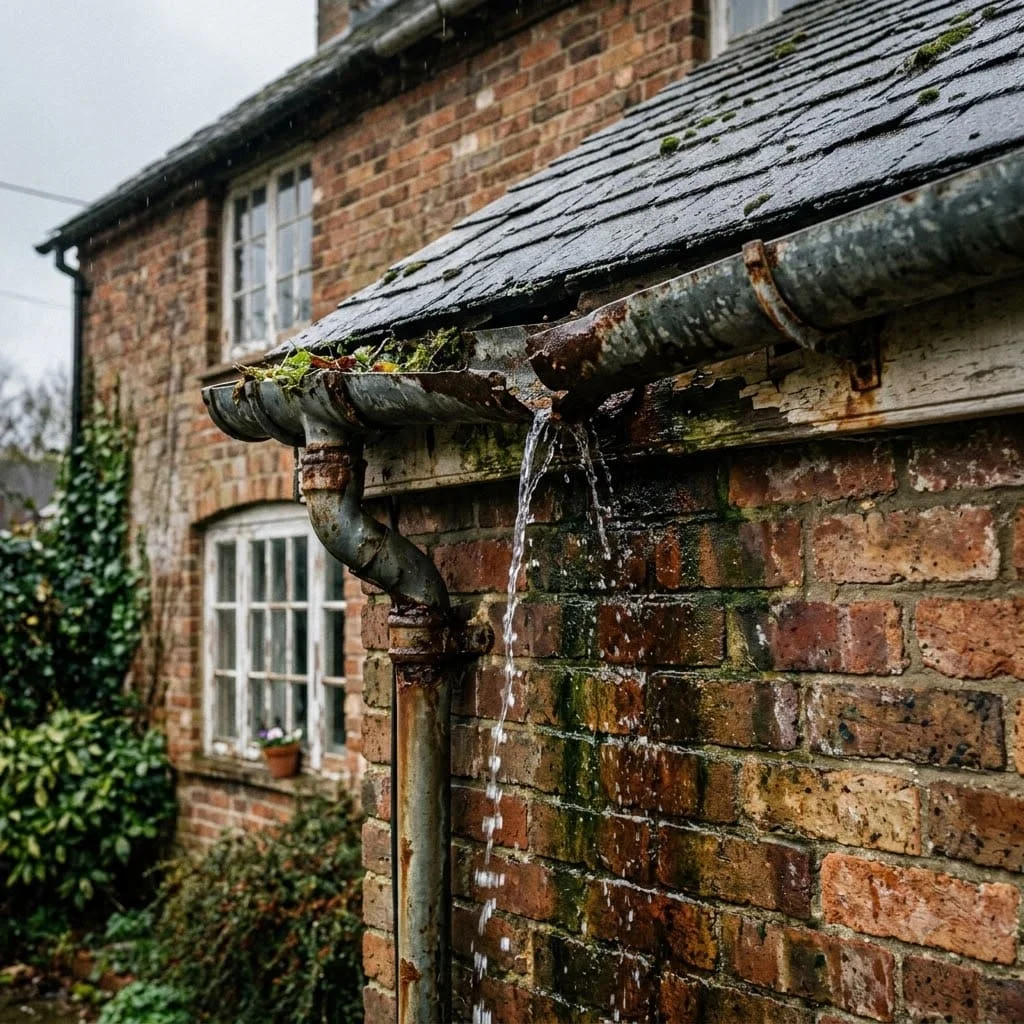
Old rusted metal gutter and downspout leaking water down a weathered brick wall below a moss-covered roof
Free EstimatesAugusta & Richmond CountySeamless Gutter SpecialistsWritten PricingNo-Pressure Quotes

The Short Answer

Your gutters need replacing when the same problem shows up along the whole system rather than in one spot. Leaks at most joints, rust or cracks in several lengths, sagging that comes back after rehanging, and rotted fascia along most of a side are the clearest signs.

One leaking corner is not one of them. Neither is one sagging section, or water spilling over during a storm. Those are usually repairs, and treating them as a reason for new gutters is how homeowners end up spending $2,000 on a $250 problem.

This guide walks through what to look for, which signs are misleading, and the rough arithmetic that decides it.

A Ten-Minute Walk-Around

You can learn most of what matters without a ladder. The best time to look is during or just after a steady rain, when leaks and overflow are actually happening.

  1. Stand back and sight along each run. A straight, even line is good. A dip in the middle, a wave, or a gap between the gutter and the house is not.
  2. Look at the joints and corners. Drips, rust-colored streaks, or white chalky trails under a seam mean the sealant has failed there.
  3. Check the fascia and soffit below the gutter. Peeling paint, dark stains, or wood that looks swollen means water is getting behind the gutter.
  4. Look at the ground. Trenches in the mulch, splashed-up mud on the siding, or spikes and nails lying in the beds all tell you something is failing above.
  5. Watch the downspouts in rain. Water should come out the bottom in a steady flow. A dry downspout during rain means the water is going somewhere it should not.
  6. Check the basement or crawlspace. New dampness on the wall below a corner of the roof often traces back to a gutter or downspout above it.

Make a note of where each problem is. The pattern — one spot or everywhere — is what decides repair or replacement.

Eight Signs It Is Time to Replace

1. Leaks at most of the joints

Sectional gutters come in 10- or 20-foot lengths joined with sealant. Sealant lasts years, not decades. When most of the joints on a run are dripping, resealing them one by one costs a large share of a new seamless run that has no joints at all. The seamless vs sectional guide explains why joint count is the whole argument.

2. Cracks or splits in the trough

Aluminum that has flexed at the hanger line for years develops hairline cracks, often along the back edge. Sealant does not hold on a crack that keeps moving. One crack can be patched. Cracks in several lengths mean the metal is worn out.

3. Rust or holes in steel gutters

Galvanized steel rusts from the inside, where wet debris sits. Orange streaks on the outside mean the coating is already gone underneath. Once you can push a screwdriver through a rust spot, the rest of the run is not far behind. Georgia humidity speeds this up.

4. Brittle, cracked, or warped vinyl

Vinyl gutters fade and turn brittle in Georgia sun. They crack when a ladder touches them and sag in summer heat. If vinyl has started to split, it is at the end of its life. Patching brittle plastic rarely lasts a season.

5. Sagging that returns after rehanging

One sagging section is usually loose fasteners. But if a run was rehung and it is dipping again, the problem is deeper — a bent trough, or wood behind it that can no longer hold a screw. The sagging gutters guide covers how to tell which.

6. Rotted fascia along most of a side

When the board behind the gutter is soft along most of an elevation, the gutter has to come off to replace the wood. At that point, putting old, worn gutters back up on new fascia rarely makes sense.

7. Overflow every hard rain, even when clean

If a freshly cleaned gutter still overflows in every thunderstorm, it is too small for the roof above it or it has too few downspouts. A repair cannot make a gutter bigger. On long runs, adding a downspout sometimes fixes it; if not, a larger system is the answer.

8. A patchwork of mismatched pieces

Hurricane Helene tore gutters off homes across the CSRA in September 2024, and a lot of them went back up in a hurry. Several patched lengths in different profiles or colors, extra sealant at every joint, and hangers that do not match are all signs of a system held together rather than working.

Signs That Look Bad but Are Fixable

These make gutters look like they are failing. On their own, none of them means you need new ones.

What you see Usual cause Usual fix
Water pouring over the front edge Clogged trough or downspout Cleaning, $150 – $400
One corner dripping Failed sealant at a miter Reseal, $150 – $250
One section sagging Spikes backed out of the wood Rehang and re-pitch, $200 – $400
Downspout hanging loose Broken straps or elbow Reattach or replace, $150 – $300
Standing water in one spot Pitch off in that section Re-pitch the section, $200 – $400
Black streaks on the outside of the gutter Dirt and mildew, sometimes called "tiger striping" Cleaning the outside; not a failure at all

Most of these are covered on our gutter repair page. If your list from the walk-around is one or two of these in separate places, a repair is the right call.

How Long Each Gutter Type Lasts Here

Age is a clue, not a verdict. But it helps to know roughly where your system is in its life.

Gutter type Typical life in the Augusta climate What usually ends it
Seamless aluminum 20 – 25 years Worn hangers, cracks at the back edge, fascia rot
Sectional aluminum Shorter — joints start leaking first Failed sealant at every seam
Galvanized steel 15 – 20 years Rust through the bottom of the trough
Vinyl 7 – 12 years Sun damage, brittleness, heat sag
Copper 50+ years Usually the fasteners or soldered joints, not the metal

A 25-year-old aluminum system with no leaks and a straight line does not need replacing. A 10-year-old vinyl system that is cracking does. The gutter materials guide covers what Georgia heat and humidity do to each metal in more detail.

Repair or Replace: The Arithmetic

Here is a simple way to decide. Add up the repairs the system needs now, then compare that number to replacing the same elevation.

Job Typical Augusta range
Single repair (reseal, rehang, reattach) $150 – $400
Larger repair (full run, pitch across an elevation, fascia) $400 – $900
Replace one elevation $600 – $1,400
Replace all gutters, single-story, 5-inch seamless $1,600 – $2,900
Replace all gutters, two-story, 5-inch seamless $2,800 – $4,800
Fascia replacement, per linear foot $9 – $18

A good rule: once the repairs add up to about a third of replacing that elevation, replace it. Below that, repair. Above it, you are spending real money on a system that will need more work soon.

A worked example. A 60-foot sectional run on the back of a ranch house has four leaking joints at $150 to $250 each and one sagging section at $200 to $400. That is $800 to $1,400 — about the same as replacing the whole elevation in seamless aluminum with no joints left to leak. Replacement wins.

Now take the same run with one leaking corner and nothing else. That is a $150 to $250 repair, and replacing it would be throwing away a system with years left in it.

Full pricing for a new system, including 6-inch upgrades and worked totals by house shape, is in the gutter installation cost guide.

Check the Wood Before Deciding

The fascia board behind the gutter is the part that most often turns a repair into a replacement, and it is the part you cannot see from the driveway.

If you can reach it safely from a ladder, press a screwdriver into the board just below the gutter at a few points along each side. Sound wood resists. Rotted wood gives, feels spongy, or crumbles.

Pay most attention below corners, below leaking joints, and anywhere the gutter has pulled away. Those are the spots where water has been getting in longest.

A few soft spots can be cut out and replaced during a repair. Soft wood along most of a side means the gutter comes off either way — and that is the cheapest moment to put up a new one. The Thomson page goes deeper on fascia as the real job behind many gutter calls.

Getting an Honest Assessment

Take your notes from the walk-around and look at the pattern. Problems in one or two spots point to repair. The same problems along whole runs, or rotted wood behind them, point to replacement.

Augusta Gutters Pros does both, which means we have no reason to push one over the other. We check the gutters, the hangers, and the fascia behind them, then give you a written price for the option that fits. Call (706) 441-1723 or see how our free estimates work. If replacement is the answer, our gutter replacement service explains the process from tear-out to cleanup.

About the prices on this page

Every range here describes what gutter work generally sells for in the Augusta and CSRA market rather than a national average. They show what to expect, not a final offer — your exact price comes from measuring your roofline. The figures were last checked in September 2026; see our terms of service for the full disclaimer.

Straight answers

Frequently Asked Questions

How do I know if my gutters need to be replaced or just repaired?

Count the problems and look at where they are. One leaking corner, one sagging section, or one bent length is a repair at $150 to $400.

Replacement makes sense when the problems are spread along the whole system: leaks at most joints, cracks or rust in several places, sagging that returns after rehanging, or rotted fascia along most of an elevation. A useful rule is that once repairs would cost about a third of a new elevation, replace it.

How long do gutters last in Georgia?

Seamless aluminum hung on hidden hangers typically gives 20 to 25 years in the Augusta climate. Galvanized steel rusts in this humidity and rarely passes 15 to 20. Vinyl turns brittle in Georgia sun and usually lasts 7 to 12. Copper lasts 50 years or more.

Age alone is not a reason to replace. A well-hung aluminum system that has been kept clear can outlast those figures.

Is water behind my gutters a sign they need replacing?

Not by itself. Water running behind a gutter is usually caused by a clog, a missing or short drip edge, or a gutter hung too low on the fascia. All of those are fixable without new gutters.

It becomes a replacement question when that water has already rotted the fascia along most of the run, because the gutter has to come off to replace the board anyway.

What does it cost to replace gutters in Augusta?

Replacing the gutters on a single-story Augusta home in 5-inch seamless aluminum typically runs $1,600 to $2,900. A two-story home runs $2,800 to $4,800. A single elevation runs $600 to $1,400.

Rotted fascia is priced separately at $9 to $18 per linear foot, so it is worth knowing its condition before comparing prices.

Can I replace gutters on just one side of the house?

Yes. The north and west sides of a house often fail first because they stay damp longer and take more wind-driven rain. Replacing one elevation at $600 to $1,400 is common.

The trade-off is appearance. If the existing color has faded or been discontinued, the new run may not match exactly.

Do sagging gutters mean I need new ones?

Usually not. Most sagging comes from spike fasteners backing out of the wood or hangers spaced too far apart. Rehanging on hidden hangers fixes it for $200 to $400 a section.

Sagging points to replacement only when the trough itself is bent or kinked, or when the fascia behind it is too rotted to hold new hangers along most of the run.

Find Out If Your Gutters Can Be Saved

We’ll check the gutters, the hangers, and the wood behind them, then tell you plainly whether it’s a repair or a replacement — with a written price for either one.

Call Us Now (706) 441-1723