Greenpoint · Appling-Harlem Road · Sawdust Road

Gutter Installation and Gutter Repair in Harlem, GA

Gutter installation and gutter repair in Harlem run into something the rest of Columbia County mostly does not: metal roofs. Houses, shops, and barns across the west end of the county are covered in standing seam and exposed-fastener panel, and water leaves that surface far faster than it leaves asphalt shingle — which changes where the gutter has to sit and how hard it has to be held on.

  • Gutter positioned to the roof slope line so fast metal runoff lands in the trough
  • Hanger spacing tightened where the roof covering or tree load calls for it
  • Trough and downspout sized for peak flow, not just annual rainfall
  • Barns, shops, and detached garages priced alongside the house
  • Regular Columbia County route
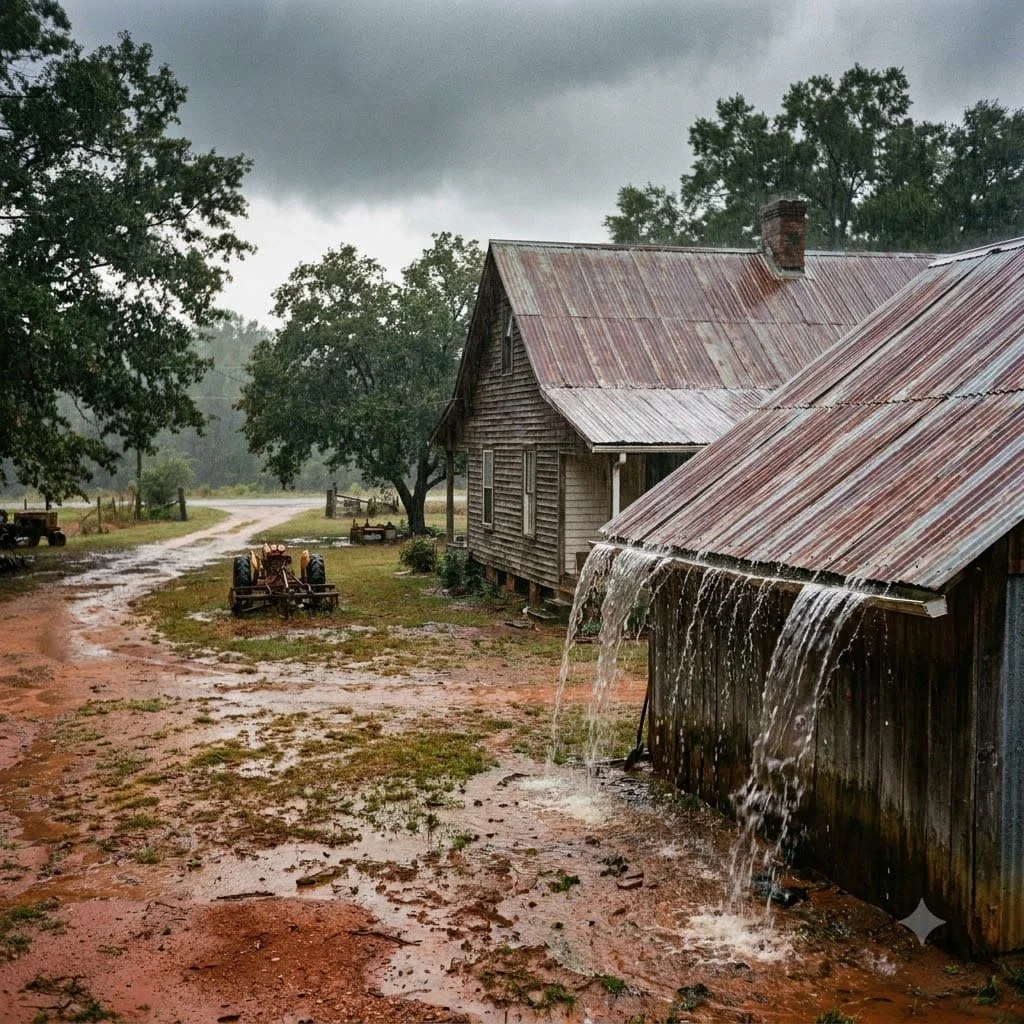
Rainwater sheeting off a metal roof and overshooting the gutter beneath it
Free EstimatesAugusta & Richmond CountySeamless Gutter SpecialistsWritten PricingNo-Pressure Quotes

Harlem is the west end of Columbia County, and it is two different housing markets sharing one ZIP code. The older streets around the town centre are 1940s to 1970s ranches and bungalows under mature oaks. Out past them, Greenpoint and Cornerstone Creek are pushing new construction west from Grovetown. Between and around both sit working properties with shops, barns, and equipment sheds.

What ties them together is the roof covering. Metal roofing is far more common here than it is in Evans or Martinez — and a metal roof changes the gutter specification in ways that almost never make it onto a quote. That is where this page starts, because it is the single most common reason a Harlem gutter underperforms.

Why Metal Roofs Overshoot Their Gutters

Asphalt shingle is a rough, granular surface. It slows water down, holds some of it briefly in the texture, and releases the rest over the edge at a fairly modest speed. Metal panel does none of that. It is smooth, and on a steep plane water arrives at the eave moving fast.

The consequence is that a gutter hung correctly for shingle can be entirely wrong for metal. The stream leaves the panel on a flatter trajectory than the roof slope, clears the front lip of the trough, and lands on the ground — while the gutter itself stays bone dry in the middle of a downpour. Homeowners reasonably conclude the gutter is too small. Usually it is in the wrong place.

The straightedge check anyone can do

Hold a straightedge against the roof surface and extend the line of the slope out past the eave. That projected line should pass into the gutter trough — not over the front of it, and not behind the back. If it clears the front lip entirely, the run is hung too low or set too far back, and no amount of extra capacity will fix it.

Correcting it means rehanging the run, sometimes with a different fascia bracket or a slightly forward-set position, and occasionally with a wider trough so there is more target to aim at. None of that is expensive compared with a replacement, which is why we check for it before we quote new gutters. The gutter repair page covers what rehanging a run actually involves.

Peak Flow, Not Annual Rainfall

The second metal-roof consequence is capacity, and it gets misunderstood in the same way. Over a full year, a metal roof and a shingle roof of the same size shed exactly the same volume of water. Nothing about the covering changes how much rain falls.

What changes is how fast it arrives. A thousand square feet of roof sheds roughly 620 gallons in one inch of rain, and an Augusta-area summer storm can drop two inches in an hour. Off shingle, that arrives spread out. Off metal, a much larger share of it hits the trough in the first few minutes, and peak flow is what a gutter either handles or does not.

On long or steep metal planes, that pushes the honest specification up a size — a 6-inch trough with 3x4 downspouts where 5-inch with 2x3 would have been fine under shingle. A 3x4 downspout carries substantially more than a 2x3 for a modest price difference, and on a metal roof it is usually the better value of the two upgrades. The seamless gutter page covers trough profiles and how the runs are formed on site.

Hangers, Spacing, and Metals That Should Not Touch

A metal roof loads a gutter harder in the moment, and it also sheds debris differently. Pine straw and leaves do not sit on metal the way they sit on shingle — they slide, then arrive in the trough all at once as a mat rather than accumulating gradually. Both facts point the same direction on fastenings.

  • Hidden hangers, not spikes. Spike-and-ferrule works by friction in a fascia board that is expanding and contracting all year. Under a surge load it pulls. A hidden hanger screwed into the fascia does not.
  • 24-inch centres as the baseline, tighter where warranted. Closer spacing is the sensible call under a metal roof, under the mature oaks in the older part of Harlem, or anywhere guards are going to be added later.
  • Keep aluminum away from copper. Aluminum in direct contact with copper, or sitting downstream of copper flashing, corrodes galvanically. If there is copper anywhere on the roof, it needs isolating from an aluminum trough.
  • Fixings matter as much as the metal. Stainless or aluminum fasteners, or an isolating washer, are what stop a run failing at the screw holes long before the aluminum itself is worn out.

The Older Streets: Oaks, Fascia, and Original Systems

Around the town centre, Harlem looks nothing like the new subdivisions. Large lots, mature oaks overhanging the roofline, and houses old enough that the gutters may well be original or close to it.

Oak leaf fall is a weight problem rather than a flow problem — a saturated blocked trough across a long run carries several hundred pounds, and that is what finally pulls an old spike system off a fascia board. Two to three clearings a year is realistic under genuine oak cover, and the pine straw removal page covers what that involves.

The other thing worth checking on a house of that age is the wood itself. Where a gutter has been overflowing behind the trough for years, the fascia underneath is often soft, and nothing can be hung securely on soft wood. That problem is common enough further west that it gets its own section on the Thomson page.

Greenpoint, Cornerstone Creek, and the New Builds

The newer end of Harlem has the opposite problem. Nothing is worn out — it was simply specified down. Production builders across Columbia County fit a 5-inch trough, 2x3 downspouts, and the minimum number of outlets, because gutters are one of the last line items on a build and one of the easiest to trim.

That specification handles ordinary rain and gives up in a summer storm. On a new house the fix is rarely replacement — it is usually adding outlets. Going from three downspouts to five on a typical two-storey costs a fraction of a new system and addresses the actual constraint, which is how far water has to travel inside the trough before it can leave. The same pattern is covered in more detail on the Grovetown page, since the housing stock is effectively continuous between the two.

Barns, Shops, and Detached Garages

Rural and semi-rural Harlem property comes with structures that rarely get gutters and usually should. A metal-roofed shop sheds water more efficiently than the house does, and because nobody is standing inside it during a storm, the damage goes unnoticed for years.

The failure runs the same way every time. Water sheets off an unguttered edge in a concentrated line, cuts a trench along the drip edge, and then works sideways under the slab edge or against the bottom plate of a timber wall. By the time it is obvious from outside, the repair is structural.

Guttering an outbuilding is usually a single run and one or two downspouts. It is worth pricing at the same time as the house rather than as a separate trip later.

What Gutter Work Costs in Harlem

Augusta-market guidance rather than an offer. The per-foot rates are the same across the CSRA; what shifts the total in Harlem is how often a metal roof justifies the 6-inch trough and how much repositioning a run needs rather than straight replacement.

Work Typical Harlem range
Seamless 5-inch aluminum, installed per foot $8 – $14
Seamless 6-inch oversized, installed per foot $12 – $20
Full replacement, typical 200 ft roofline $1,600 – $4,000
Repositioning an existing run to the roof slope line $8 – $14 per foot
Upgrade from 2x3 to 3x4 downspout, each $90 – $190
Additional downspout on a long run, each $120 – $240
Barn, shop, or detached garage guttering $350 – $900
Gutter cleaning under mature oak cover $175 – $325
Micro-mesh guards, installed per foot $15 – $25
Rehanging a run on hidden hangers $180 – $350

How We Handle Gutter Work in Harlem

  • We account for the metal roof. Metal sheds water faster and farther than shingles, so it changes both where the gutter sits and how big it needs to be.
  • We set the gutter to catch the water. On a metal roof, the gutter’s position against the roof slope decides whether the water lands in it at all.
  • We size to your roof. Long or steep metal roof planes often need 6-inch gutters, and we’ll show you why.
  • We calculate the downspouts. Number and size come from the roof planes, not from what’s already there.
  • Hidden hangers every 24 inches. Enough to handle metal-roof runoff and wet oak leaves.
  • We keep copper away from aluminum. If there’s copper on the roof, we isolate it so the two metals don’t corrode each other.
  • Outbuildings spelled out in the quote. Shops and barns are listed as included or not, in writing, so there are no surprises.
  • We clean up the nails. We run a magnet over the yard when old spike systems come down.

Gutter Services Available Across Harlem

Augusta Gutters Pros treats Harlem as part of the regular Columbia County route rather than an outlying trip. Installation, full replacement, repair and rehanging, cleaning, guards, and downspout and drainage work are all available here, including on barns, shops, and detached garages.

We also cover Grovetown and Evans to the east, Appling to the north, and Thomson further west along I-20 — the full list is on the service areas page, and every job type is broken down on the gutter services hub. Sizing and timing questions are answered plainly in the gutter FAQ. Request a free estimate and we will check the gutter position against the roof slope before anything else gets priced.

Where we work in Harlem

Neighbourhoods and Roads We Cover

Augusta Gutters Pros covers Harlem as part of the regular Columbia County route. These are the areas and roads we work most often — a genuine split between the older streets around the town centre and the newer subdivisions spreading west from Grovetown, with rural acreage and outbuildings either side of both.

  • Greenpoint
  • Cornerstone Creek
  • Philips Crossing
  • Oakbrook
  • West Forrest
  • Tudor Branch
  • Appling-Harlem Road
  • Louisville Road
  • Sawdust Road
  • County Line Road
Straight answers

Frequently Asked Questions

Do you cover Harlem, GA?

Yes. Harlem sits at the west end of Columbia County and is on the regular route for Augusta Gutters Pros, including Greenpoint, Cornerstone Creek, Philips Crossing, Oakbrook, West Forrest, and the properties out along Appling-Harlem Road, Louisville Road, and Sawdust Road.

Gutter installation, repair, cleaning, guards, and drainage work are all available here. Because a large share of Harlem roofs are metal rather than asphalt shingle, jobs in this area more often involve repositioning or resizing the gutter rather than simply replacing what is there.

Why does water shoot straight over my gutters when it rains hard?

On a metal roof this is almost always a positioning problem rather than a capacity problem. Water leaves a metal panel far faster than it leaves asphalt shingle, and if the gutter is hung too low or too far back, the stream simply arcs past the front lip and lands in the flower bed.

The check is straightforward. Extend the line of the roof slope past the eave with a straightedge. That line should pass into the trough, not over the front of it. If the water is clearing the gutter entirely, the fix is repositioning the run, not buying a wider one.

Do metal roofs need bigger gutters than shingle roofs?

Frequently, yes — but the reason is peak flow rather than total volume. The same square footage of roof sheds the same number of gallons across a storm, but a metal roof delivers a much larger share of it in the first few minutes because nothing slows the water down.

On long or steep metal roof planes in Harlem, a 6-inch trough with 3x4 downspouts is often the honest specification where a 5-inch with 2x3 downspouts would be adequate under shingle. Any quote that does not mention the roof covering has not accounted for it.

How much does gutter work cost in Harlem, GA?

Seamless 5-inch aluminum runs $8 to $14 per linear foot installed across the CSRA, and 6-inch oversized runs $12 to $20. Harlem sits toward the middle of those ranges, with metal-roof properties more often landing in the 6-inch band.

A typical Harlem house at 180 to 220 feet of roofline therefore falls somewhere between $1,600 and $4,000 depending on trough size and how much of the run needs repositioning rather than straight replacement. These are Augusta-market figures for planning, not a quoted price.

Should the barn, shop, or detached garage get gutters too?

On anything with a slab or a timber bottom plate you care about, it is worth pricing. Metal-roofed outbuildings are the worst offenders in west Columbia County precisely because they shed water so efficiently — the runoff arrives concentrated, fast, and always in the same line.

What it does over a few seasons is cut a trench along the drip edge, then work sideways under the slab edge. Guttering an outbuilding is usually one run and one or two downspouts, and it is far cheaper priced alongside the house than as a separate trip later.

How close together should gutter hangers be in Harlem?

Hidden hangers at 24-inch centres is the general standard, and it is what we would treat as the baseline on a shingle roof here. On a metal roof, or under the mature oaks in the older part of town, closer spacing is the sensible call.

The reason is that both conditions load the run harder than average — a metal roof delivers a heavier momentary surge, and oak leaf fall adds real weight when saturated. Spike-and-ferrule hangers should not be reinstalled on either.

Can aluminum gutters be fitted to a metal roof safely?

Yes, and it is the normal pairing. What matters is what the aluminum is allowed to touch. Aluminum in direct contact with copper, or downstream of copper flashing, corrodes — that combination should be isolated or avoided outright.

Steel fasteners driven straight into aluminum are the other thing to watch. Stainless or aluminum fixings, or an isolating washer, are what keep a run from failing at the fastener holes years before the metal itself gives out.

Do new-build homes in Harlem need gutter work already?

Often sooner than owners expect. The newer subdivisions on the Harlem side of Columbia County were built to the same pattern as the rest of the county, which means a 5-inch trough, 2x3 downspouts, and the smallest number of outlets that would pass.

That specification survives ordinary rain and fails in a summer downpour. Adding downspouts is usually the cheapest meaningful improvement on a house like this, and it does not require replacing anything that is already up.

Get a Free Gutter Estimate in Harlem

We check where the gutter sits relative to the roof plane before anything else, measure the full roofline including outbuildings, and work out the outlet count the roof actually needs. Written pricing, no obligation.

Call Us Now (706) 441-1723