
Drops · extensions · buried lines

Downspout Installation & Repair Across Augusta, GA

A gutter is only as good as where it puts the water. Added drops, upsized outlets, extensions, and buried lines that carry runoff clear of Augusta's red clay instead of into your crawlspace.

  • Added and relocated drops on undersized runs
  • 3x4 upsizing for homes under heavy pine
  • Extensions and buried lines routed well clear of the footing
  • Existing underground lines checked for blockage or collapse
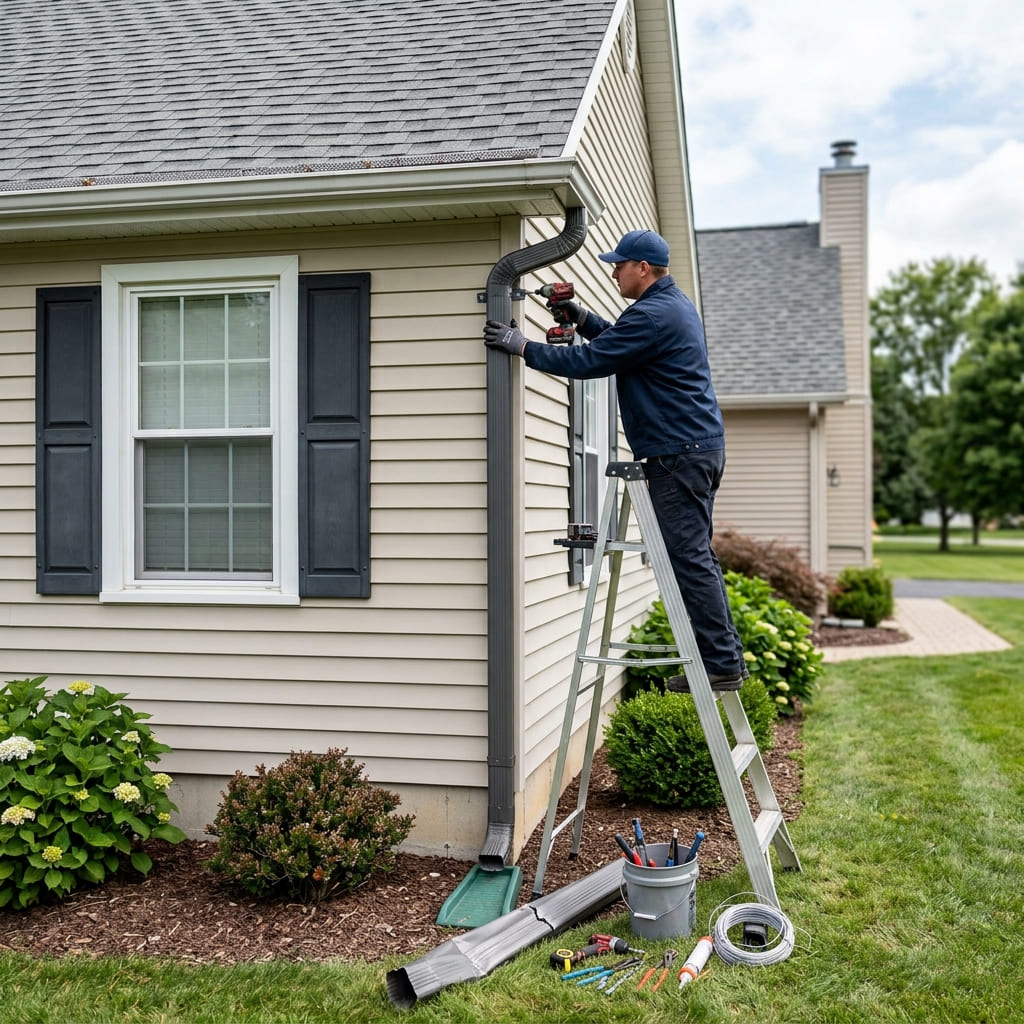
Downspout and drainage extension routing rainwater away from a home foundation
Free EstimatesAugusta & Richmond CountySeamless Gutter SpecialistsWritten PricingNo-Pressure Quotes

Most gutter complaints in Augusta are actually downspout complaints. The trough is clear, the pitch is fine, and water still ends up against the house — because there are too few drops, the outlets are too small, or the discharge dumps three feet from the brick and runs straight back toward the foundation.

Georgia red clay makes this worse than it would be almost anywhere else. Clay has very low infiltration — water does not soak in, it sits and spreads. A downspout emptying beside a footing on an Augusta lot is not watering the soil; it is pressurising it.

What We Handle

  • New downspout installation — drops added where a long run has nowhere to send water, sized to the trough above them.
  • Replacement and reattachment — crushed, dented, or storm-torn downspouts, and the sections that have pulled off the wall straps.
  • Outlet upsizing — moving from 2x3 to 3x4, which roughly doubles the flow a drop can carry and dramatically reduces needle blockage.
  • Elbow and offset work — routing around bay windows, brick returns, and porch framing without creating a trap for debris.
  • Extensions and splash blocks — the cheap fix that solves a surprising number of wet-crawlspace complaints.
  • Buried drainage lines — solid PVC carrying roof runoff to a pop-up emitter or a daylight point at the low end of the property.
  • Existing underground line diagnosis — checking whether an old buried line is clogged, silted, root-invaded, or collapsed.

Sizing and Placing Drops Correctly

The working rule is one downspout for every 30 to 40 feet of gutter, positioned at the ends of a run rather than the middle. A 60-foot elevation with a single centre drop is asking one outlet to swallow the whole roof plane in a storm, and it will overflow at both far ends long before the drop itself is the constraint.

Outlet size matters as much as count. A 3x4 downspout carries roughly twice the water of a 2x3 and is far harder for pine straw to bridge. On homes under loblollies through Forest Hills, National Hills, or the wooded lots toward Hephzibah, the upsizing pays for itself in avoided clog calls.

Where the drop lands matters too. Downspouts should not discharge onto a walkway, into a planting bed that will wash out, or at the top of a slope that runs back toward the house. On the hillside lots around Monte Sano and the Hill, getting this wrong sends the entire roof's runoff down the grade and against the foundation wall.

Getting Water Genuinely Away From the House

Option Typical cost When it is the right call
Splash block $30 – $60 Grade already falls away hard; minimal runoff
Surface extension, 4–8 ft $40 – $110 Good grade, low-traffic area, needs water pushed out
Hinged / flip-up extension $60 – $120 Across a mowing line where a fixed pipe is a nuisance
Buried line to pop-up emitter $12 – $25 per ft Flat lots, clay soil, water needs to travel 10+ ft
Buried line to daylight discharge $12 – $25 per ft Sloped lot with a low point to release into

One material note worth knowing: we run solid PVC, not corrugated perforated tubing, for downspout lines. Perforated pipe exists to collect groundwater. Using it to carry roof runoff means the water leaks back into the soil along the route — often still within a few feet of the house you were trying to protect.

Why this matters more on Augusta clay

Piedmont red clay holds water at the surface and swells when saturated, then shrinks as it dries. That cycle is hard on foundations, and it is the mechanism behind a lot of the crawlspace moisture and settlement complaints in older Augusta neighbourhoods. Moving roof water eight to ten feet out is one of the cheapest structural protections available to a homeowner here.

Diagnosing a Blocked or Failing Drop

  1. Check the top elbow first. The transition from trough to outlet is where pine straw bridges and packs. Nine blockages in ten are here rather than down the pipe.
  2. Flush from the top and watch the bottom. If water goes in and nothing comes out, the plug is in the vertical section or the buried line beyond it.
  3. Listen at the wall. A hollow ring means the pipe is clear; a dull thud usually means packed debris sitting behind that point.
  4. Find the discharge end. On homes with buried lines, the emitter is often overgrown or buried under mulch. A backed-up line frequently just needs the outlet found and cleared.
  5. Check for root intrusion. Older clay tile and corrugated lines on established Augusta lots are commonly invaded by roots from the same mature trees that fill the gutters.

Storm Damage and Downspouts

Downspouts take a disproportionate share of storm damage because they are the part of the system at ground level. Falling limbs crush them, wind pulls the straps out of siding, and the bottom elbow gets hit by everything from mowers to car doors.

Across the CSRA, Helene left a lot of homes with downspouts reattached quickly and roughly — strapped back without correcting the offset, or reconnected to a buried line that had already been crushed by root heave. If your drainage has not worked right since, the downspout is worth checking before anyone touches the gutters themselves.

Serving Augusta and the Surrounding Counties

We handle downspout and drainage work across Augusta and Richmond County — including Summerville, Olde Town, Forest Hills, National Hills, Harrisburg, Monte Sano, Sand Hills, and Daniel Village — as well as Evans, Martinez, Grovetown, Hephzibah, Harlem, Thomson, and Waynesboro, plus North Augusta and Aiken in South Carolina.

If water is showing up somewhere it should not be, that is worth a look even if the gutters themselves seem fine. Request a free drainage assessment and we will walk the grade with you, not just the roofline.

Straight answers

Frequently Asked Questions

How much does downspout work cost in Augusta?

Replacing or adding a downspout typically runs $150 to $350 per drop on a single-story home and $250 to $500 on a two-story. Extensions and splash blocks are inexpensive additions at $30 to $90 each.

Buried drain lines carrying water away from the house run roughly $12 to $25 per foot depending on trenching conditions — and in Augusta, hitting hard red clay or tree roots is what moves that number.

How far from the house should a downspout discharge?

Six feet is the practical minimum, and eight to ten is better on Augusta clay. Clay soil sheds water rather than absorbing it, so anything discharging close to the wall runs along the surface and finds its way under the footing.

Where the grade runs back toward the house — common on sloped lots around Monte Sano and the Hill — surface extensions are not enough and a buried line is the only real answer.

How many downspouts does my house need?

The general rule is one drop for every 30 to 40 feet of gutter run, and one at each end of a long elevation rather than a single drop in the middle.

Builder-grade layouts frequently undershoot this. If one corner of your house floods in every storm while the rest drains fine, an added drop on that run usually solves it for a couple of hundred dollars.

Why does my downspout keep clogging?

Almost always at the top elbow, where the trough narrows into the outlet. Pine straw bridges that transition and packs down until nothing passes. It is the single most common blockage point on CSRA homes.

Undersized 2x3 downspouts clog far more readily than 3x4. If you are clearing the same drop every season, upsizing the outlet is usually cheaper over five years than repeat visits.

Can you connect downspouts to an underground drain?

Yes. A buried solid PVC line carrying water to a pop-up emitter or a daylight discharge point at the low end of the lot is the most reliable way to get roof runoff genuinely clear of the foundation.

We use solid pipe rather than corrugated perforated tubing for downspout lines. Perforated pipe is for collecting groundwater — using it to carry roof runoff just releases the water back into the soil beside your house.

My downspout drains into an old buried pipe that backs up. Can it be fixed?

Often, yes. Older Augusta homes frequently have clay tile or corrugated lines that have collapsed, filled with silt, or been invaded by tree roots. We check flow at the discharge end first to find out whether it is blocked or broken.

A blocked line can sometimes be jetted clear. A collapsed one needs replacing — but usually only the failed section rather than the whole run.

Get the Water Away From Your Foundation

We look at the roofline and the grade together, then price the fix — whether that is one added drop or a buried line to the low end of the lot.

Call Us Now (706) 441-1723