
Winter Colony · Horse District · Whiskey Road

Gutter Installation and Gutter Replacement in Aiken, SC

Gutter installation and gutter replacement in Aiken involve two things nowhere else in the CSRA does. The city has historic overlay districts where an exterior change is reviewed rather than assumed, and it sits in the Sandhills rather than on Piedmont clay — so the soil under your downspout behaves in the opposite way to the soil across the river in Augusta.

  • Profile and material matched to the house before design review becomes a problem
  • Half-round, K-style, aluminum and copper priced honestly against each other
  • Discharge detailed for sandy Sandhills soil, not for clay
  • Cleaning scheduled around the spring live oak drop
  • Aiken County covered on planned routes
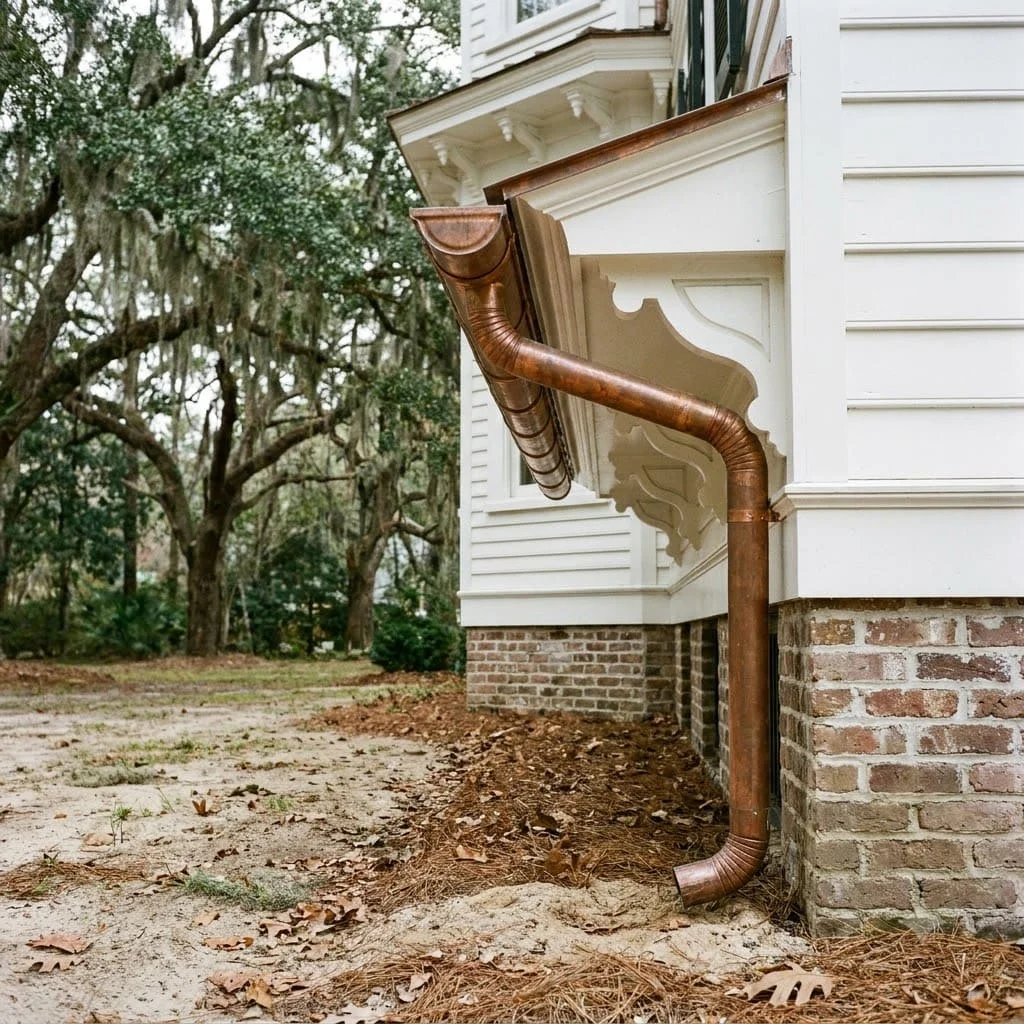
Copper half-round gutter and round downspout on a historic home with deep eaves
Free EstimatesAugusta & Richmond CountySeamless Gutter SpecialistsWritten PricingNo-Pressure Quotes

Aiken is the least generic town in the CSRA, and its gutters reflect that. A single afternoon can cover a landmark Winter Colony house where the profile is a preservation question, a 1980s Houndslake home where it is purely a capacity question, and a property backing onto Hitchcock Woods where the whole issue is what falls on the roof in April.

Two things run underneath all of it. The city reviews exterior alterations in its historic overlay districts, and Aiken sits in the Sandhills rather than on the Piedmont clay that shapes every drainage decision in Augusta. Both change what a correct answer looks like here.

The Historic Overlay Districts and What They Mean for Gutters

The City of Aiken Design Review Board issues Certificates of Appropriateness for construction, alteration, demolition, and relocation of structures in the Historic Overlay District and the Old Aiken Overlay District. Gutters and downspouts are exterior alterations. That does not make them prohibited — it makes them worth asking about before anything is ordered.

How much latitude you have depends on how the property is designated. Landmark structures are considered essential to the character of the district and noticeable changes are avoided. Contributing structures are generally over fifty years old with aesthetic or historical importance, and are allowed more change than landmarks. Noncontributing properties sit inside the overlay but are treated far more flexibly.

How we handle historic-district homes

Before we order anything, we check how your property is designated and whether the change needs a Certificate of Appropriateness. Like-for-like replacement is usually the simplest path. If you want to change the profile or material, or move a downspout to a visible side, we sort that out with the City of Aiken planning office first.

In practice this rarely stops a job. It changes the order of operations: decide the profile and material first, confirm it is acceptable, then measure and price. Getting that sequence backwards is the only way it becomes expensive.

Half-Round, K-Style, Aluminum, Copper

On a period Aiken house the profile is not decoration — it is what the eave detail was designed around, and it is the first thing design review looks at.

  • Half-round is the historically correct profile on most pre-war Aiken housing. It sheds debris better than K-style because there is no flat inner shoulder for grit to settle on, and it holds less water for a given nominal width — which matters on a steep roof plane.
  • K-style holds more water per inch of width and costs less, which is why it is standard on everything built since. On a noncontributing or modern Aiken property it is the sensible default.
  • Aluminum is the workhorse in both profiles, roll-formed seamless on site so there are no sectional joints to split.
  • Copper is the genuine article on a landmark house and priced accordingly — roughly $25 to $45 per foot installed. It also brings a hard constraint: copper and aluminum must not be in contact or share runoff, so a copper gutter means copper downspouts and compatible fixings, not a mixed system.

Whichever profile the house takes, the runs themselves are formed the same way. The seamless gutters page covers on-site roll forming, and the replacement page covers what a full tear-out and refit involves.

Sandhills Soil Does the Opposite of Augusta Clay

Every drainage instinct that works in Augusta needs adjusting in Aiken. Augusta sits on Piedmont red clay, which holds water at the surface and turns a badly placed downspout into a standing puddle against the foundation. Aiken sits in the Sandhills, the band of sandy soil that begins at the fall line, and sand does not pool.

It scours. A concentrated downspout discharge lands on sand and cuts a hole, and the hole keeps getting deeper because there is nothing to resist it. This is why a small splash block that would be marginal in Richmond County can simply vanish into a crater in Aiken within a couple of seasons.

The counterpart is less obvious and more important. The Sandhills sit over Cretaceous clay beds, and where that layer is shallow, water drains freely down through the sand and then stops dead at the clay. It spreads sideways along that boundary instead of continuing down. A property can have perfectly dry-looking topsoil and a persistently damp crawlspace at the same time, and the reason is a metre underground where nobody is looking.

The practical answer is the same either way: spread the discharge energy and move the water a genuine distance from the building. A rock apron or a full-size splash pad rather than a token block, a longer extension, and on properties with any fall, a buried line to a discharge point well clear of the structure. The downspout and drainage page covers how those lines are run and what they cost per foot.

Live Oaks Drop in Spring, Not Autumn

Most of the CSRA runs on an autumn cleaning calendar because pine and hardwood shed in autumn. Aiken does not follow that pattern, and the reason is its live oaks.

Live oaks are evergreen. They hold their leaves through winter and shed the old ones in spring as the new growth pushes them off, which means the heaviest debris load along South Boundary, through the Winter Colony, and around Hitchcock Woods arrives in roughly February to April rather than November.

A property under genuine live oak canopy therefore wants a spring clearing at minimum, and a second in late autumn if there are water oaks or willow oaks nearby — their small leaves pack far more tightly at an outlet than large ones do. Two to three clearings a year is realistic under the older canopy. The pine straw removal page covers what a hand clearing involves and why flushing the run matters as much as lifting debris out of it.

Near the Horse District there is a second, quieter load. Aiken keeps unpaved lanes for the horses, and the fine sand off them settles on nearby roofs and washes into the troughs, building a dense base layer that holds moisture and chokes outlets faster than leaves alone. It is the reason a run there can look clear from the ground and still drain badly.

Guards on an Aiken Roof

Micro-mesh guards handle live oak leaf and grit better than screens or foam inserts, both of which clog rather than shed. On a wooded Aiken lot the payback case is reasonable at two to three clearings a year.

Two Aiken-specific caveats. On a half-round profile, the guard has to be made for half-round — fitting a flat K-style panel across a round trough leaves gaps at the edges that let in exactly what it was meant to stop. And in a historic overlay district, a visible guard on a prominent elevation is an exterior change like any other, so it belongs in the same conversation as the profile.

What Gutter Work Costs in Aiken

Market guidance rather than an offer. Labour rates match the Georgia side of the river; in Aiken it is profile and material that move the total.

Work Typical Aiken range
Seamless 5-inch K-style aluminum, installed per foot $8 – $14
Seamless 6-inch oversized aluminum, installed per foot $12 – $20
Half-round aluminum, installed per foot $14 – $26
Copper, installed per foot $25 – $45
Full replacement, typical 200 ft roofline in aluminum $1,600 – $4,000
Rock apron or full-size splash pad, each $120 – $300
Buried discharge line, per foot $18 – $35
Gutter cleaning, live oak canopy $175 – $350
Micro-mesh guards on K-style, installed per foot $15 – $25
Micro-mesh guards on half-round, installed per foot $20 – $32

How We Handle Gutter Work in Aiken

  • We check the overlay district first. If your home is in the Historic Overlay or Old Aiken Overlay District, we find out before you choose a gutter style, because it decides what you can change.
  • We tell you if it’s like-for-like or a change. On a contributing or landmark house, replacing half-round with half-round is a very different job from switching profiles.
  • Copper stays copper. We never mix copper and aluminum in one system. The two metals corrode each other.
  • We plan where the water lands. Aiken’s sandy soil washes out under a splash block, so we use a rock apron, a full pad, or a buried line.
  • Hidden hangers every 24 inches. Closer than that under heavy tree cover.
  • Guards that fit the gutter. A flat panel doesn’t belong on a half-round gutter, so we match the guard to the profile.
  • We clean up the nails. Old spike systems drop nails everywhere, so we run a magnet over the yard before we leave.

Gutter Services Available Across Aiken

Augusta Gutters Pros covers Aiken on planned routes rather than as a daily run, which makes early contact worthwhile so a trip can be grouped. Installation, full replacement, repair and rehanging, cleaning, guards, and drainage work are all available.

Closer to the river we cover North Augusta, which shares the South Carolina permitting picture but sits on very different ground, along with Augusta and Richmond County and the Columbia County towns of Evans, Martinez, and Grovetown. The full list is on the service areas page, every job type is broken down on the gutter services hub, and sizing and pricing questions are answered in the gutter FAQ. Request a free estimate and we will start with the profile and the designation before anything gets measured.

Where we work in Aiken

Neighbourhoods and Roads We Cover

Augusta Gutters Pros covers Aiken on planned routes across the Savannah River. These are the areas we work most often — the historic overlay districts and the Horse District at the centre, the golf and lake communities out along Whiskey Road, and the everyday Midtown streets in between, each with a genuinely different set of gutter questions.

  • Winter Colony
  • The Horse District
  • Hitchcock Woods
  • Woodside
  • Houndslake
  • Cedar Creek
  • Gem Lakes
  • Midtown
  • Whiskey Road
  • South Boundary Avenue
  • Richland Avenue
  • Laurens Street
Straight answers

Frequently Asked Questions

Do you cover Aiken, SC?

Yes. Aiken sits at the outer edge of the coverage area for Augusta Gutters Pros and is worked on planned routes across the Savannah River, including the Winter Colony and Horse District, Midtown, Woodside, Houndslake, Cedar Creek, Gem Lakes, and the streets running off Whiskey Road, Richland Avenue, and South Boundary.

Gutter installation, replacement, repair, cleaning, guards, and drainage work are all available. Because Aiken is a scheduled run rather than a daily one, it is worth getting in touch early so the trip can be grouped.

Do I need approval to change my gutters in the Aiken historic district?

Possibly, and it is worth checking before anything is ordered. The City of Aiken Design Review Board issues Certificates of Appropriateness for exterior alteration of structures in the Historic Overlay District and the Old Aiken Overlay District, and gutters and downspouts are an exterior alteration.

What is allowed depends on how the property is designated — landmark, contributing, or noncontributing. Landmark structures are held to the tightest standard. In practice, like-for-like replacement of an existing profile is usually the least complicated route, while switching from half-round to K-style on a landmark house is the kind of change that needs asking about first. The City of Aiken planning office is the place to confirm.

Half-round or K-style on an older Aiken house?

On a house that already has half-round, replacing like for like is usually the right answer both practically and for design review. Half-round suits the period, sheds debris more readily because there is no flat inner shoulder for grit to sit on, and is what the roofline was detailed around.

K-style holds more water for the same nominal width and costs less, which is why it dominates modern construction. On a noncontributing or newer Aiken property it is a perfectly sensible choice. On a landmark house it is a conversation to have before the order goes in.

Why does the ground wash out under my downspout in Aiken?

Because Aiken sits in the Sandhills rather than on the Piedmont clay that covers Augusta. Sandy soil does not pool — it scours. A concentrated downspout discharge on sand cuts a hole and keeps deepening it, which is why splash blocks that work adequately in Richmond County often disappear into a crater here.

The fix is to spread the energy and move the discharge away from the structure: a longer extension, a proper splash pad or rock apron rather than a small block, and in some cases a buried line to a discharge point well clear of the foundation.

Does sandy soil mean drainage is never a problem in Aiken?

No — it means the problem shows up differently. The surface sand drains quickly, but the Sandhills sit over Cretaceous clay beds, and where that layer is shallow, water moves down through the sand and then stops. It spreads sideways at that boundary rather than continuing to drain.

That is why an Aiken property can have beautifully dry topsoil and a persistently damp crawlspace at the same time. Getting roof water discharged well away from the building matters here as much as it does on clay; the mechanism is just less visible.

When should gutters be cleaned in Aiken?

Aiken runs on a different calendar to most of the CSRA because of its live oaks. Live oaks are evergreen and shed their old leaves in spring as the new growth pushes through, so a spring clearing matters here in a way it does not in a pine-and-hardwood neighbourhood where autumn is the main event.

Under the canopy along South Boundary, through the Winter Colony, and near Hitchcock Woods, two to three clearings a year is realistic — typically one in spring after the live oak drop and one in late autumn. Water oaks and willow oaks add small leaves that pack tightly at the outlet.

Does living near the Horse District affect gutters?

It adds grit. Aiken keeps unpaved lanes through the Horse District for the horses, and the fine sand and dust from them settles on roofs nearby. Over a season it washes into the trough and forms a dense base layer that ordinary leaf debris then sits on top of.

It is not a dramatic problem, but it is a real one: grit sludge holds moisture against the bottom of the trough and blocks outlets faster than leaves alone would. Flushing the run rather than only lifting the debris out is what actually clears it.

How much does gutter work cost in Aiken, SC?

Seamless 5-inch aluminum runs $8 to $14 per linear foot installed and 6-inch oversized runs $12 to $20 — the same rates as the Georgia side of the river. What moves the number in Aiken is material and profile rather than geography.

Half-round aluminum typically runs above standard K-style, and copper is a different order of cost again at roughly $25 to $45 per foot installed. On a historic-district house those choices, not the labour, are what determine the total.

Get a Free Gutter Estimate in Aiken

We look at the existing profile and how the house is designated before recommending anything, measure the full roofline, and detail the discharge for sandy soil rather than clay. Written pricing, no obligation.

Call Us Now (706) 441-1723