
Liberty Street · Herndon Road · River Road

Gutter Installation and Downspout Repair in Waynesboro, GA

Gutter installation and downspout repair in Waynesboro run into a problem Augusta mostly does not have. Burke County sits below the fall line on flat Coastal Plain ground, and the difficulty here is almost never collecting the roof water — it is finding somewhere for it to go once you have. On a lot with no natural fall, that question has to be answered before anything is dug.

  • Available fall measured with a level before any line is buried
  • Dry wells assessed against the water table, not assumed to work
  • Discharge load split across more outlets where the ground cannot take it
  • Foundation grading checked on lots with no natural slope
  • Burke County covered on planned routes
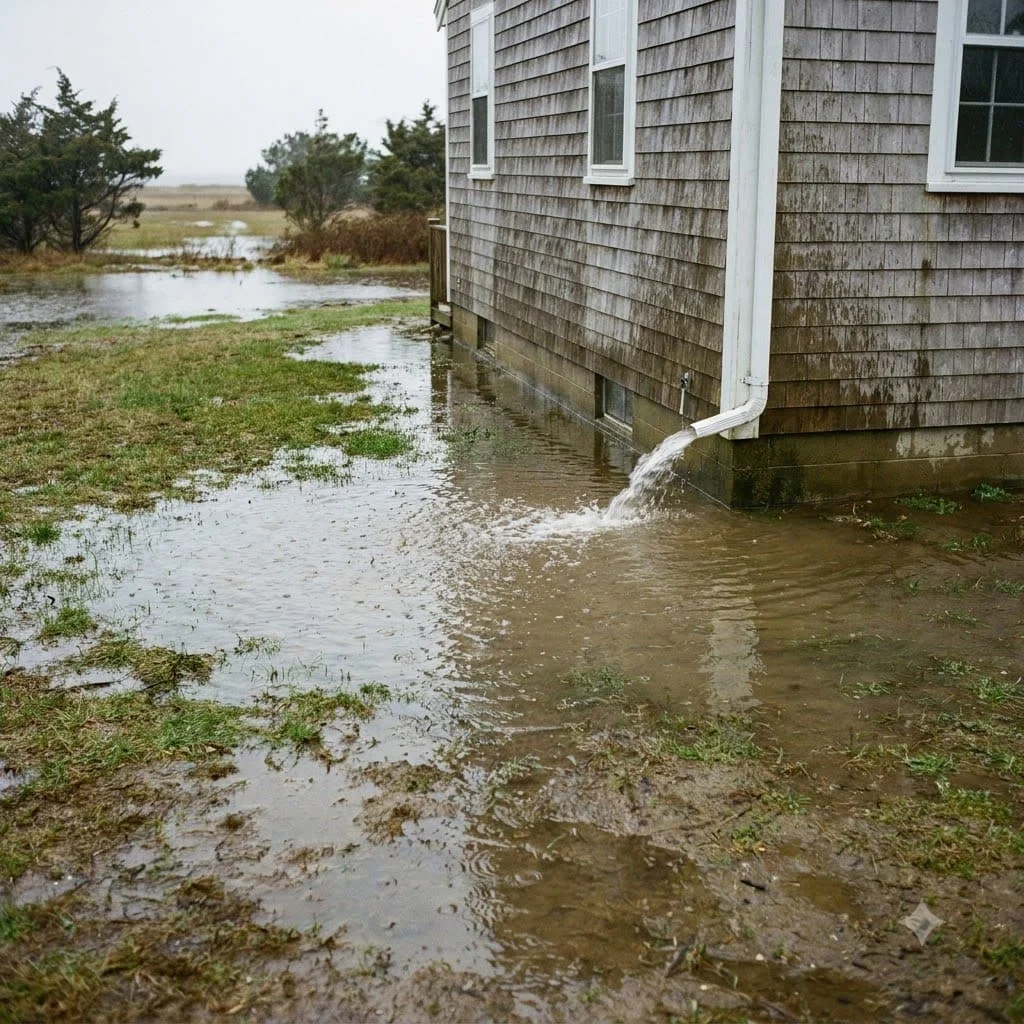
Downspout discharging onto flat saturated ground with water pooling near the foundation
Free EstimatesAugusta & Richmond CountySeamless Gutter SpecialistsWritten PricingNo-Pressure Quotes

Waynesboro is thirty miles south of Augusta on US 25, and crossing that distance means crossing a geological boundary. Augusta sits on the fall line. Burke County sits below it, on Coastal Plain ground that is flat to gently rolling, with sandy loam soils, clay lenses near the river and wetland corridors, and a water table that in the low-lying parts is closer to the surface than people expect.

That changes which half of the job is difficult. Collecting roof water is straightforward anywhere. On a flat Waynesboro lot, getting rid of it is the entire problem. Almost every gutter complaint we hear from Burke County traces back to a discharge point that was never really thought about, and that is where this page spends its time.

Collecting the Water Is the Easy Half

A gutter run does one job: it catches what comes off the roof and delivers it to an outlet. That part is a sizing calculation and it works the same in Waynesboro as it does in Evans.

The numbers involved are the reason the second half matters so much. A thousand square feet of roof sheds roughly 620 gallons in one inch of rain, and a summer storm here can deliver two inches. A modest house therefore puts well over a thousand gallons through its downspouts in a single afternoon, all of it arriving at a handful of points on the ground.

On a sloped lot gravity handles the rest and nobody thinks about it. On flat ground there is no rest. Those thousand gallons land where they land and stay in the vicinity, which is why the discharge design is the job in Burke County.

Buried Lines Need Fall, and Flat Lots May Not Have It

The instinctive fix is to bury a pipe and run it away from the house. It is often the right answer. It is only the right answer if the fall is there.

A buried drain line needs a minimum grade of roughly one eighth of an inch per foot — a one percent fall. Over a forty-foot run that is five inches of drop between the downspout connection and the outlet. Over eighty feet it is ten inches. On genuinely flat ground those numbers are not always available, and installing the pipe anyway does real harm.

A buried line without fall is worse than no line

A pipe laid flat holds standing water along its length. Silt settles out of that standing water and builds up, the effective bore shrinks, and eventually the line backs up into the downspout during the exact storm it was installed for. Establishing the available fall with a level before anyone digs takes minutes. Discovering the shortfall costs a second excavation.

Where the fall exists, a buried line to daylight is the cleanest solution available and worth doing properly — solid pipe rather than corrugated for the main run, and a discharge point where the water can actually leave. The downspout and drainage page covers how those lines are built and what they cost per foot.

Dry Wells and the Water Table

When there is no fall to daylight, the next suggestion is usually a dry well — a buried chamber or gravel pit that holds a surge of water and lets it soak away. In sandy loam that is a good idea, and in much of Burke County it works well.

It fails in one specific circumstance, and that circumstance is common enough in the low-lying parts of the county to be worth checking every time. A dry well only works if the ground beneath it is unsaturated. Where the water table is high, a dry well is a hole that is already full before the storm starts.

The test is simple and no reputable installer should object to it. Dig a hole to the intended depth and leave it for twenty-four hours. If water stands in it on its own, the water table is at or above that level and a dry well at that depth will not perform. If it drains, note how fast — that tells you how big the well needs to be.

What Works When Neither Option Does

Some Waynesboro lots have no usable fall and a water table too high for a dry well. That is not a dead end, but it does mean giving up on a single tidy solution and spreading the load instead.

  • More outlets, less volume each. Splitting a roof plane across two downspouts rather than one halves what any single discharge point has to absorb. On flat ground this is frequently the highest-value change available, and it is cheap.
  • Long above-ground extensions. Unglamorous and effective. Ten feet of extension to a wide splash apron puts water where the ground has a chance, and it can be lifted for mowing.
  • Discharge to the lowest point you have. A flat lot is rarely perfectly flat. Two or three inches of fall across sixty feet is not enough for a buried pipe but is plenty to decide which corner the extensions should point at.
  • Rock aprons rather than small splash blocks. The goal is to spread the stream out so the soil can take it gradually instead of receiving it as a jet in one spot.

Grading at the Foundation Matters More Here

On a sloped lot, a stretch of ground that falls the wrong way is forgiven by the general slope. On a flat lot nothing is forgiven — whatever lands near the wall stays near the wall.

The standard worth aiming for is ground falling away from the building by around six inches over the first ten feet. On flat Coastal Plain ground that fall does not exist naturally and has to be built with soil. It is landscaping rather than gutter work, but it belongs in the same conversation, because the best-designed downspout arrangement in Burke County will not overcome ground that slopes back toward the house.

It is also worth checking that the ground has not settled since the house was built. Backfill around a foundation compacts over the first several years and frequently ends up level or slightly negative, which is a slow problem that only shows itself as a damp crawlspace.

Debris, Dust, and the Cleaning Calendar

Waynesboro has less pine cover than Richmond County and correspondingly less needle debris, so two clearings a year suits most properties in town — one after the spring pollen and one in late autumn. Wooded lots and properties toward the river want three.

The Burke County difference is agricultural dust. Field work through the dry months puts fine soil into the air, it settles on roofs, and it washes into the trough where it consolidates into a dense sludge along the bottom. Sludge does not lift out the way leaves do, and it is what actually chokes an outlet. Flushing the run and the downspouts through is the part of a cleaning visit that deals with it.

What Gutter Work Costs in Waynesboro

Augusta-market guidance rather than an offer. Gutter rates match the rest of the CSRA. What moves a Waynesboro total is the drainage line, because the run to a workable discharge point is typically longer on flat ground.

Work Typical Waynesboro range
Seamless 5-inch aluminum, installed per foot $8 – $14
Seamless 6-inch oversized, installed per foot $12 – $20
Full replacement, typical 200 ft roofline $1,500 – $4,300
Additional downspout to split discharge load, each $120 – $240
Downspout extension and splash apron, each $60 – $180
Rock apron at a discharge point $120 – $300
Buried discharge line to daylight, per foot $18 – $35
Dry well installation $650 – $1,800
Gutter cleaning and downspout flush, single storey $150 – $300
Micro-mesh guards, installed per foot $15 – $25

How We Handle Gutter Work in Waynesboro

  • We plan where the water goes. On flat ground that’s the hardest part of the job, and we give you a clear answer.
  • We measure the fall. Before we propose a buried line, we check there’s at least an eighth of an inch of drop per foot.
  • We test the water table. A test hole left overnight tells us whether a dry well will work.
  • Solid pipe, not corrugated. It silts up far more slowly on shallow grades.
  • We split big roof planes. Two downspouts instead of one is often the cheapest real improvement on a flat lot.
  • We check the grade by the house. If the ground slopes back toward the foundation, we’ll point it out.
  • We clean up the nails. We run a magnet over the yard when old spike systems come down.

Gutter Services Available Across Waynesboro

Augusta Gutters Pros covers Waynesboro and Burke County on planned routes, so early contact helps the trip get grouped. Installation, full replacement, repair and rehanging, cleaning, guards, and downspout and drainage work are all available here.

Heading back north we cover Hephzibah in south Richmond County, which shares Burke County's larger lots and septic properties but sits on clay rather than Coastal Plain soil, along with Augusta itself and the Columbia County towns beyond it. The full list is on the service areas page, every job type is broken down on the gutter services hub, and sizing and pricing questions are answered in the gutter FAQ. Request a free estimate and we will work out where the water can go before quoting how to get it there.

Where we work in Waynesboro

Neighbourhoods and Roads We Cover

Augusta Gutters Pros covers Waynesboro on planned Burke County routes. These are the areas and roads we work most often — the older streets in and around town, the newer subdivisions on the edges, and the rural and river properties running out toward Thomas Station and Sardis where the drainage question gets harder rather than easier.

  • Waynesborough Place
  • Montville on the Savannah
  • Liberty Street
  • Myrick Street
  • Academy Avenue
  • Herndon Road
  • Brinson Road
  • Pine Hill Church Road
  • River Road
  • Fairway Drive
  • Thomas Station
  • Sardis
Straight answers

Frequently Asked Questions

Do you cover Waynesboro, GA?

Yes. Waynesboro is the Burke County seat, about thirty miles south of Augusta on US 25, and sits at the outer edge of the area Augusta Gutters Pros covers. It is worked on planned routes, including Waynesborough Place, Montville on the Savannah, the streets off Liberty Street and Academy Avenue, and the properties out along Herndon Road, Brinson Road, and River Road.

Installation, repair, cleaning, guards, and drainage work are all available. Because it is a scheduled run rather than a daily one, getting in touch early means the trip can be grouped with other work in Burke County.

Why is drainage harder in Waynesboro than in Augusta?

Because Burke County is below the fall line and the ground is flat. In Augusta the drainage problem is Piedmont clay refusing to absorb water; in Waynesboro the soil often absorbs perfectly well and there is simply nowhere downhill for the water to go.

That inverts the usual advice. Collecting roof water is the easy half of the job anywhere. On a flat Coastal Plain lot, deciding where it goes afterwards is the entire engineering problem, and it is the part most quotes skip.

How much fall does a buried drain line need?

A minimum of about one eighth of an inch per foot, which is a one percent grade. Over a forty-foot run that is five inches of drop between the downspout and the outlet, and on a genuinely flat Waynesboro lot that fall is not always there to find.

When it is not, burying a pipe is the wrong answer. A line without fall holds standing water, silts up, and eventually backs up into the downspout. Better to establish the available fall with a level before anyone digs than to discover the shortfall a year later.

Will a dry well work on my property?

Sometimes, and the deciding factor is the water table rather than the soil. A dry well works by holding water temporarily and letting it soak away into unsaturated ground underneath. In the low-lying parts of Burke County the water table can be close to the surface, and a dry well dug into saturated ground is just a hole that is already full.

The check is straightforward and worth insisting on: dig a test hole to the intended depth and leave it for a day. If it holds water on its own, a dry well at that depth will not perform, and the discharge needs to go somewhere else instead.

What are the options when there is no fall and no dry well?

Above-ground extensions taken a genuine distance from the house, discharge to the lowest point on the property even if that point is only slightly lower, and splitting the load across more downspouts so no single discharge point has to absorb everything.

Spreading the water out is the underrated one. Two outlets each shedding half the volume across a wide apron will disperse where one outlet delivering the lot in a concentrated stream will not, and on a flat lot that difference decides whether the ground can keep up.

Why does water sit against my foundation on a flat lot?

Because there is no slope to carry it away, so anything that lands within a few feet of the wall stays there. On a sloped lot a minor grading fault is forgiven by gravity. On a flat one it is not forgiven at all.

The standard worth aiming for is ground falling away from the building by roughly six inches over the first ten feet. On a flat Waynesboro lot that fall has to be built deliberately with soil, because the site will not provide it, and no downspout arrangement fully compensates for ground that slopes back toward the wall.

How often do gutters need cleaning in Waynesboro?

Twice a year suits most properties in and around town, typically once after the spring pollen and once in late autumn. Properties under heavy pine or backing onto wooded ground want three.

The Burke County specific is agricultural dust. Field work through the dry months puts fine soil onto roofs, and it washes into the trough and settles as a dense sludge at the bottom. Flushing the run through the downspouts matters as much as lifting debris out of it, because sludge is what actually blocks an outlet.

How much does gutter work cost in Waynesboro, GA?

Seamless 5-inch aluminum runs $8 to $14 per linear foot installed and 6-inch oversized runs $12 to $20, the same as the rest of the CSRA. A typical Waynesboro roofline of 180 to 240 feet lands somewhere between $1,500 and $4,300 for the gutters themselves.

The variable that matters more here is drainage. Buried lines run $18 to $35 per foot, and on a flat lot the run to a workable discharge point is frequently longer than it would be on sloped ground. That line, not the gutter line, is where a Waynesboro quote is won or lost.

Get a Free Gutter Estimate in Waynesboro

We measure the fall available across the property before recommending a buried line, test whether a dry well will actually perform at depth, and price the discharge as openly as the gutters. Written pricing, no obligation.

Call Us Now (706) 441-1723