
Types & materials · Augusta, GA

Seamless vs Sectional Gutters: Which Is Best for Augusta Homes?

The two systems look identical from the driveway and cost within a few dollars a foot of each other. What separates them is joint count — and in a climate that cycles sealant this hard, joint count is the whole argument.

  • Seamless: joints only at corners, ends and outlets
  • Sectional: a manufactured joint roughly every 10 ft
  • 5-inch seamless aluminum: $8 – $14 per ft installed
  • Pro-installed sectional: $7 – $12 per ft installed
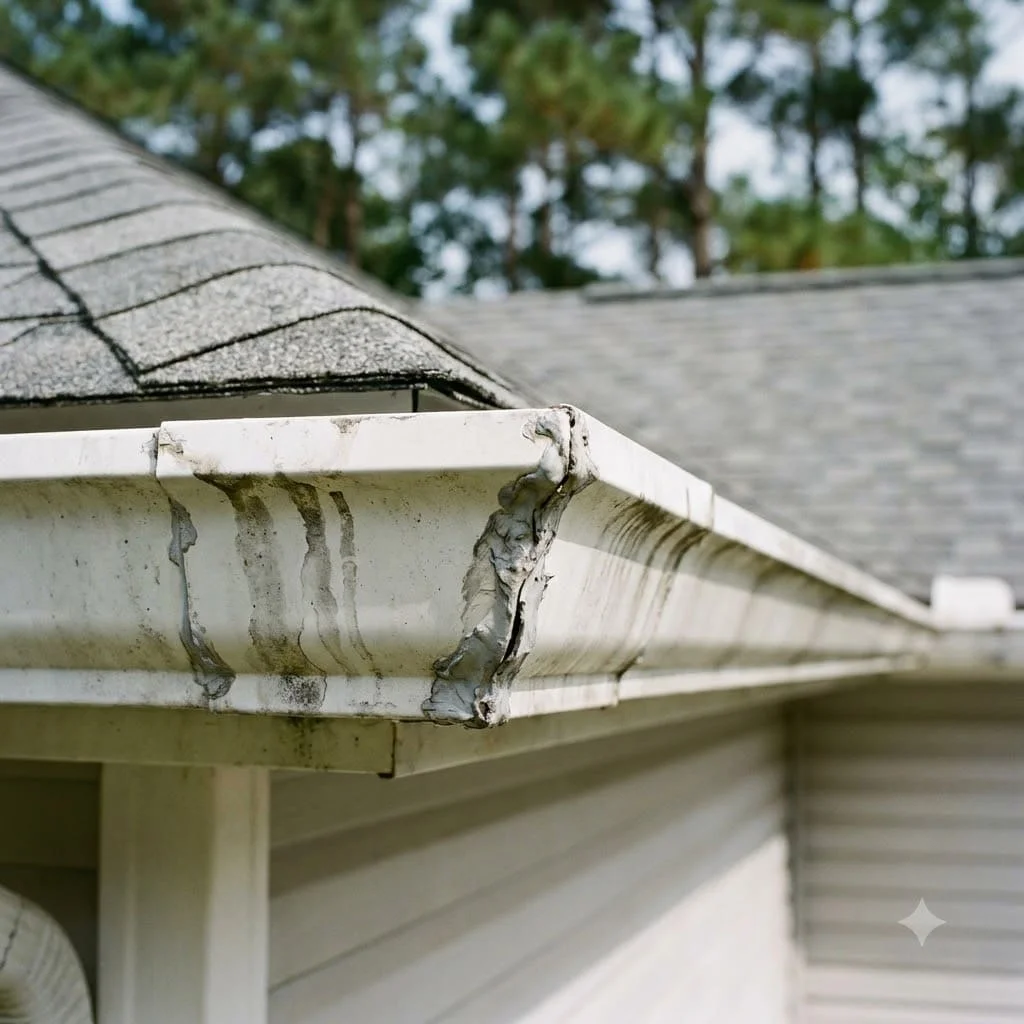
Sealant and dark water staining at the mitred lap joint of an older sectional aluminum gutter
Free EstimatesAugusta & Richmond CountySeamless Gutter SpecialistsWritten PricingNo-Pressure Quotes

The Short Answer

For a house you plan to keep, seamless is the better system on almost every Augusta roofline — and it costs less extra than most people expect. Professionally installed sectional aluminum runs $7 to $12 per linear foot here. Five-inch seamless runs $8 to $14.

On a 180-foot roofline that gap is frequently under $400 across the whole house. For that difference you go from roughly eighteen manufactured joints down to six or eight, all of them at corners and outlets where they are easier to seal and easier to inspect.

The comparison people actually have in their heads is usually different, though. It is not seamless against professionally installed sectional — it is seamless against ten-foot vinyl lengths from a big-box store, hung over a weekend. That is a genuine saving and a genuine trade-off, and it is covered separately in the DIY versus professional guide.

Everything below is about which system belongs on your house once someone else is hanging it.

What Actually Differs Between Them

Both systems are usually the same metal, in the same K-style profile, in the same colour. Set them side by side on the ground and most people cannot tell which is which.

The difference is how the trough gets to your fascia.

Sectional gutter arrives as pre-cut lengths, typically ten or twelve feet. Each length is joined to the next with a slip connector, a lap joint, or a snap-together union, and that junction is sealed with gutter sealant. A long run is a chain of these.

Seamless gutter arrives as a coil of flat aluminum on a truck. A roll-forming machine on site presses that coil into the K-style profile and cuts it to the exact length of your roof edge. A forty-foot run comes off the machine as one forty-foot piece.

That is the entire mechanical difference, and everything else in this comparison follows from it.

How to tell what you already have

Stand under a long straight run and look up at the outside face of the gutter. If you can see regular vertical lines every ten or twelve feet — often with a slight ridge, a colour difference, or a dirt streak running down from them — that is sectional. A run with no interruptions between the corner and the downspout is seamless.

How Many Seams You Are Really Buying

Joint count is the number worth having in front of you, because it is the number that predicts maintenance.

Take an ordinary Augusta ranch: 180 feet of roofline, eight corners, four downspouts. Here is how the two systems compare on the only metric that meaningfully separates them.

Joint type Sectional Seamless
Joints along straight runs ~18 0
Miters at corners 8 8
Downspout outlets 4 4
End caps 4 – 6 4 – 6
Total sealed joints 34 – 36 16 – 18

Roughly twice as many, and the extra eighteen are in the worst possible places. Corner miters and outlets sit where you would look anyway. Mid-run joints sit in the middle of a straight stretch where nobody is looking until a stripe of staining appears on the fascia below.

There is a second-order effect that matters more than the count itself. A joint is not just a leak risk — it is a snag point. Every slip connector projects slightly into the trough, and debris moving along the gutter catches on it.

Where Sectional Fails First in Augusta

Sectional gutter does not fail randomly. It fails in a predictable order, and knowing that order lets you read an existing system accurately from the ground.

  1. The sealant at mid-run joints shrinks. Usually first on south and west elevations, where surface temperature swings hardest. A hairline gap opens between the sealant bead and the aluminum.
  2. A drip line appears on the fascia. Water finds the gap, runs down the back of the trough, and stains the board. This is the stage most people first notice, and it is already several seasons in.
  3. Debris packs behind the connector. Pine straw catches on the lip, holds moisture against the joint permanently, and accelerates everything.
  4. The joint separates under load. Wet debris is heavy. A trough that has held a standing load through a wet spring pulls the lap apart, and the two lengths step out of alignment.
  5. The fascia behind it goes soft. By this point the repair is no longer a gutter repair. Board replacement runs $9 to $18 per linear foot, higher where the rafter tails behind it have gone too.

That last step is the reason this comparison is worth reading before you buy rather than after. The system itself is the cheap part of the failure. What sits behind it is not — as the fascia-first approach we take in Thomson makes clear, the board is often the real job by the time anyone calls.

What Each Costs Installed

These are Augusta-market rates, installed, including hangers, miters and end caps. Downspouts are priced separately on both systems.

System Installed price Typical 180 ft roofline
Sectional, DIY materials only $4 – $8 per ft $720 – $1,440 plus your weekend
Sectional aluminum, professionally installed $7 – $12 per ft $1,260 – $2,160
5-inch seamless aluminum $8 – $14 per ft $1,440 – $2,520
6-inch seamless aluminum $12 – $18 per ft $2,160 – $3,240

Two things stand out. The first is how narrow the seamless premium is once someone is being paid to hang either one — a dollar or two a foot, because the labour is nearly identical and the coil stock is not more expensive than pre-cut lengths.

The second is that the real price gap in the table is not seamless against sectional at all. It is professional installation against DIY vinyl, and that is a different decision entirely.

Worked totals for other roofline shapes — two-story, long single-story on acreage, single elevation only — are in the Augusta gutter installation cost guide.

The Pine Straw Problem Nobody Mentions

Most seamless-versus-sectional comparisons online were written for a climate that drops its leaves once, in October, and then stops. The CSRA does not work that way, and it changes the weighting of this decision.

Loblolly pine sheds needles year-round, with heavy drops in late spring and again in autumn. Pine straw is not like leaf litter: individual needles are stiff, three to nine inches long, and they interlock. A mat of wet pine straw behaves like a felt pad rather than a pile of loose debris.

That matters at a sectional joint specifically. A leaf flows over a slip connector. Pine straw catches on it, and once a few needles have caught, the rest build against them.

The result is that on a pine-covered lot in Evans or Martinez, a sectional system does not just leak at the joints sooner — it clogs at the joints first, holds water against those joints permanently, and reaches step four on the failure list years earlier than the same system would under hardwoods.

It is also why joint count feeds into cleaning frequency. Every connector is a place a clear-out has to work around. How often that needs doing under Augusta pine is covered in the gutter cleaning cost guide.

A test you can run from the ground

After the next hard rain, walk the perimeter and look for vertical dirt stripes on the outside face of the gutter, and for staining on the fascia directly below them. On a sectional system those stripes land at regular intervals — that spacing is your joint spacing, and each stripe is a joint that is already losing its seal.

Four Times Sectional Is the Right Call

A comparison that concludes the more expensive option always wins is not a comparison. These are the four cases where sectional is the correct answer, and they come up often enough to matter.

  • Detached garages, workshops and sheds. The structure is not the house, the fascia behind it is often not finished lumber, and the consequence of a slow joint leak is a damp patch on a slab rather than a rotted soffit. Sectional is proportionate.
  • Rooflines the truck cannot reach. Seamless has a physical constraint people rarely think about: the forming machine has to be parked close enough to feed a full-length run to the roof edge. Narrow lots, gated back yards, steep drop-offs and dense planting can all make that impossible. A back elevation behind a fence sometimes has to be sectional.
  • Short isolated runs. Under about twenty feet, seamless saves you one joint. A porch roof, a bay projection, or a single dormer return is not worth mobilising a forming truck for on its own.
  • Patching a system you are not replacing yet. If forty feet of an otherwise sound sectional system has been damaged, matching it is sensible. Splicing seamless into a sectional run gives you a mismatched profile and a joint at each end anyway.

What these four have in common is that the joints are either few, tolerable, or unavoidable. When none of those apply — a main elevation, a full roofline, a house you are keeping — the joint count decides it.

How Long Each Lasts in Georgia

Aluminum outlives sealant. That single sentence explains most of the lifespan difference, and it is why the numbers below are about maintenance intervals rather than replacement dates.

Sectional Seamless
Aluminum service life 20+ years 20+ years
First joint re-sealing Year 5 – 8 Year 10 – 15, corners only
Joints to maintain 34 – 36 16 – 18
Typical failure point Mid-run lap joint Corner miter or outlet

Georgia is specifically hard on the sealant rather than on the metal. It is not rainfall that breaks the bond — it is thermal cycling. A south-facing aluminum gutter gets genuinely hot on an August afternoon and cools sharply overnight, and the two materials in a sealed joint expand at different rates through every one of those cycles.

Note what is not on that list: freeze-thaw. Sustained ice loading is a northern failure mode and does not drive gutter wear here, which is why comparisons written for the Midwest weight this decision differently than they should for the CSRA.

What to Ask Before You Sign

Whichever system you choose, these are the questions that separate a quote you can compare from one you cannot.

  • Is the trough formed on site, or delivered in lengths?
  • How many sealed joints will the finished system have, in total?
  • What gauge is the aluminum?
  • How far apart are the hangers, in inches?
  • Are hidden hangers used, or spikes and ferrules?
  • How many downspouts, and what size?
  • Will any elevation have to be sectional because of access?
  • What happens if soft fascia is found once the old gutter is off?
  • Is tear-out and haul-away included?
  • What workmanship cover comes with the fitting, in writing?

The second and the seventh are the ones specific to this decision. An installer who cannot tell you the joint count has not measured properly, and one who does not raise an access constraint before the day is going to raise it on the day.

Get the workmanship terms written down before work starts rather than after. A verbal assurance about coming back to reseal a joint is worth what it is written on.

Getting a Number for Your Own Roofline

The joint count on your house is knowable in about ten minutes with a tape measure, and it is the single most useful thing to have before you compare quotes. Corner count, downspout positions and the condition of the board behind the existing gutter are the rest of it.

Augusta Gutters Pros forms seamless aluminum on site across Augusta, Richmond County and the wider CSRA, and will say plainly where an elevation is better off sectional rather than pretending the truck can reach it. Call (706) 441-1723, or read how our estimates work first.

If you are weighing profile or material at the same time, the Georgia gutter materials guide covers what to hang, the 5-inch versus 6-inch guide covers what size, and the half-round versus K-style guide covers what shape. Outside Augusta itself, the service areas page lists every town covered, from Grovetown across to North Augusta and Aiken.

About the prices on this page

Every range here describes what gutter work generally sells for in the Augusta and CSRA market rather than a national average. They show what to expect, not a final offer — your exact price comes from measuring your roofline. The figures were last checked in September 2026; see our terms of service for the full disclaimer.

Straight answers

Frequently Asked Questions

Are seamless gutters worth the extra money in Augusta?

On a house you intend to keep, generally yes — but not because seamless is dramatically more expensive. Professionally installed sectional aluminum runs $7 to $12 per linear foot around Augusta and 5-inch seamless runs $8 to $14, so the gap on a 180-foot roofline is often only a few hundred dollars.

The value is in what you are not buying. A 180-foot sectional system carries roughly eighteen manufactured joints along its length, and every one of them is a place where sealant will eventually shrink, crack, and drip. Seamless leaves you with joints only at corners and outlets.

Do seamless gutters have any seams at all?

Yes, and any installer who says otherwise is overselling. Seamless means the straight runs are formed as one continuous length from a coil on site, so there are no joints along the run itself.

You still get a sealed joint at every inside and outside miter, at each end cap, and at every downspout outlet. On a typical Augusta ranch that is six to ten joints instead of twenty-five or more. Fewer joints in better locations is the actual benefit, not zero joints.

How much do seamless gutters cost in Augusta, GA?

Five-inch seamless aluminum runs $8 to $14 per linear foot installed in the Augusta market. A single-story home with 160 to 200 feet of roofline usually lands between $1,400 and $2,600 for a complete system with downspouts.

Six-inch seamless runs $12 to $18 per foot. The full breakdown by material and by roofline shape is in the gutter installation cost guide.

Can a seamless gutter be repaired, or does the whole run come off?

It can be repaired. This is the most common misconception about seamless, and it puts people off unnecessarily.

A damaged section is cut out and a new length is formed and joined in, or the whole run is replaced if the damage is extensive — but a dented eight-foot stretch does not condemn a forty-foot run. Sag, loose hangers, a leaking miter, and a detached downspout are all ordinary repairs on either system.

Are sectional gutters ever the better choice?

Four situations, genuinely. Detached garages, sheds and workshops where appearance and longevity matter less. Rooflines a 40-foot forming truck physically cannot reach, which happens on tight lots and behind fenced back yards. Single short runs under 20 feet, where seamless saves almost no joints. And a like-for-like patch on an existing sectional system you are not ready to replace.

Outside those cases, the joint count is the deciding factor and it points the same way every time.

How long do sectional gutters last in Georgia?

The aluminum itself outlives the sealant by a wide margin. Expect to be re-sealing joints on a sectional system somewhere between year five and year eight in this climate, and to keep doing it periodically after that.

Georgia is hard on joint sealant specifically. Summer surface temperatures on a south-facing gutter cycle hard against overnight cooling, and that repeated expansion and contraction is what breaks the bond — not rainfall.

Can I install seamless gutters myself?

Not practically. Seamless gutter is roll-formed on site by a machine that runs $5,000 or more and mounts in a trailer or truck bed, so the material simply is not sold to homeowners in continuous lengths.

What is sold at big-box stores is sectional — ten-foot vinyl or aluminum lengths that snap and seal together. That is a real DIY project with real trade-offs, worked through properly in the DIY versus professional comparison.

Not Sure Which Your House Already Has?

Most homeowners cannot tell from the ground. We will walk the roofline, count the joints, tell you what you have got and what it needs — in writing, with no obligation.

Call Us Now (706) 441-1723