
Maintenance & problems · Augusta, GA

Why Are My Gutters Overflowing? Common Causes and Fixes

Where the water comes over tells you why. Overflow in the middle of a run, at a corner, and behind the gutter are three different problems with three different fixes.

  • Over the front, everywhere: clogged trough or downspout
  • At one corner: a roof valley overshooting
  • Middle of a run: sag or wrong pitch
  • Behind the gutter: hung too low or no drip edge
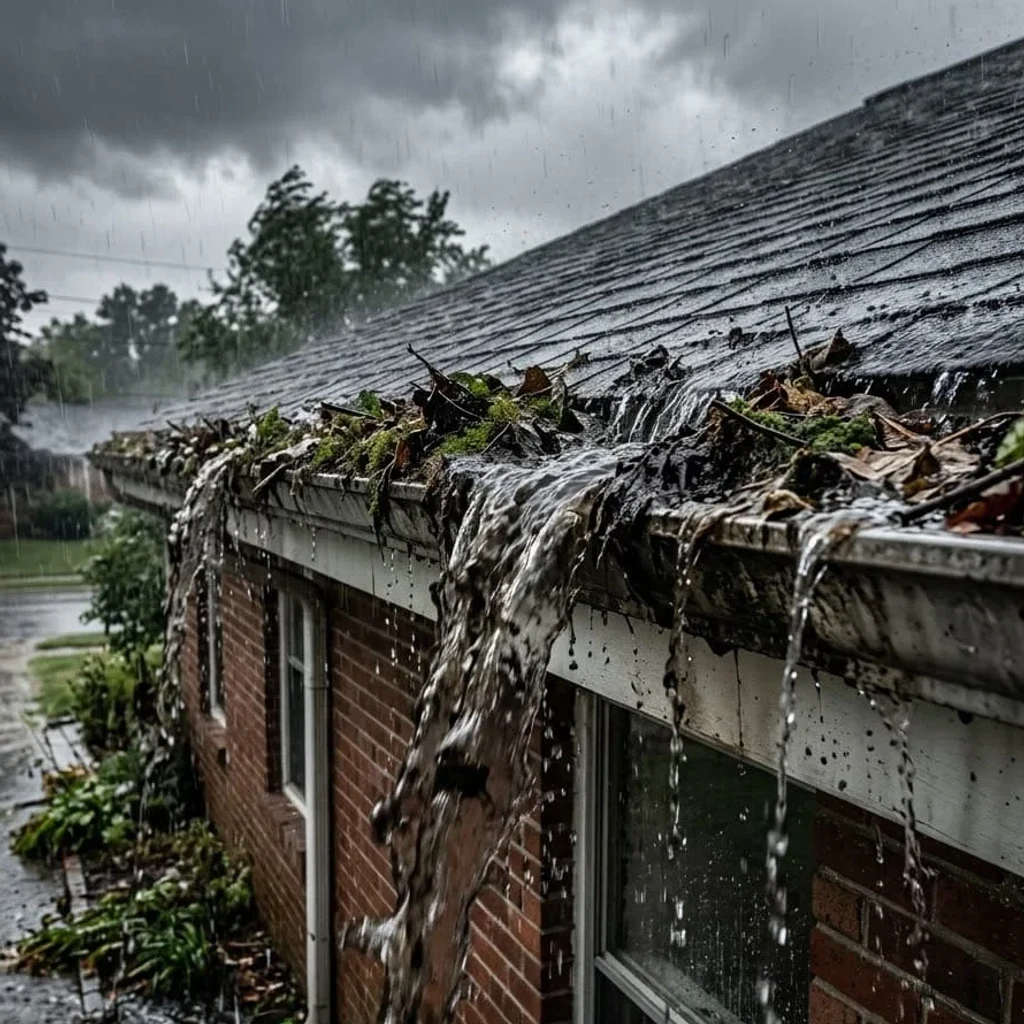
Rainwater pouring over a gutter clogged with leaves and moss on a brick house during a heavy storm
Free EstimatesAugusta & Richmond CountySeamless Gutter SpecialistsWritten PricingNo-Pressure Quotes

The Short Answer

Gutters overflow because water reaches them faster than it can leave through the downspouts. The most common reason is a clog in the gutter or downspout. The others are a pitch that runs the wrong way, a section that has sagged, a roof valley pouring into a corner, too few downspouts, and a gutter that is simply too small for the roof above it.

The good news is that you can usually tell which one you have by watching where the water spills. That is the fastest way to avoid paying for the wrong fix — like new gutters when the real problem is one clogged elbow.

Read Where the Water Comes Over

Next time it rains hard, go outside with an umbrella and look along each run. Note exactly where the water leaves the gutter.

Where it overflows Most likely cause Check first
Over the front edge along the whole run Clogged trough or blocked downspout Is the downspout dry during rain?
At an inside or outside corner Roof valley sending a fast stream into one spot Is there a valley right above the corner?
In the middle of a run Sag or low spot holding water Does the gutter dip when you sight along it?
At the far end from the downspout Pitch running the wrong way Is there standing water at that end after rain?
Behind the gutter, down the wall Gutter hung too low, missing drip edge, or a clog Is there a gap between shingle edge and gutter?
Only in the heaviest storms, even when clean Too few downspouts or undersized gutters How much roof drains to each downspout?

If the water comes over in more than one of these places, work through them in order. A clog is the most common cause and the cheapest to fix, so clear that first and watch the next rain again.

Seven Causes of Overflowing Gutters

1. A clogged trough

Leaves, pine straw, oak tassels, and shingle grit build up until water cannot flow along the gutter. Under loblolly pine, needles knit into a mat that holds water like a dam. The gutter can look half empty from the ground and still overflow. How often that happens depends on the trees — see how often to clean gutters in Augusta.

2. A blocked downspout

If the downspout is plugged, the gutter fills from the outlet backward. The telltale sign is a dry downspout during rain. Blockages usually sit at the top outlet or at the elbows, where debris has to turn a corner. The clogged downspouts guide covers how to find and clear one.

3. Wrong pitch

Gutters should fall about a quarter inch for every ten feet toward the downspout. If a run is dead level, or tilts the wrong way, water sits in the trough and spills at the low end. After rain, you will see standing water that does not drain away.

4. A sagging section

When a fastener pulls loose, the gutter dips. Water collects in the low spot, adds weight, and pulls the next fastener too. Overflow in the middle of a run almost always means a sag. The sagging gutters guide explains the causes and repairs.

5. A roof valley pouring into a corner

Where two roof slopes meet, they form a valley that collects water from both sides and sends it down in one fast stream. That stream hits the gutter corner hard enough to jump the outside edge. A valley splash guard fixed to the gutter lip turns it back into the trough.

6. Too few downspouts

Each downspout can only drain so much roof. A 2x3 downspout handles up to roughly 600 square feet of roof. A 3x4 handles roughly double that. A long run with one downspout at the end often overflows even when it is perfectly clean, because the outlet cannot keep up.

7. Gutters too small for the roof

Steep roofs, large roof areas, and metal roofs all send water to the gutter faster. A 5-inch gutter with 2x3 downspouts may not keep up. A 6-inch gutter holds about 50 percent more and pairs with 3x4 downspouts. The 5-inch vs 6-inch guide explains how to tell if yours is undersized.

Water shooting over the gutter entirely

If rain flies off the roof edge and clears the gutter altogether, the gutter is hung too low or too far back, or the roof is shedding water too fast for it. Metal roofs do this often — the Harlem page covers why metal roofs in the CSRA need gutters sized and positioned differently.

The Hose Test

You do not have to wait for a storm. On a dry day, this test narrows down most overflow problems in about fifteen minutes. On a single-story home with safe ladder access, you can do it yourself.

  1. Clear any visible debris first. Otherwise the test just tells you the gutter is dirty.
  2. Put a garden hose in the far end of the run — the end away from the downspout — and turn it on medium.
  3. Watch the water move. It should run steadily toward the downspout. If it pools or runs backward, the pitch is wrong in that section.
  4. Watch the bottom of the downspout. Water should come out within a few seconds. If the trough fills up and the downspout stays dry, the downspout is blocked.
  5. Check the joints and the back of the gutter. Drips at seams mean failed sealant. Water running down the fascia means the gutter is not catching water at the back.
  6. Look for standing water after you turn it off. Puddles that stay put mark the low spots.

A hose cannot copy a thunderstorm, so a system that passes can still be too small. But if it fails the hose test, you have found a problem that has nothing to do with size.

Why Augusta Storms Find the Weak Spot

Augusta gets roughly 45 inches of rain a year, but the yearly total is not what makes gutters overflow. Intensity is. A summer afternoon thunderstorm can drop a large share of an inch in a few minutes, and that burst is what tests a gutter system.

Tropical systems are the other test. Hurricane Helene in September 2024 brought heavy rain and wind across the CSRA, and many gutters that had coped for years were overwhelmed or torn down.

Two local conditions make overflow more likely here:

  • Pine straw mats. They hold water even when a gutter looks fairly clear, and summer storms arrive after months of steady needle drop.
  • Builder-grade downspouts. Many newer subdivision homes were built with 2x3 downspouts spaced far apart. They pass inspection and overflow in the first real storm. The Grovetown page covers this in detail.

Fixes and What They Cost

Match the fix to the cause. These are typical ranges in the Augusta market.

Cause Fix Typical Augusta cost
Clogged trough Hand cleaning and flush $150 – $250 single-story, $250 – $400 two-story
Blocked downspout Clear elbows and flush; replace if crushed Usually part of a cleaning; replacement $150 – $350 per drop
Wrong pitch or sag Rehang and re-pitch the section $200 – $400
Loose spikes along a run Replace spikes with hidden hangers $180 – $350 per run
Too few downspouts Add a downspout on the long run $150 – $350 single-story, $250 – $500 two-story
Undersized system Replace with 6-inch gutters and 3x4 downspouts $12 – $18 per ft installed
Leaking seams Reseal miters and end caps $150 – $250

Adding a downspout is often cheaper than a bigger gutter. On a long run with one outlet, a second drop in the middle halves the roof area each downspout has to handle. That fixes a lot of "undersized" systems for a fraction of replacement.

Our gutter repair service handles pitch, sag, and seam problems, and the downspout page covers adding drops and carrying water away from the house.

What Overflow Does to a House

An overflowing gutter is doing worse than not working. It is taking roof water and dropping it in the worst possible place.

  • Foundation. Water spilling at the drip line lands right against the slab or crawlspace wall. Augusta's red clay drains slowly, so that water sits there rather than soaking away.
  • Fascia and soffit. Overflow behind the gutter soaks the wood. Rotted fascia can no longer hold hangers, which leads to more sagging and more overflow.
  • Siding and windows. Constant splashing stains brick, grows mildew on siding, and gets behind window trim.
  • Landscaping. A sheet of water off the roof edge digs trenches in beds and washes mulch and soil across walkways.

If the overflow has been going on for a while, look at the wood behind the gutter before deciding on a fix. The signs your gutters need replacing guide explains how to check it and when rot changes the decision.

Getting It Fixed

Watch where the water spills, run the hose test, and match what you find to the table above. In most cases the cause is a clog or a downspout, and the fix is quick and inexpensive.

If you would rather have someone find the cause for you, Augusta Gutters Pros works across Augusta, Evans, Martinez, Grovetown, North Augusta, and the rest of the CSRA. Call (706) 441-1723 and tell us where the water comes over. We will track down why and give you a written price for the fix — or see how our free estimates work first.

About the prices on this page

Every range here describes what gutter work generally sells for in the Augusta and CSRA market rather than a national average. They show what to expect, not a final offer — your exact price comes from measuring your roofline. The figures were last checked in September 2026; see our terms of service for the full disclaimer.

Straight answers

Frequently Asked Questions

Why are my gutters overflowing when they are clean?

A clean gutter that still overflows usually has one of four problems: a blocked downspout, too few downspouts for the roof area, a trough that is too small, or a pitch that runs the wrong way.

Start with the downspout. Run a hose into the gutter and watch the bottom of the downspout. If water backs up in the trough instead of flowing out, the blockage is in the downspout, often at an elbow.

Is it normal for gutters to overflow in heavy rain?

A little spill at a corner in a severe downpour can happen on any system. Steady overflow along a run, or overflow in ordinary rain, is not normal.

Augusta summer thunderstorms can drop rain very fast, so a system that copes with a gentle shower may still be undersized. If a clean gutter overflows in most thunderstorms, it needs more downspout capacity or a bigger trough.

Why does water overflow at the corner of my gutter?

Corners usually sit below a roof valley, where two roof slopes meet and send a concentrated stream of water into one spot. The water hits the corner fast and shoots over the outside edge.

A valley splash guard, a small metal piece fixed to the gutter lip at the corner, deflects that water back into the trough. Adding a downspout close to the corner helps too.

Why is water coming out behind my gutters?

Water running between the gutter and the house usually means the gutter is hung too low, the drip edge is missing or too short, or a clog is backing water up to the rear of the trough.

This is the overflow to fix first, because it goes straight into the fascia board and down the wall. Left alone it rots the wood that holds the gutter up.

Will gutter guards stop my gutters overflowing?

Only if debris is the cause. Guards keep leaves and pine straw out, but they do nothing for an undersized system, a bad pitch, or a valley overshooting the corner.

Under heavy pine, fine needles and pollen can also coat the top of a guard and make water run over it. Guards still need occasional cleaning.

How much does it cost to fix overflowing gutters?

It depends on the cause. A cleaning runs $150 to $250 on most single-story Augusta homes. Re-pitching a section runs $200 to $400. Adding or replacing a downspout runs $150 to $350 on a single-story home.

If the whole system is too small, replacement with 6-inch gutters and 3x4 downspouts is the lasting fix, and it is priced per linear foot.

Stop the Overflow at Its Source

Tell us where the water comes over and we’ll find out why — then give you a written price for the fix that actually solves it, with no obligation.

Call Us Now (706) 441-1723