
Gutter Installation and Downspout Repair in Beech Island, SC
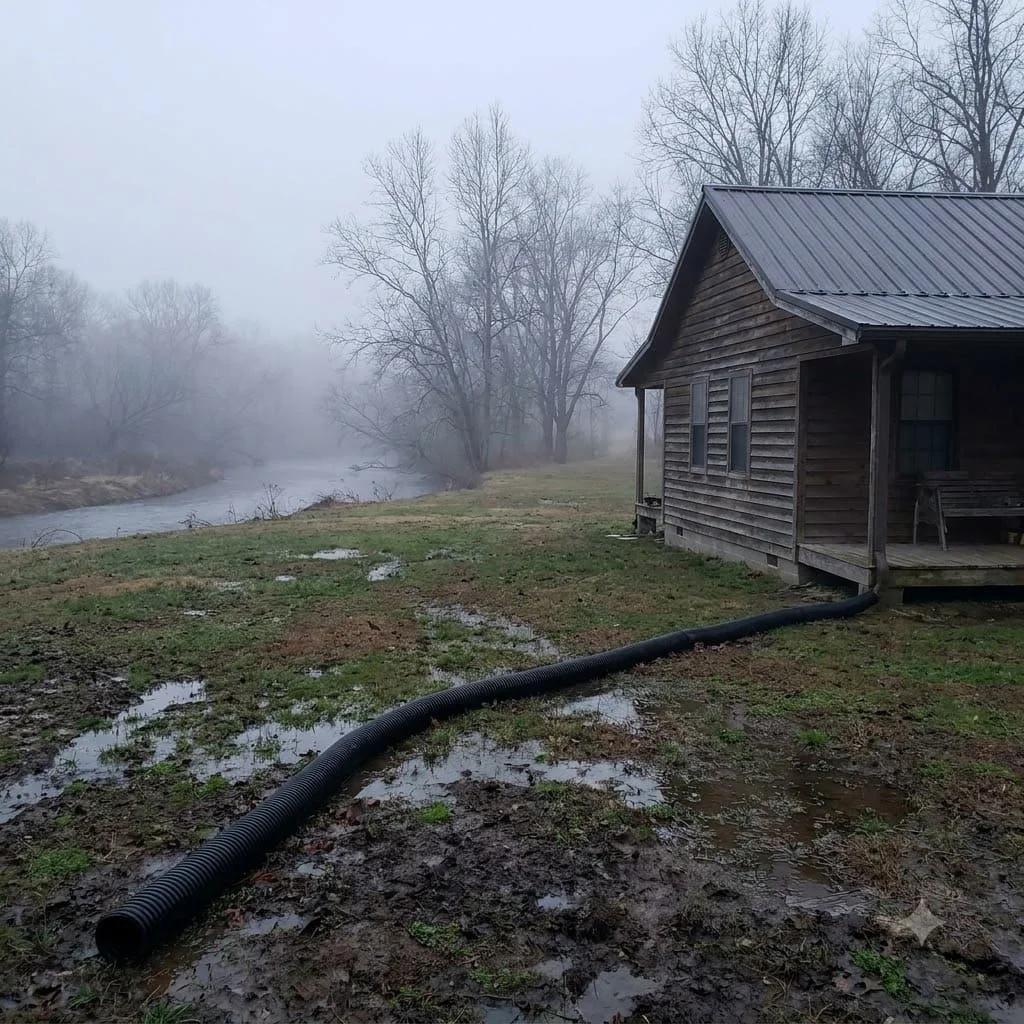
Gutter installation and downspout repair in Beech Island run into a constraint most of the CSRA does not have. This is Savannah River bottomland and river terrace, the water table sits close to the surface across much of it, and the standard advice to bury a drain line and run it to daylight assumes something the ground here often will not give you — somewhere lower for the water to go.
- Outlet levels checked against the water table before any trench
- Surface routing where a buried line would have nowhere to empty
- Discharge spread wide and shallow rather than concentrated
- Extensions carried past the low point, not stopped at it
- Regular Aiken County and South Carolina route
Neighbourhoods and Roads We Cover
Augusta Gutters Pros covers Beech Island as part of the regular South Carolina route. These are the roads and subdivisions we work most often — the Storm Branch and Pine Log corridors through the middle of the community, the Sand Bar Ferry approach from the Augusta side, and the newer subdivisions off them.
- Storm Branch Road
- Sand Bar Ferry Road
- Pine Log Road
- Beech Island Avenue
- Retreat at Storm Branch
- Fox Hollow
- Woodcrest
- Russel Hills
- Riverbend Drive
- Lanier Place
- Blackstone
- Tavelle Place
Frequently Asked Questions
Do you cover Beech Island, SC?
Yes. Beech Island is just across the Savannah River from Augusta in Aiken County, and it is on the regular South Carolina route for Augusta Gutters Pros. That covers Storm Branch Road, Sand Bar Ferry Road, Pine Log Road, and Beech Island Avenue, along with Retreat at Storm Branch, Fox Hollow, Woodcrest, Russel Hills, Riverbend Drive, Lanier Place, Blackstone, and Tavelle Place.
Installation, repair, cleaning, guards, and drainage work are all available. Drainage is the larger share of the work here, because the ground behaves differently from the Georgia side and a discharge arrangement that works in Augusta will not always work in the bottomland.
Why does my buried drain line hold water instead of draining?
Usually because the outlet end is at or below the level the groundwater sits at. A buried line only works if it can empty, and a line that daylights into ground already saturated has nowhere to send what is in it.
The symptom is a line that runs fine for the first few minutes of a storm and then backs up at the downspout, or one that stays full between storms and smells. On low ground the answer is often to stop burying it — a shallow surface route to a point that genuinely drains beats a buried line to a point that does not.
How high is the water table around Beech Island?
It varies a great deal over short distances, which is the point. The ground here runs from sandy river terrace to genuine Savannah River bottomland within a few hundred yards, and the depth to water changes with it and with the season.
The practical way to find out is to dig a test hole at the proposed outlet in a wet week and see what fills it. That is a twenty-minute job that decides whether a drainage design will work, and it is worth doing before the trench rather than after.
What should discharge look like on low, flat ground?
Spread wide and shallow, moving slowly, and as far from the foundation as the lot allows. Where there is no fall to work with, distance and spread are the only two variables left, and both are worth more here than pipe diameter is.
A splash block does not achieve either. A six-foot extension is a minimum rather than a target on flat ground, and where the ground falls back toward the house — which happens more often than people expect on a graded lot — the extension needs to reach past the low point rather than stop at it.
Does the sandy soil here drain well or badly?
Both, depending on how deep you go. The upper layer on a river terrace often takes water quickly, which is why lots here can look well drained after a normal storm. Below it there is frequently a denser layer, and once water reaches that it moves sideways rather than down.
That is why a Beech Island lot can absorb an ordinary rain without a mark and then hold standing water for two days after a heavy one. The surface capacity is real but shallow, and once it fills, the water has to go somewhere across the top of the ground.
Is a rain garden or dry well a sensible option here?
A dry well is usually not, for the same reason a buried line often is not — it depends on the water having somewhere to go downward, and on low ground it frequently does not. A dry well in bottomland is a hole that fills up.
A shallow spread area planted with something that tolerates wet feet is a better fit, because it works by holding and evaporating rather than by infiltrating. It is also the arrangement least likely to fail quietly, since you can see whether it is working.
How often do gutters need cleaning in Beech Island?
Twice a year on most properties, three times where there is heavy pine or river bottom hardwood over the roof. The mixed cover on the older tracts here produces both problems at once — pine straw that packs solid at the outlet, hardwood leaf that adds weight when it saturates.
The autumn clearing is the one that cannot slip. A trough that goes into winter full is a trough that overflows through every storm until spring, and on low ground that overflow lands exactly where you least want extra water.
How much does gutter work cost in Beech Island, SC?
Seamless 5-inch aluminum runs $8 to $14 per linear foot installed and 6-inch oversized runs $12 to $20, the same rates as the rest of the CSRA. A full replacement on a typical 200 ft roofline lands between $1,600 and $4,000.
Drainage is the line that varies most here. Surface extensions run $85 to $190 each, buried lines $18 to $35 per foot where burying is actually appropriate, and a shallow spread or infiltration area $250 to $700 depending on size and planting.
Get a Free Gutter Estimate in Beech Island
We check where the water actually is before designing anywhere to send it, and we will tell you when burying a line is the wrong answer on your lot. Written pricing, no obligation.
Every Gutter Service We Offer in Beech Island
From a single leaky corner to a full replacement, we handle every gutter job across Beech Island and the rest of Aiken County.
New Installations
New seamless aluminum gutters formed on site to fit your roofline exactly — sized for Augusta rainfall, not a national spec sheet.
Learn more →Gutter Repair
Sagging runs, split seams, pulled spikes, leaking miters and pitch problems fixed properly instead of patched with caulk.
Learn more →Cleaning & Pine Straw Removal
Full hand-clearing of troughs and downspouts — the only thing that actually moves packed loblolly pine straw and pollen sludge.
Learn more →Gutter Replacement
Tear-out and full replacement when repair stops making financial sense — including fascia checks most crews skip.
Learn more →Gutter Guards
Micro-mesh gutter guards that stand up to Georgia pine needles, fitted so they stay put and keep your gutters clear.
Learn more →Seamless Gutters
Continuous runs rolled on a truck-mounted machine at your curb — no sectional joints to split open in a summer downpour.
Learn more →Downspout Installation & Repair
Downspouts, extensions and underground drain lines that move water away from Augusta clay instead of into your crawlspace.
Learn more →