
Horse Creek Valley · Bath · Langley

Gutter Installation and Gutter Replacement in Clearwater, SC

Gutter installation and gutter replacement in Clearwater deal with a housing stock the rest of the CSRA mostly does not have. This is Horse Creek Valley mill housing — compact, close together, shallow-pitched, with eaves that barely overhang and rafter tails that in many cases were never boxed in. The question on these houses is not which gutter to buy. It is what there is to hang one from.

  • Fixings worked out for exposed rafter tails and aged fascia
  • Sub-fascia fitted where there is no continuous board
  • Trough set high enough for short eaves and shallow pitch
  • Side-elevation water routed round rather than into the gap
  • Regular Aiken County and South Carolina route
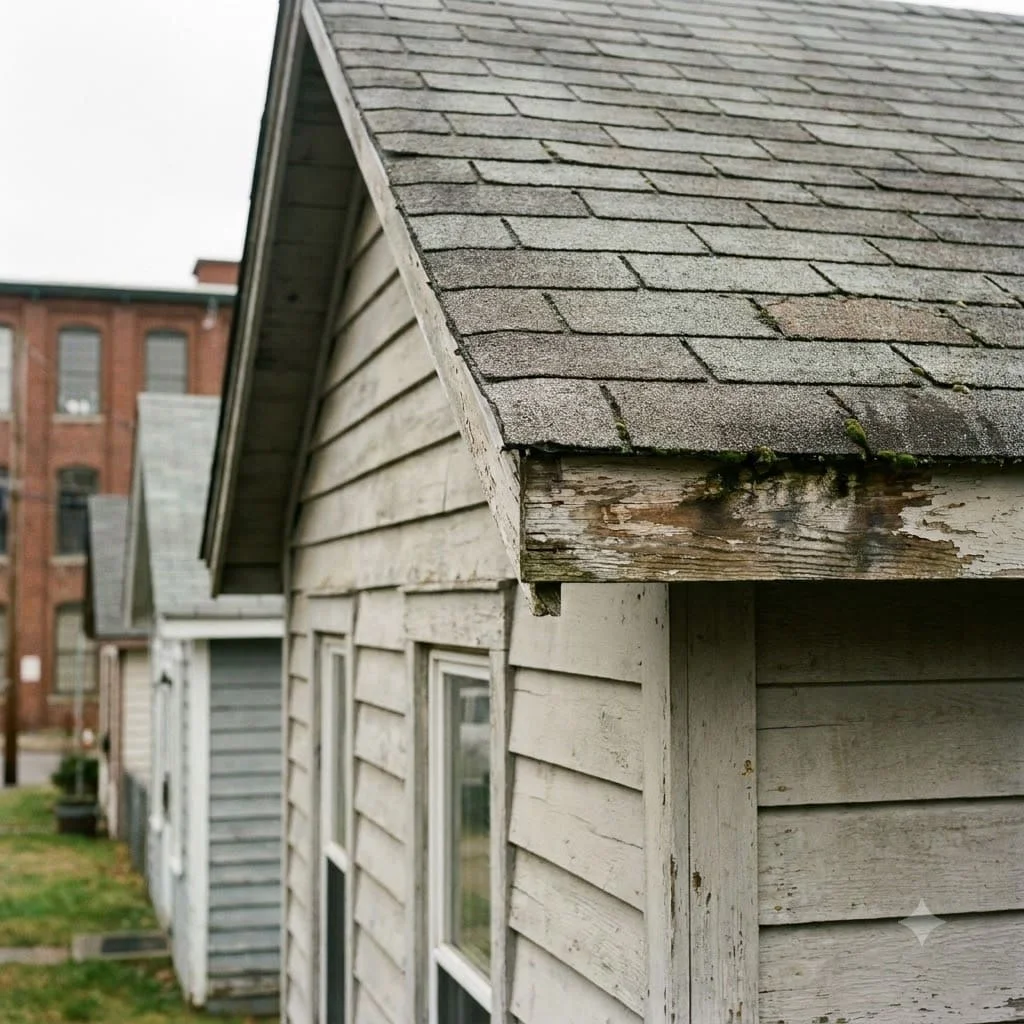
Short eave overhang and narrow original fascia on an early-1900s mill village cottage
Free EstimatesAugusta & Richmond CountySeamless Gutter SpecialistsWritten PricingNo-Pressure Quotes

Clearwater is one of the Horse Creek Valley communities, named for the textile mill that built it, strung along the US 1 and 78 corridor with Bath, Langley, Burnettown, Gloverville, Warrenville, and Graniteville. The valley was mill country and the housing shows it — modest, well built, close together, and in many cases eighty to a hundred years old.

That housing stock is the whole story for gutter work here, because it determines what a gutter can be fastened to. Modern gutter fitting assumes a continuous fascia board of known age screwed to a rafter end. On a mill house you often have neither the board nor the certainty about the wood, and the fitting has to be designed around what is actually there.

When There Is No Fascia to Hang From

Exposed rafter tails are common on housing of this era — the rafter ends project past the wall and were left visible rather than boxed in behind a fascia board. It looks right on the house and it is a genuine complication for a gutter.

A hidden hanger needs something continuous to screw into. Rafter tails are not continuous; they are discrete points at whatever spacing the original carpenter used, which on a house of this age is not always the spacing you would expect. There are two honest answers.

  • Fit a sub-fascia across the tails. A new board fixed to the rafter ends gives a continuous, known-condition fixing for the whole run. This is usually the better value and it is what most of these houses end up with.
  • Fasten to the tails themselves. Wrap-around or roof-mounted hangers fix at the rafter positions rather than between them. This preserves exposed tails where they matter to the look of the house, and it means the hanger spacing is set by the rafters rather than chosen.

What does not work is screwing a hanger into whatever timber is nearest and hoping. It holds for a season and then the run starts to drop between fixings.

Old Board, Several Previous Gutters

Where there is a fascia, its history matters as much as its condition. A board on a ninety-year-old house has usually carried two or three gutter systems, and every one of them put fasteners into the same narrow zone of wood.

Sound on the face, soft an inch in

Paint holds a surface together long after the wood behind it has gone. Probing behind the gutter and at the run ends with a screwdriver takes a minute and tells you what a visual inspection cannot. On this housing stock we do it before every quote.

The practical consequence is that a gutter quote on a mill house should have two numbers in it — the gutter, and the per-foot rate for board work if the board turns out to be soft when the old run comes down. Getting that agreed in writing beforehand is the difference between a fixed price and a conversation on the day. Board work and rehanging are covered on the gutter repair page.

Short Eaves Leave No Margin

Mill housing tends to have overhangs of a foot or less, against two feet or more on a modern house. The gutter therefore sits almost directly above the wall.

Everything a gutter does wrong is worse in that position. An overflow runs down the siding rather than landing clear of it. A leaking joint drips onto the wall. Water getting behind the trough goes into the wall head rather than into open air. On a deep-eaved house these faults are untidy; here they are the reason the paint fails on one elevation and not the others.

The same geometry means positioning has to be right the first time. There is very little tolerance between too high — where sheeting water overshoots — and too low, where it tracks back under the roof edge. On a shallow-pitched roof, which most of these are, the water leaves slowly and close to the edge, which pushes the risk firmly toward the second.

The Drip Edge Detail That Solves It

A drip edge flashing is a strip of metal that runs along the roof edge and overhangs into the trough, so that water leaving the roof has no path back under the sheathing.

Modern roofs have one as standard. A great many mill-era roofs do not, and on a low-pitch roof with a short eave the absence is exactly where the trouble starts — water follows the underside of the roof edge by surface tension, tracks back over the fascia, and gets in behind everything.

Adding one during a gutter replacement is inexpensive, because the trough is off and the roof edge is accessible anyway. It is one of the few genuinely cheap permanent fixes in this trade, and on these houses we add one wherever it is missing. Full replacement detail is on the gutter replacement page, and forming runs on site is covered on the seamless gutters page.

Narrow Lots and Where the Water Goes

Mill villages were laid out tight. The gap between two houses is often a matter of feet, and a downspout on a side elevation has almost no ground to discharge onto before it reaches the boundary.

Discharging into that gap concentrates two roofs' worth of water into a strip that gets no sun and dries slowly, and it puts it against two foundations rather than one. The better arrangement is to carry side-elevation water round to the front or the back — either along the wall at trough level, or through a shallow buried line where a surface route would be in the way.

Where the ground genuinely will not allow either, splitting the roof plane across two outlets at least halves what any one point has to deal with. Sizing and extension detail are on the downspout and drainage page, and the narrow-lot problem is treated at more length on the North Augusta page.

Big Trees and Old Fixings

The older streets in the valley have mature trees on them, which is one of the pleasant things about living here and one of the harder things about maintaining a gutter.

The specific risk on this housing is weight rather than blockage. A trough blocked with saturated hardwood leaf carries several hundred pounds along a run, and where that run is fastened into eighty-year-old wood the weight is what tears it off. Clearing before winter matters more here than in a newer neighbourhood, because a full trough that freezes gains weight again.

Twice a year suits most properties in the valley and three times suits those with mature cover directly over the roof. Details on the pine straw removal page, and micro-mesh guards are worth costing once the runs are sound — but only once, since guards add weight and wind load to whatever is holding them up.

What Gutter Work Costs in Clearwater

Augusta-market guidance rather than an offer. Per-foot rates match the rest of the CSRA. Mill houses are compact, so the trough total is often lower than average — and the preparation total is often higher.

Work Typical Clearwater range
Seamless 5-inch aluminum, installed per foot $8 – $14
Seamless 6-inch oversized, installed per foot $12 – $20
Full replacement, typical 130 ft roofline $800 – $2,400
Fascia board replacement, per foot $8 – $18
Sub-fascia fitted across rafter tails, per foot $10 – $22
Drip edge flashing added, per foot $3 – $8
Rehanging a run on hidden hangers $180 – $350
Routing side-elevation water to front or rear $150 – $420
Additional downspout, each $120 – $240
Gutter cleaning, single-storey house $125 – $250
Micro-mesh guards, installed per foot $15 – $25

How We Handle Gutter Work in Clearwater

  • We look at the eave first. On a mill house, what the gutter fastens to is the first question, so we check it before we quote.
  • Exposed rafter tails handled properly. We add a sub-fascia or use tail-mounted hangers, never screws into whatever wood is nearest.
  • We probe the board. Behind the gutter and at the ends of each run, and you get the per-foot board rate in writing before work starts.
  • We add drip edge where it’s missing. On a short eave with a shallow pitch, it’s what stops water running back behind the gutter.
  • We set the gutter height carefully. On a twelve-inch eave there’s no room for error. Too low and water gets behind it.
  • Side water goes somewhere useful. We don’t dump it into the narrow gap between houses.
  • Hidden hangers every 24 inches. They hold up under this area’s tree cover.
  • We clean up the nails. These are small yards used by kids and pets, so we run a magnet over them before we leave.

Gutter Services Available Across Clearwater

Augusta Gutters Pros treats Clearwater and the Horse Creek Valley as part of the regular South Carolina route rather than an outlying run. Installation, full replacement, repair and rehanging, cleaning, guards, seamless forming on site, and drainage work are all available here, including on porches, additions, and outbuildings.

Along the same corridor we cover Aiken to the east and North Augusta to the west, plus Beech Island south of the river crossing and Augusta itself across it. The full list is on the service areas page, every job type is broken down on the gutter services hub, and sizing and pricing questions are answered in the gutter FAQ. Request a free estimate and we will start at the eave rather than at the price list.

Where we work in Clearwater

Neighbourhoods and Roads We Cover

Augusta Gutters Pros covers Clearwater as part of the regular South Carolina route. These are the areas we work most often — Clearwater itself along the Jefferson Davis Highway and Highway 421, and the neighbouring Horse Creek Valley communities strung along the same corridor.

  • Jefferson Davis Highway
  • Highway 421
  • Clearwater Lake
  • Horse Creek Valley
  • Bath
  • Langley
  • Burnettown
  • Gloverville
  • Warrenville
  • Lynwood
  • Stiefeltown
  • Graniteville
Straight answers

Frequently Asked Questions

Do you cover Clearwater, SC?

Yes. Clearwater sits in the Horse Creek Valley in Aiken County, on the US 1 and 78 corridor between North Augusta and Aiken, and it is on the regular South Carolina route for Augusta Gutters Pros. That covers Clearwater itself along the Jefferson Davis Highway and Highway 421, and the neighbouring valley communities — Bath, Langley, Burnettown, Gloverville, Warrenville, Lynwood, Stiefeltown, and Graniteville.

Installation, replacement, repair, cleaning, guards, and drainage work are all available. A large share of the work here is on mill-era housing, and that housing needs the gutter hung differently from anything built after about 1960.

My house has no fascia board. Can gutters still be fitted?

Yes, and it is a common situation on mill houses. Where the rafter tails are exposed rather than boxed in, there is no continuous board to screw a hidden hanger into, so the fitting has to work with the structure that is actually there.

The two workable approaches are fitting a new sub-fascia board across the rafter tails to give a continuous fixing, or using roof-mounted or wrap-around hangers that fasten to the tails themselves. The first is tidier and usually better value; the second avoids adding a board where the exposed tails are part of the look.

Why do gutters keep pulling off my older house?

Almost always because of what they are fastened into rather than the gutter itself. On a house of this age the board has often been through several gutter systems, each one screwed or spiked into the same zone of wood, and each one leaving the board a little more perforated than it found it.

Add eighty years of water getting behind the trough and the board can be sound-looking on the face and soft an inch in. A new gutter fastened into that will pull away exactly as the last one did. The board has to be assessed and often replaced before anything is hung on it.

The eaves barely overhang. Does that change anything?

It changes where the water ends up. A short eave — and twelve inches or less is normal on mill housing — puts the gutter almost directly above the wall, so any overflow, any leak at a joint, and any water getting behind the trough runs straight down the siding rather than clear of it.

It also means there is very little margin for a mistake in positioning. On a house with a two-foot overhang a slightly misplaced gutter is forgiving. On a twelve-inch eave it is not, which is the main reason these houses reward getting the fitting right rather than getting it cheap.

Can gutters be fitted where the houses are close together?

Yes, but the discharge design has to account for it. Mill village lots are narrow, and a downspout on the side elevation often has only a few feet between the wall and the property line before the water is somebody else's problem.

The usual answer is to bring side-elevation water round to the front or back rather than discharging it into the gap. Where that is not possible, a shallow buried line carrying it through to the rear is better than an extension that simply reaches the boundary.

Are these roofs low pitch, and does that matter?

Many of them are shallower than a modern roof, yes. Low pitch means water leaves the edge slowly and close to the wall rather than being thrown clear, so it is more likely to run back under the drip edge and behind the gutter if the trough is set too low.

The fix is positional. The back edge of the gutter has to sit high enough relative to the roof edge that water cannot track backwards, and a drip edge flashing that overhangs into the trough is the detail that makes it reliable. On an old roof without one, adding it during a gutter replacement is inexpensive and solves the problem permanently.

How often do gutters need cleaning in Clearwater?

Twice a year for most properties in the valley, three times where there is mature hardwood or pine directly over the roof. The older streets here have genuinely large trees on them, which is pleasant to live under and hard on a gutter.

Weight is the specific risk on mill housing. A blocked trough full of saturated leaf carries several hundred pounds along a run, and where that run is fastened into eighty-year-old wood the weight is what tears it off the house. Clearing before winter matters more here than in a newer neighbourhood.

How much does gutter work cost in Clearwater, SC?

Seamless 5-inch aluminum runs $8 to $14 per linear foot installed and 6-inch oversized runs $12 to $20, the same rates as the rest of the CSRA. Mill houses are compact, so 100 to 160 feet is common and a full replacement lands between $800 and $2,400.

What moves a Clearwater total is what has to happen before the gutter goes up. Fascia replacement runs $8 to $18 per foot, and fitting a new sub-fascia across exposed rafter tails runs $10 to $22 per foot depending on the timber and the access.

Get a Free Gutter Estimate in Clearwater

We look at what the gutter will be fastened into before quoting the gutter, because on a mill house that is the part that decides whether it lasts. Written pricing, no obligation.

Call Us Now (706) 441-1723