
Seamless aluminum · rolled on site

Top-Rated Gutter Installation in Augusta, GA

New seamless aluminum formed on a truck at your curb, hung with hidden hangers, and pitched by hand so every run drains where it should. One day on most Augusta homes.

  • Continuous runs with no sectional joints to split
  • Hidden hangers every 24 inches — no spikes
  • Fascia condition assessed before the quote
  • Every run water tested before sign-off
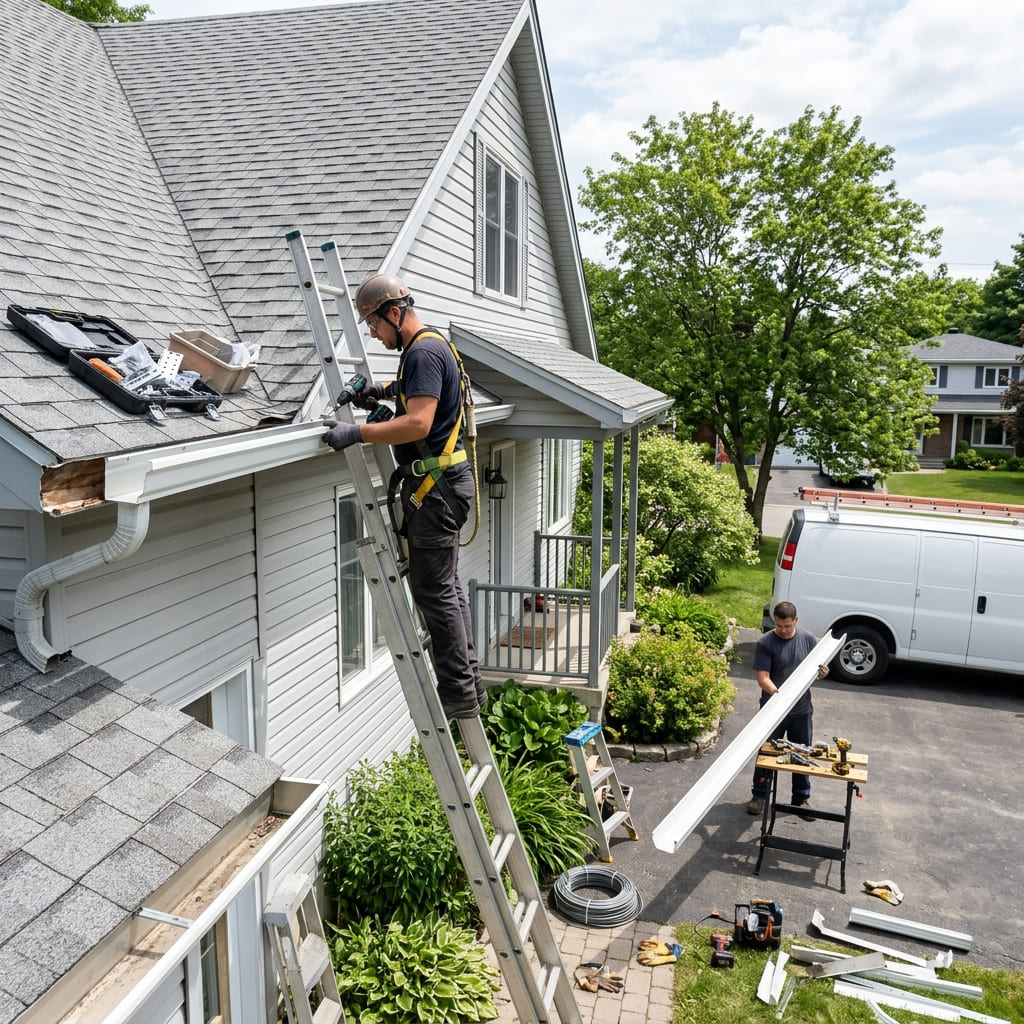
New seamless aluminum gutters installed along the roofline of an Augusta GA home
Free EstimatesAugusta & Richmond CountySeamless Gutter SpecialistsWritten PricingNo-Pressure Quotes

If the front of your house has gutters and the back does not, or the run over the porch has been dumping water on the steps since you bought the place, this is the fix. Gutter installation in Augusta is not complicated work, but it is easy to do badly — and the difference does not show up until the first hard storm or the third summer, when the aluminum starts pulling away from the fascia.

Augusta homes need a drainage system sized for roughly 45 inches of rain a year, most of it arriving in short, intense bursts between June and September. A properly installed system moves that water off the roof, past the foundation, and out into the yard without ever touching brick, siding, or crawlspace. That is the whole job. Everything below is how we get there.

What a Complete Installation Includes

A real install is more than hanging trough. Every quote we write covers the full system, so there is nothing to add later:

  • Seamless K-style trough — roll-formed on site from a single coil of .027 or .032 aluminum, cut to the exact length of each run.
  • Hidden hangers — screwed through the trough into the fascia board every 24 inches, or every 18 inches on long runs and under heavy pine cover.
  • Sealed miters — inside and outside corners either strip-mitered from the same coil or boxed and sealed with butyl, not silicone.
  • Downspouts and drops — 2x3 or 3x4 outlets punched to match the trough size, strapped to the wall, routed away from the foundation.
  • End caps, splash guards, and kickouts — the small pieces that stop water firing over a valley corner or running behind siding at a roof-to-wall junction.
  • Haul-off and cleanup — old aluminum, old spikes, and every screw off the ground.

Color matching matters more than people think on Augusta's older homes. Aluminum coil comes in twenty-plus baked-enamel finishes, and matching trim rather than defaulting to white keeps a Summerville bungalow or an Olde Town Victorian looking like itself.

How We Install Gutters, Step by Step

  1. Measure and assess. Every run gets measured, corners and drops counted, roof pitch noted, and the fascia probed with a screwdriver at the low points where rot starts.
  2. Remove the old run. Old gutter comes down carefully rather than being ripped. Ripping tears fascia, and torn fascia turns a one-day job into carpentry.
  3. Repair what is behind it. Soft fascia gets replaced before anything new goes up. Drip edge gets checked so water lands in the trough instead of behind it.
  4. Roll the trough. The coil feeds through the machine and comes out as one continuous piece the exact length of the run. On a 40-foot side that means zero joints.
  5. Set the pitch and hang. Roughly a quarter inch of fall per 10 feet toward each downspout — enough to drain fully, little enough that it stays invisible from the curb.
  6. Punch outlets and hang downspouts. Drops are placed at the ends of runs and at low points, then strapped and extended away from the wall.
  7. Water test. A hose runs into every trough while you watch. Standing water, slow drains, and drips at miters all show up here — and get corrected here.

Sizing a System for Augusta Rainfall

This is where most builder-grade installs fall short in the CSRA. A gutter is sized by how much water hits the roof in the worst ten minutes of the year, not by the annual total. Augusta's summer thunderstorms routinely drop over two inches an hour, and a 5-inch trough with a single 2x3 downspout on a long, steep run simply cannot swallow that.

Three things push a house up to 6-inch trough and 3x4 downspouts: steep pitch, long unbroken runs, and large roof planes draining to one corner. A steep roof throws water outward with real velocity, which is why so many two-story homes in Evans and West Lake overshoot a narrow gutter entirely during a downpour. Six-inch trough holds roughly 40 percent more water and a 3x4 downspout moves close to double what a 2x3 does.

Pine cover is the other Augusta-specific factor. On heavily wooded lots toward Hephzibah and along the older streets in Forest Hills, the wider 6-inch opening and larger outlet dramatically reduce how often needles bridge and block the drop. If loblollies overhang your roof, that upgrade usually pays for itself in avoided gutter cleaning visits within a few years.

A note on drip edge

If your roof has no drip edge — common on Augusta homes built before the 1980s — water can wick backward off the shingle and run down behind the gutter onto the fascia. New aluminum hung over that condition looks perfect and still rots the board. We check for it every time and tell you plainly if it needs addressing.

What New Gutters Cost in Augusta

Gutter work is priced by the linear foot, plus the drops. These are the ranges Augusta homeowners typically see for a professionally installed seamless system:

System Installed price Best suited to
5-inch seamless aluminum $8 – $14 per ft Most one-story Augusta homes, moderate pitch
6-inch seamless aluminum $12 – $18 per ft Steep or large roofs, long runs, heavy pine cover
Half-round aluminum $16 – $26 per ft Historic homes in Summerville and Olde Town
Copper $30 – $50 per ft Period-correct restorations, architectural detail
Downspouts $8 – $14 per ft Priced separately from trough on most quotes

A typical single-story Augusta ranch carries 160 to 200 feet of roofline, which puts a complete 5-inch system in the $1,400 to $2,600 range. Two-story homes with more corners and taller downspout runs generally land between $2,600 and $4,500.

Four things move a quote: total footage, the number of inside and outside corners, how many downspout drops the layout needs, and whether any fascia has to be replaced first. Nothing else should. If a price changes after the estimate without one of those changing, something was missed on the first visit.

What Separates a Good Install From a Cheap One

Two crews can hang the same aluminum on the same house for prices $900 apart, and both jobs will look identical from the driveway on day one. The difference shows up later, and it comes down to four things.

Hangers versus spikes. Spike-and-ferrule is faster and cheaper. It also works loose as fascia swells and shrinks through Georgia's humid summers and dry winters, which is why so many older Augusta gutters sag in the middle of the run. Hidden hangers with a screw hold indefinitely.

Pitch by eye versus pitch by string. Water that stands in a trough breeds mosquitoes, adds weight, and accelerates corrosion at the seams. Correct fall is measured, not guessed.

Sealant choice. Silicone does not bond to aluminum long-term. Butyl-based gutter sealant does. A miter sealed with the wrong product will weep within two seasons.

Downspout placement. Putting a drop where it is convenient rather than where the water goes is the most common shortcut of all — and in red-clay Augusta, a downspout discharging three feet from a foundation is a future drainage problem, not a finished job.

Areas We Cover Around Augusta

We install throughout Augusta and Richmond County — Summerville, Olde Town, Forest Hills, National Hills, West Lake, Harrisburg, Monte Sano, Daniel Village, Sand Hills, and the neighborhoods out toward Goshen and Lake Olmstead.

Beyond the county line we work regularly in Evans, Martinez, and Grovetown, south into Hephzibah, west to Harlem and Thomson, and across the Savannah River into North Augusta and Aiken, South Carolina. The full list lives on our service areas page, and if your address is not on it, ask — we will give you a straight yes or no rather than a maybe.

Ready to price it out? Request a free on-site estimate and we will measure the roofline, check the fascia, and put a real number in your hands.

Straight answers

Frequently Asked Questions

How long does a gutter installation take?

Most single-story Augusta homes are done in one day, start to finish. The old run comes off in the morning, the new aluminum is rolled and hung by mid-afternoon, and the water test happens before the truck leaves.

Two-story homes, complex rooflines with a lot of corners, or jobs that need fascia carpentry first can run into a second day. You will know which one yours is before we start, not halfway through.

What size gutters do I need in Augusta?

Five-inch K-style handles most one-story Augusta homes with moderate roof pitch. Six-inch trough with 3x4 downspouts is the better call for steep roofs, long unbroken runs, large roof areas draining to a single point, or homes under heavy pine cover.

The calculation is roof area, pitch, and rainfall intensity — not square footage of the house. Augusta gets short, violent downpours, so we size for peak intensity rather than annual average.

Do I need to be home during the install?

No. As long as the installer has clear access to the perimeter of the house and gates are unlocked, the work happens outside entirely. Nobody needs to come indoors.

That said, most homeowners like to be there for the water test at the end so they can watch each run drain and point out anything they want adjusted before we pack up.

What happens to my old gutters?

They come down and get hauled away as part of the job. Aluminum is recyclable, so old runs should go to a metal recycler rather than a landfill — worth confirming that removal is included rather than billed separately.

The other thing to check is a magnet sweep across the beds and driveway at the end. Old spike-and-ferrule systems shed a surprising number of nails, and those end up in tires and bare feet if nobody looks for them.

Can you install gutters on a house that has never had them?

Yes, and it is more common than people expect — especially on older Harrisburg and Turpin Hill homes and on newer builds where the builder only guttered the front elevation.

A bare roofline needs a little more assessment. We check that the fascia is sound and plumb, look at where the ground slopes, and plan downspout drops so water actually leaves the foundation instead of pooling beside it.

How soon can you get out to measure?

It varies with the season and where you are in the service area. Estimates are free and a straightforward home takes about twenty minutes to measure properly.

Spring, right after pollen season, and late fall after the pine straw drops are the two busiest stretches of the year here. Booking ahead of those windows is the best way to avoid waiting.

Ready for Gutters That Actually Drain?

Free on-site measure, honest assessment of the fascia behind the old run, and a written price before anything comes off the house.

Call Us Now (706) 441-1723