
Cost guide · Augusta market rates

How Much Does Gutter Installation Cost in Augusta, GA?

Per-foot rates for every common material, worked totals for the rooflines Augusta actually has, and a plain explanation of why two quotes on the same house land $900 apart.

  • 5-inch seamless aluminum: $8 – $14 per linear foot installed
  • Typical single-story Augusta home: $1,400 – $2,600
  • Typical two-story home: $2,600 – $4,500
  • Six-inch upgrade adds roughly $3 – $5 per foot
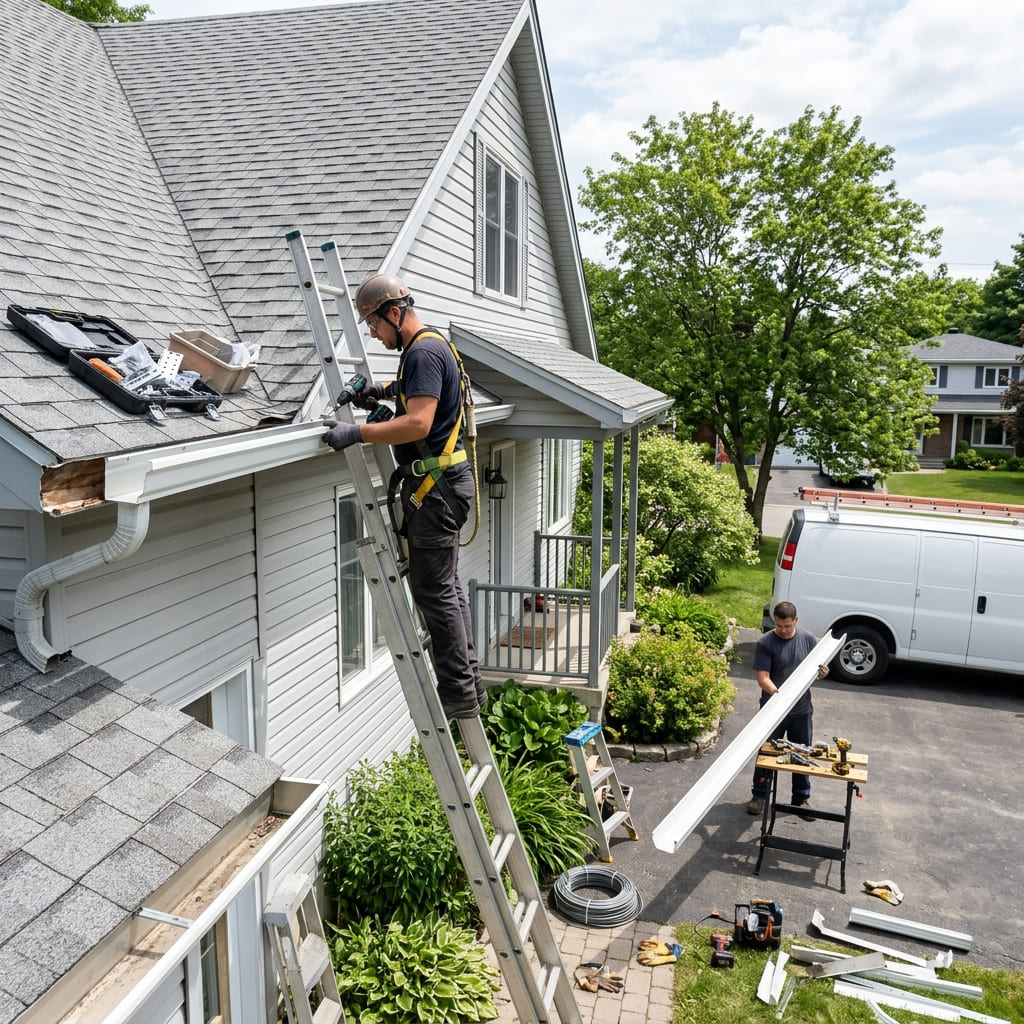
New seamless aluminum gutter being fitted along the fascia of an Augusta, Georgia home
Free EstimatesAugusta & Richmond CountySeamless Gutter SpecialistsWritten PricingNo-Pressure Quotes

The Short Answer

Gutter installation in Augusta, GA costs $8 to $14 per linear foot for 5-inch seamless aluminum, installed. A typical single-story home with 160 to 200 feet of roofline comes to somewhere between $1,400 and $2,600 for the complete system, downspouts included.

Two-story homes carry more corners, longer downspout drops, and harder access. Most of them land between $2,600 and $4,500 for the same 5-inch aluminum.

Those two ranges cover the large majority of houses in Richmond and Columbia County. Everything below explains what pushes a specific house toward the bottom or the top of them — and what a quote outside those ranges is usually telling you.

How Gutter Pricing Actually Works

Gutter work is priced by the linear foot, not by the job. That single fact explains most of the confusion homeowners run into when comparing quotes.

The installer measures every roof edge that needs a trough beneath it, adds up the total footage, multiplies by a rate for the chosen material, then adds downspouts as separate footage running from the roofline to the ground. A few fixed items sit on top: end caps, miters at each corner, outlets, and hangers.

This is why house size alone is a bad predictor of cost. A compact house with a complicated roof can carry more gutter footage than a larger house with a simple rectangle above it. Corners are the specific culprit — every inside and outside miter is a cut, a seal, and a potential future leak, and complex rooflines have many of them.

It is also why you can estimate your own budget before anyone visits. Walk the perimeter, add up the runs sitting under a roof edge, and multiply. That figure will not be exact, but a quote that comes back at double it deserves a question.

A quick way to sanity-check any quote

Divide the quoted total by your rough footage. If the result falls between $8 and $14 for 5-inch aluminum, the pricing is normal for Augusta. Below $8, ask what gauge the aluminum is and how far apart the hangers go. Above $14, ask what the premium covers — sometimes it is a genuine upgrade, sometimes it is not.

Installed Price by Material

Material is the single largest lever on the number. These are the rates that hold across the Augusta market, installed and including hangers, miters, and end caps.

System Installed price Best suited to
5-inch seamless aluminum $8 – $14 per ft Most single-story Augusta homes, moderate pitch
6-inch seamless aluminum $12 – $18 per ft Steep or large roofs, long runs, heavy pine cover
Half-round aluminum $16 – $26 per ft Historic homes in Summerville, Olde Town, and the Hill
Copper $30 – $50 per ft Period-correct restorations and architectural detail
Downspouts $8 – $14 per ft Priced separately from trough on most quotes

Aluminum accounts for the overwhelming majority of gutter installed around Augusta, and for good reason. It does not rust, it takes a baked-on finish that holds colour for decades in Georgia sun, and it can be roll-formed on site into a single continuous length. The upgrade decisions worth thinking about are trough size and profile, not usually a jump to a different metal — the materials guide works through why, including where steel and copper genuinely earn their place.

Vinyl is the one material missing from that table, and its absence is intentional. Sectional vinyl sold in big-box stores is cheap per foot, but it becomes brittle under sustained Georgia UV, sags between hangers in summer heat, and joins every ten feet at a seam that will eventually leak. It is covered in the DIY versus professional comparison, where the real cost of the cheap option gets worked through properly.

What Real Augusta Homes Cost

Per-foot rates are only useful once you attach them to an actual house. These are worked totals for the roofline shapes that show up most often across the CSRA.

Home Roofline System Typical total
Single-story ranch 160 – 200 ft 5-inch seamless aluminum $1,400 – $2,600
Single-story, heavy pine cover 160 – 200 ft 6-inch seamless aluminum $2,000 – $3,400
Two-story, standard 200 – 260 ft 5-inch seamless aluminum $2,600 – $4,500
Two-story, upgraded trough 200 – 260 ft 6-inch seamless aluminum $3,200 – $5,400
Long single-story on acreage 220 – 300 ft 5-inch seamless aluminum $2,000 – $4,200
Single elevation only 40 – 80 ft 5-inch seamless aluminum $600 – $1,400

The pattern worth noticing is that footage matters more than storeys. A long single-story house on a large lot in Hephzibah can carry 280 feet of roofline and cost more than a compact two-story in town, even though the two-story is the harder job per foot. When people are surprised by a gutter quote, it is usually because they were thinking in square footage of living space rather than linear footage of roof edge.

Seven Things That Move Your Number

Two houses with identical footage can quote several hundred dollars apart for entirely legitimate reasons. These are the seven that account for nearly all of it.

  1. Roof height and access. Two-story elevations need taller ladders, longer downspout runs, and slower work. Anything above a walk-out basement on a sloped lot adds the same way.
  2. Corner count. Every miter is a cut and a sealed joint. A roofline with eight corners takes materially longer than a straight run of the same total length.
  3. Roof pitch. Steep pitch means water arrives at the trough faster and with more force, which often pushes the sizing recommendation up and adds hanger density.
  4. Trough size and gauge. Six-inch trough is more aluminum per foot. So is heavier gauge, which resists denting from ladders and falling limbs. Whether your roofline actually needs the wider trough is worked out in the 5-inch versus 6-inch guide.
  5. Downspout count and size. Roof area determines how many outlets the system needs. Under-downspouting is the most common way a system that looks right overflows anyway.
  6. Fascia condition. New gutter should not be screwed into soft board. Where rot is found, board replacement runs $9 to $18 per linear foot, higher on older houses where the rafter tails behind it have gone too.
  7. Tear-out and disposal. Removing an existing system and hauling it away is normally folded into a replacement rate, but it is real work and belongs on the quote so you can see it.

What Is Usually Not in the Base Price

A gutter quote covers gutter. Several genuinely useful things sit just outside it, and knowing which is which stops a quote feeling like it grew after the fact.

  • Gutter guards. A separate purchase at $8 to $25 per foot depending on type. Whether they are worth it on your house is a real question with a real answer — worked through in the gutter guard cost guide.
  • Fascia and soffit carpentry. Quoted separately so you can see what is gutter work and what is woodwork. Any installer who hides carpentry inside a per-foot gutter rate is making it impossible to compare their quote with anyone else's.
  • Underground drainage. Carrying water properly away from the foundation is drainage work, not gutter work. See downspout and drainage installation for how that is priced.
  • Painting or colour-matching trim. Gutter comes in a baked finish. Matching existing trim paint is a different trade.
  • Roof repair. If the drip edge is wrong or shingles are lifting at the eave, that is roofing, and it wants fixing before new gutter goes underneath it.

Why Two Quotes Differ by $900

This is the question that brings most people to a page like this one. Two crews, same house, same aluminum, totals nine hundred dollars apart — and from the driveway both finished jobs look identical.

The gap is almost always in one of four places, and none of them are visible after the ladders come down.

Where the money goes The cheaper version What it costs you later
Aluminum gauge Thinner coil stock Dents from ladders and limbs, and deformation between hangers
Hanger spacing Hangers every 36 in instead of 24 in Sag under wet pine straw, usually visible by year four
Downspout sizing 2x3 downspouts, fewer drops Overflow at the corners in heavy rain and faster clogging
Fascia inspection New gutter screwed onto whatever is there Hangers pulling free of soft board, and hidden rot spreading

A lower quote is not automatically the wrong choice. Sometimes it is a smaller crew with lower overhead doing identical work, and that is a genuine saving. The point is to find out which it is before you sign, because all four of the shortcuts above show up in year four or five rather than year one — long after the cheaper crew has been paid.

Ask the question directly: what gauge is the aluminum, how far apart do the hangers go, how many downspouts, and what happens if you find soft fascia. Any competent installer answers all four without hesitating.

When Installation Is the Wrong Purchase

Not every gutter problem is solved by new gutter, and a quote for a full system is sometimes an expensive answer to a cheap question.

If the trough itself is sound and the problem is sag, loose hangers, a dripping corner, or a detached downspout, that is gutter repair. Most single-issue repairs in the Augusta area run $150 to $400. Replacing spikes with hidden hangers across a run costs $180 to $350 — against $1,400 or more for a new system that would have solved the same symptom.

If the gutters overflow every autumn but hold water fine the rest of the year, the problem is debris load, not capacity. A proper hand clear-out at $150 to $400 fixes it, and the cleaning cost guide covers how often that needs doing under Augusta's pine.

Replacement genuinely is the right call when the aluminum is cracking along the back edge, when you are patching the same run annually, or when the fascia behind it has already gone soft. At that point repair money is being spent on a system that has reached the end of its service life. The gutter replacement page sets out where that line sits.

How to Read a Gutter Quote

A quote that answers all of the following is one you can actually compare against another. A quote that gives you a single number and a signature line is not.

  • Total linear footage of trough, stated
  • Trough size and profile — 5-inch or 6-inch, K-style or half-round
  • Aluminum gauge
  • Hanger type and spacing in inches
  • Number and size of downspouts
  • Where each downspout discharges
  • Tear-out and haul-away, included or extra
  • Fascia condition, and what happens if rot is found
  • Colour and finish
  • What workmanship cover comes with the fitting, in writing

That last one deserves emphasis. Get the workmanship terms in writing before work starts, not after — a verbal assurance about coming back to fix something is worth exactly as much as the paper it is not written on.

Getting a Number for Your Own Roofline

Everything above is designed to let you walk into a quote already knowing where it should land. The remaining variables — your actual footage, your corner count, the condition of the board behind the existing gutter — need someone on a ladder with a tape measure.

Augusta Gutters Pros quotes gutter installation across Augusta, Richmond County, and the wider CSRA, itemised the way the checklist above describes. Call (706) 441-1723, or read how our estimates work before you do. If you are outside Augusta itself, the service areas page lists every town covered, from Evans and Grovetown across to North Augusta and Aiken.

About the prices on this page

Every range here describes what gutter work generally sells for in the Augusta and CSRA market rather than a national average. They show what to expect, not a final offer — your exact price comes from measuring your roofline. The figures were last checked in August 2026; see our terms of service for the full disclaimer.

Straight answers

Frequently Asked Questions

How much does gutter installation cost in Augusta, GA?

Five-inch seamless aluminum runs $8 to $14 per linear foot installed in the Augusta market. A single-story home with 160 to 200 feet of roofline usually lands between $1,400 and $2,600 for a complete system including downspouts.

Two-story homes carry more corners and taller downspout runs, which puts most of them between $2,600 and $4,500. Moving up to 6-inch trough adds roughly $3 to $5 per foot on top of either figure.

How do I work out my own roofline footage?

Walk the perimeter of the house and add up every run that sits under a roof edge, ignoring gable ends where no gutter goes. Most single-story Augusta ranches come out between 160 and 200 feet; most two-storys between 200 and 260.

Multiply that by the per-foot rate for the material you want and you have a working budget. It will not match a measured quote exactly, because corners, downspout drops, and roof pitch all adjust the number, but it will tell you within a few hundred dollars whether a quote is in the right postcode.

Why is one gutter quote $900 cheaper than another for the same house?

Usually gauge, hanger spacing, downspout sizing, or fascia. Thinner aluminum, hangers at 36 inches instead of 24, one downspout where the roof area needs two, and screwing new gutter onto soft board are all invisible from the driveway and all cheaper on the day.

None of those show up in year one. They show up in year four or five as sag, overflow, and a fascia repair that costs more than the saving. A cheaper quote is not automatically a worse one — but it is worth asking which of those four explains the gap.

Is gutter installation cheaper at certain times of year in Augusta?

The rate per foot does not really move seasonally, but availability does. Demand spikes twice a year here — after the February through April pollen season, and again once the pine straw and hardwood leaves come down in late autumn.

Booking outside those two windows generally means more scheduling flexibility. Nobody should promise you a discount for it, but you are choosing from a wider calendar.

Does the price include removing the old gutters?

On a replacement it should, and it is worth confirming in writing. Tear-out and haul-away of the old system is normally folded into the per-foot replacement rate rather than billed separately.

On a house that has never had gutters at all there is nothing to remove, which is why new installation on a bare roofline sometimes prices slightly under a like-for-like replacement.

Should I get 5-inch or 6-inch gutters in Augusta?

Five-inch handles most single-story Augusta rooflines with moderate pitch. Six-inch is worth the extra $3 to $5 per foot on steep roofs, long unbroken runs, large roof areas draining to few outlets, and anything under heavy loblolly cover.

The wider trough matters here for a reason that has nothing to do with rainfall volume: a 6-inch trough with 3x4 downspouts stays functional far longer as pine straw accumulates, because it takes more debris to bridge the opening.

Do gutters add value when selling an Augusta home?

Gutters are rarely a line item a buyer pays extra for, but missing or failing ones show up in inspection reports and become a negotiating point. Water staining on fascia, a damp crawlspace, or erosion at the foundation all trace back to drainage and all cost more to argue about than to fix.

The practical framing is that gutters protect value rather than add it. A sound system keeps water off the foundation, the siding, and the soffit, which is where the expensive damage happens.

Get the Real Number for Your Roofline

These ranges get you close. A measured quote gets you exact — every run counted, every line itemised, in writing and with no obligation.

Call Us Now (706) 441-1723