
Buying guide · Augusta market rates

DIY vs Professional Gutter Installation: An Honest Comparison

What the materials really cost, why the thing you can buy at a store is not the thing a contractor installs, and the specific jobs where doing it yourself is the right call.

  • DIY sectional materials: roughly $4 – $8 per linear foot
  • Professional 5-inch seamless: $8 – $14 per linear foot installed
  • Seamless gutter cannot be bought at retail — it is formed on site
  • Hanger spacing and pitch are what separate the two in year three
Seamless aluminum gutter being roll-formed on site from a coil outside an Augusta home
Free EstimatesAugusta & Richmond CountySeamless Gutter SpecialistsWritten PricingNo-Pressure Quotes

The Short Answer

DIY gutter installation costs roughly $4 to $8 per linear foot in materials. Professional 5-inch seamless aluminum runs $8 to $14 per linear foot installed. On a 180-foot Augusta house that is about $900 in parts against roughly $1,800 to $2,500 for a finished job.

So DIY saves real money — around half. But the two sides of that comparison are not the same product, and the gap is not simply labour. What you can buy at a store is sectional gutter, joined every ten feet. What a contractor installs is one continuous piece formed on your driveway.

That distinction drives everything below, including the honest answer about when DIY is genuinely the better decision.

What DIY Actually Costs

Material lists for gutter jobs tend to be quoted as the trough alone, which understates them considerably. A complete sectional system needs all of the following.

Item Typical retail cost Needed for 180 ft
Sectional aluminum gutter, 10 ft lengths $9 – $16 each 18 lengths
Hidden hangers $3 – $6 each 90 at 24 in spacing
Inside and outside miters $10 – $18 each 6 – 10 typical
End caps $4 – $8 each 4 – 8
Downspout, elbows, and brackets $45 – $90 per drop 4 – 6 drops
Sealant, rivets, screws $60 – $120 total —
Ladder standoffs, if not owned $40 – $80 1

That lands most 180-foot DIY jobs somewhere around $750 to $1,300 in materials, before any tool purchases and before the two full weekends it realistically takes a first-timer. The saving against a professional install is real, but it is closer to forty or fifty percent than the seventy-five percent people often expect.

The Seamless Problem

This is the part of the comparison that most DIY guides skip, and it is the most important thing on this page.

You cannot buy seamless gutter. It does not exist as a shelf product, and no supplier can sell it to you in a box. Seamless gutter is roll-formed on site: a machine on the back of a truck takes a coil of flat aluminum and forms it into a continuous trough cut to the exact length of each run on your house. A 42-foot elevation gets one 42-foot piece.

Sectional gutter — the only kind sold at retail — comes in ten-foot lengths that are joined together on the wall. A 42-foot run needs four joints. Every one of those joints is sealed with a bead of sealant, and every one of them is a place where the system will eventually leak.

It is not a manufacturing defect. Aluminum expands and contracts through Georgia's temperature swing, and a sealed joint is the point where that movement concentrates. Sealant is a consumable with a service life measured in years. The joints do not fail because the work was bad; they fail because that is what joints do.

A seamless system has joints only where they are structurally necessary — the corner miters, the end caps and the downspout outlets. That is typically sixteen to eighteen sealed points on a whole house, against thirty-four or more on a sectional system of the same length, because sectional adds a joint every ten feet along every straight run on top of all of those. The full count is broken down in the seamless versus sectional comparison.

The comparison people actually mean to make

If you are pricing DIY against a quote, the like-for-like comparison is DIY sectional against professionally installed sectional — and there the saving is mostly labour. Against seamless, you are comparing two different systems with different service lives. Both comparisons are valid. They just answer different questions.

Side by Side Over Ten Years

DIY sectional Professional seamless
Upfront cost, 180 ft $750 – $1,300 in materials $1,800 – $2,500 installed
Your time Two weekends, realistically Under a day, not yours
Sealed joints on the house 40 or more 6 – 10, at corners only
Typical first leak Year 3 – 5, at a joint Year 10+, usually at a miter
Colour and finish Limited stock range Wide baked-finish range
If something is wrong Yours to diagnose and redo Workmanship terms, in writing
Risk carried You, on the ladder The contractor

Five Mistakes That Surface in Year Three

DIY gutter jobs rarely fail immediately. They usually look correct on the day and develop problems two or three seasons later, which makes the cause hard to trace. These five account for most of it.

  1. Pitch set by eye. The target is about a quarter inch of fall per ten feet. Judged visually against a fascia line that is itself not perfectly level, it comes out flat or backwards surprisingly often. The symptom is standing water in the trough after rain, which then holds weight and breeds mosquitoes.
  2. Hangers too far apart. Packaging often suggests 36 inches. Under Augusta's wet pine straw load, 24 inches is what holds. The symptom is a visible dip mid-run appearing in year three or four.
  3. Miters sealed but not riveted. Sealant is a gasket, not a fastener. A corner that relies on sealant alone for structural connection opens as the metal moves, and the drip at the corner that persists long after rain is the giveaway.
  4. Downspouts undersized or too few. Roof area determines how many outlets a system needs. Fitting two drops where the roof needs four produces a gutter that works fine in light rain and overflows at the corners in a real Georgia downpour — which reads as a gutter problem but is a drainage-capacity problem.
  5. Screwing into soft fascia. The one that costs the most. Hangers driven into board that has already taken water hold for a season or two, then pull. Probing the fascia before fixing anything to it is standard practice for a reason, and where rot is found the board wants replacing at $9 to $18 per foot before gutter goes back up.

All five are fixable. Most are repair jobs in the $150 to $400 range, which is worth knowing if you have inherited a system with these symptoms rather than built one.

The Ladder Question, Honestly

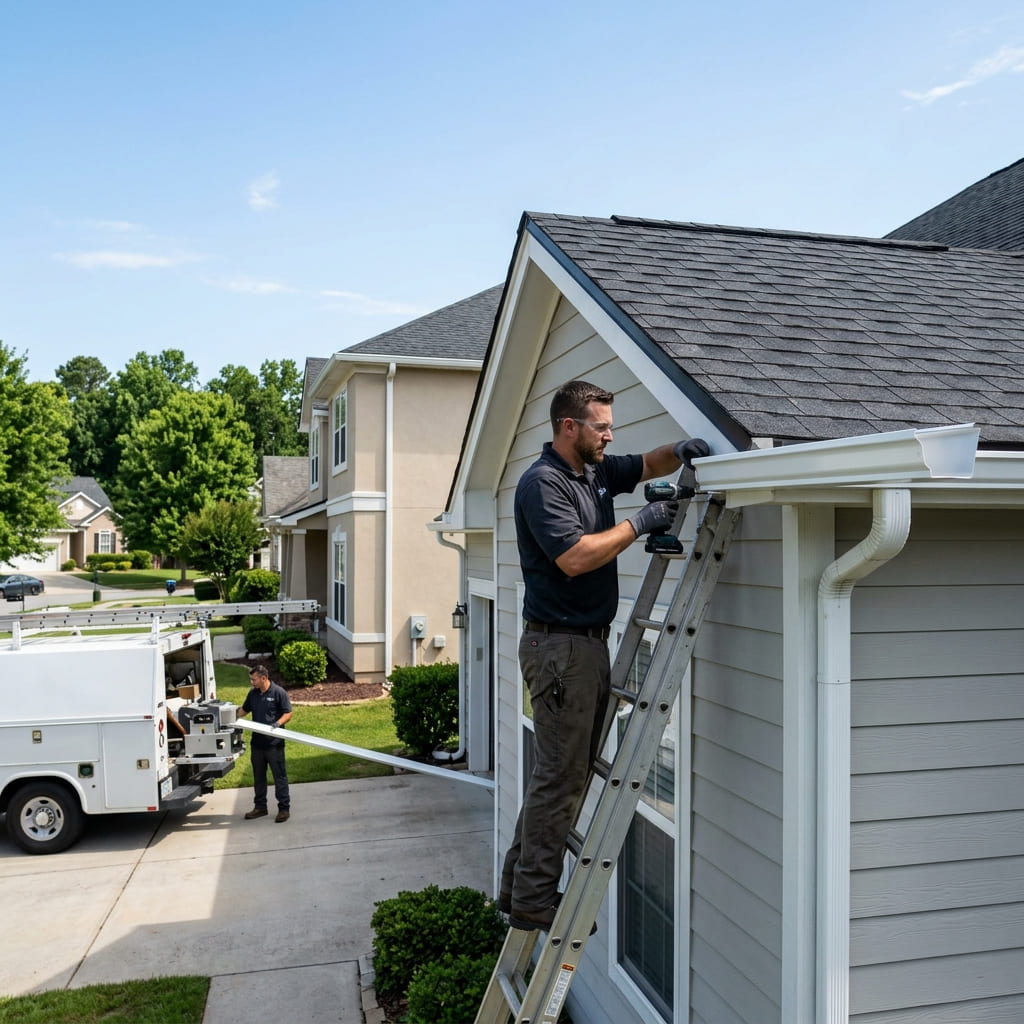
Gutter work happens at the roof edge, with both hands occupied, on a ladder that has to be moved every few feet along the entire perimeter of the house. That is the real reason a lot of people hire this out, and it deserves stating plainly rather than being buried.

Two rules matter more than the rest. Never rest a ladder on the gutter itself — use standoff stabilisers that bear on the fascia or the roof. And never work a ladder set on soft ground, a slope, or a deck board without a level base, which on Augusta's clay lots after rain rules out more positions than people expect.

Height changes the calculation entirely. A single-story ranch with firm level ground and clear access is a reasonable DIY setting. A two-story elevation, a steep pitch, a walk-out basement on a sloped lot, or a run over a conservatory or deck is a different job, and no material saving justifies it.

Where DIY Genuinely Wins

There are jobs where hiring a contractor is the wrong use of money, and pretending otherwise would make everything else on this page less trustworthy.

  • Outbuildings, sheds, workshops, and detached garages. Single-story, simple rectangle, low consequences if a joint weeps. Sectional gutter is entirely appropriate and a contractor callout for thirty feet of trough is poor value.
  • A single short run over a porch or an addition that never got one — common on older houses around Blythe and the rural CSRA.
  • Downspout extensions and splash blocks. Carrying water further from the foundation is genuinely straightforward ground-level work and makes a real difference. See downspout and drainage for what good discharge looks like.
  • Reattaching a loose downspout bracket or replacing a cracked elbow.
  • Seasonal cleaning on a single-story house with safe ladder ground, if you have the equipment and are comfortable at height. The cleaning cost guide covers what you are saving.

The pattern across all five: low height, low complexity, and a defect that would be an inconvenience rather than a water-damage event.

How to Hire Well If You Go Pro

If the house is two-story, the roofline is complex, or the fascia condition is unknown, the decision is usually made for you. What is left is hiring in a way you can actually compare.

  • Get the total linear footage stated on the quote
  • Confirm seamless or sectional, in writing
  • Ask the aluminum gauge
  • Ask hanger type and spacing in inches
  • Confirm the number and size of downspouts
  • Ask where each downspout discharges
  • Ask what happens if soft fascia is found
  • Get the workmanship terms in writing before work starts
  • Confirm tear-out and haul-away is included

Those nine turn three quotes into three comparable quotes. Without them you are comparing three numbers, which is how people end up choosing on price alone and finding out about hanger spacing in year four. The installation cost guide works through what each of those choices does to the total.

Getting a Number to Compare Against

The most useful thing you can do before buying materials is get one measured quote, so the comparison you are making is against a real figure for your actual roofline rather than a range from a web page.

Augusta Gutters Pros quotes seamless gutter installation across Augusta, Richmond County, and the wider CSRA, itemised the way the checklist above sets out. Call (706) 441-1723 or see how estimates work — and if the answer is that your shed does not need us, we will say so.

About the prices on this page

Every range here describes what gutter work generally sells for in the Augusta and CSRA market rather than a national average. They show what to expect, not a final offer — your exact price comes from measuring your roofline. The figures were last checked in August 2026; see our terms of service for the full disclaimer.

Straight answers

Frequently Asked Questions

Is it cheaper to install gutters yourself?

On materials alone, yes. Sectional vinyl or aluminum from a big-box store runs roughly $4 to $8 per linear foot in parts, against $8 to $14 per foot for professionally installed 5-inch seamless aluminum. On a 180-foot house that is around $900 in materials against roughly $1,800 to $2,500 installed.

The comparison is not like-for-like though. What you can buy at retail is sectional gutter, joined every ten feet, and every one of those joints is a future leak. You cannot buy seamless at retail because it is formed on site from a coil.

Can you buy seamless gutters at a hardware store?

No. Seamless gutter is roll-formed on site from a coil of aluminum by a machine that runs off the back of a truck, cut to the exact length of each run. That is the entire point of it — one continuous piece with no joints except at the corners.

Anything sold in ten-foot lengths off a shelf is sectional by definition. It is a legitimate product, but it is a different product, and comparing its price to a seamless quote is comparing two different things.

What tools do I need to install gutters myself?

At minimum: an extension ladder rated for your working height with standoff stabilisers, a chalk line, a level or string line for setting pitch, tin snips, a rivet gun, a cordless drill, a hacksaw, sealant and a gun, and safety glasses.

The tool that matters most is the one people skip — ladder standoffs. Resting a ladder directly on a gutter is how gutters get bent and how people fall, and it is the single most common mistake on a DIY gutter job.

How much pitch do gutters need?

Roughly a quarter inch of fall for every ten feet of run, sloping toward the downspout. Too little and the trough holds standing water; too much and it looks visibly crooked against the fascia line and the water outruns the outlet.

On runs longer than about forty feet, the usual approach is to pitch from a high point in the middle toward downspouts at both ends rather than running the fall the whole way across, which would leave one end unacceptably low.

How far apart should gutter hangers be in Augusta?

Every 24 inches is the standard worth holding to here, and closer under heavy loblolly pine cover. A lot of budget work uses 36 inches, which meets the letter of many manufacturer instructions and sags anyway once wet pine straw loads the trough.

Hidden hangers screwed into the fascia are far better than the old spike-and-ferrule method. Spikes work loose as the board moves through Georgia humidity cycles, which is why so many older CSRA homes have a run pulling away at one end.

Is DIY gutter installation dangerous?

Ladder work at gutter height carries real risk, and it is the honest reason a lot of people hire the job out. The work happens at the roof edge, both hands are occupied, and you are moving the ladder constantly along the run.

A single-story ranch with clear ground around it is a manageable DIY setting. A two-story elevation, a steep pitch, a sloped lot, or anything over a deck or a conservatory is a genuinely different proposition.

Will DIY gutters hurt my home resale value?

Not directly, but visible defects do come up at inspection. Sagging runs, standing water, visible joint leaks, and downspouts discharging against the foundation are all things an inspector notes and a buyer negotiates on.

Neatly executed sectional gutter that drains properly is unlikely to be an issue. The problem is not that it was DIY — it is that the common DIY defects are exactly the ones inspectors look for.

Want a Quote to Compare Against Your Materials List?

Get a measured, itemised price for the same roofline you were about to buy parts for — then decide. No obligation either way.

Call Us Now (706) 441-1723