Church Street · Highway 88 · McBean

Gutter Installation and Gutter Repair in Blythe, GA

Gutter installation and gutter repair in Blythe deal with a housing stock older and smaller than the Columbia County suburbs, and with a pattern that shows up here more than anywhere else in the CSRA — a roofline that is only partly guttered. Half the house was done decades ago, the additions and porches never were, and the water leaving those bare planes is doing the damage nobody attributes to a gutter.

  • Partial gutter systems extended to cover the whole roofline
  • Fascia probed before pricing, not discovered mid-job
  • Low-pitch porch and addition roofs guttered properly
  • Sectional runs replaced with seamless where joints have failed
  • Regular south Richmond County route
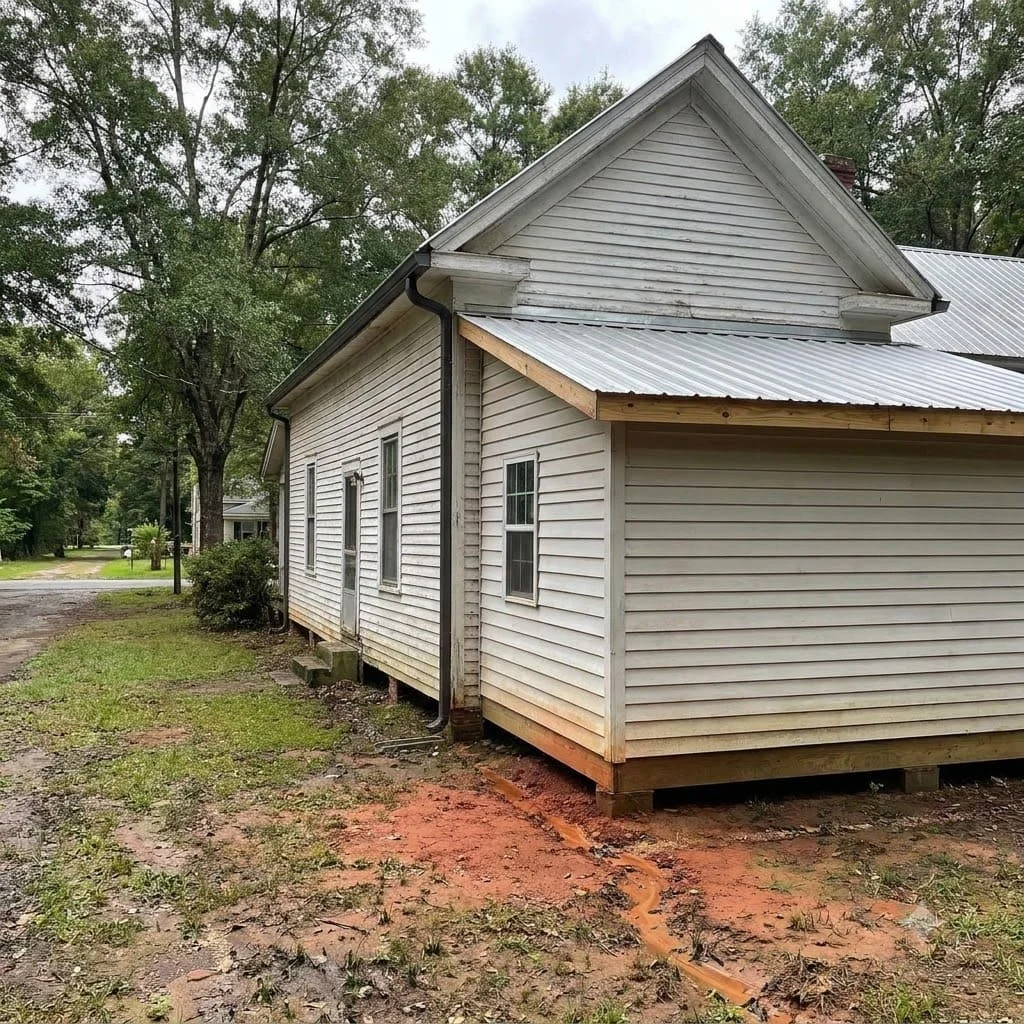
Gutter on the original roofline and none on the rear addition, with erosion below
Free EstimatesAugusta & Richmond CountySeamless Gutter SpecialistsWritten PricingNo-Pressure Quotes

Blythe is a small city where US 1 meets Highway 88, mostly in Richmond County with a corner of it in Burke. It kept its own government through the Augusta–Richmond consolidation, and it has kept its housing stock too — modest houses, a lot of them forty to eighty years old, on lots with room around them.

The defining gutter problem here is not a failed system. It is a system that was never finished. A large share of the older houses in and around Blythe have gutter on part of the roofline and nothing on the rest, and the bare part is almost always the part that was added later.

What a Partial Gutter System Actually Does

It is tempting to treat a bare roof plane as neutral — no gutter, no gutter problem. That is not how the water behaves.

A roof without a gutter does not spread its runoff evenly across the yard. It concentrates it into a line along the drip edge, and that line lands in a strip of soil usually less than a foot from the wall. A thousand square feet of roof sheds roughly 620 gallons in an inch of rain, and on a bare plane every one of those gallons lands in that strip.

The second failure is at the join. A partial system usually ends at an old corner rather than at the end of the roof, so water running along the trough reaches the stub end and goes over it — down the fascia, behind the gutter, into the exact board the whole system hangs from. The partial system is not just failing to protect the rest of the house; it is concentrating damage at its own end point.

Why the Additions Get Missed

The reason is chronological rather than technical. The gutters went on when the house was built or shortly after, the carport was enclosed in the eighties, the back porch got a roof in the nineties, and nobody went back up a ladder to extend the run.

Added roof planes are usually the low-pitch ones

A porch roof or a shed-roofed addition is nearly always shallower than the original roof. Shallow pitch means water leaves slowly and close to the wall rather than being thrown clear, so the bare addition puts more water against the foundation than a bare steep roof would. It is the plane you would gutter first if you were starting over.

Low-pitch planes also need their own detailing. The gutter has to be set higher relative to the roof edge so that sheeting water does not overshoot it, and on a very shallow roof the outlet placement matters more because there is less velocity carrying debris toward it. Both are covered on the new installation page.

Sectional Gutters and the Joint Problem

Where Blythe houses do have gutter, a good proportion of it is sectional — ten-foot lengths joined with slip connectors, which is what was sold before on-site seamless forming became normal.

Every one of those joints is a seam, and every seam eventually moves. Aluminum expands and contracts with temperature across a range that adds up to real movement over a long run, and sealant applied into a joint that is already dirty has a short life. A sectional run of a hundred feet has ten opportunities to leak; a seamless run of the same length has none except at the corners and outlets.

That is the honest case for seamless replacement on an older house, and it is a stronger case than the aesthetic one. Where the fascia is sound and the run is straight, though, rehanging on hidden hangers is a legitimate answer that buys years — the two are not interchangeable, and which one applies depends on the boards.

We Probe the Fascia Before We Price the Job

On a house of this age the fascia decides the price, and it is the part you can’t see from the ground. Paint hides a lot. A board can look fine and still be soft enough to take a screwdriver to the handle. So before we quote, we check it.

  • Behind the gutter, not in front of it. The back face is where trapped water sits, and it fails first.
  • At the ends of every run. Stub ends and outside corners are where overflow collects.
  • Under every valley. A roof valley sends two roof planes’ worth of water to one point, and if the gutter there has ever overflowed, the board below has taken it.
  • The soffit. Staining under the eave means water has been getting behind the gutter for a long time.

Checking the board at the estimate means the price we give you holds, instead of changing halfway through the job. Fascia is the dominant variable across the older housing on this side of the CSRA — it is treated at length on the Thomson page, where it is the whole job rather than one line in it.

Sandy Soil Hides What Clay Would Show You

Blythe sits on the fall line, and much of the soil around it drains faster than the heavy clay further inland. That sounds like an advantage and in one narrow sense it is — you do not get the standing puddle beside the wall that a clay lot gives you after every storm.

The trouble is that the puddle is the warning. Where the ground takes water quickly, concentrated discharge beside a foundation moves downward beside the footing instead of standing where it can be seen, and the first symptom is often a settled strip of soil, mulch that keeps vanishing from one spot, or a crawl space that smells damp for a week after heavy rain.

The remedy does not change with the soil type. Get the discharge a real distance from the wall — six feet minimum on a surface extension, further where the ground falls back toward the house. Sizing, fall, and extension detail are covered on the downspout and drainage page.

Cleaning on a Tree-Cover Schedule

Blythe is mixed ground. Some properties sit under genuine loblolly cover and some sit on open lots with nothing over the roof at all, and the right clearing schedule differs by a factor of three between them.

Pine straw is the debris that decides it. It is thin, stiff, three to six inches long, and it does not wash through — it threads into a mat and packs solid at the outlet, so a trough can look passable from the ground and still be blocked where it matters. Hardwood leaf is a weight problem rather than a flow problem, and on an older run on spike fasteners weight is what pulls it away from the board.

Two clearings a year suits most Blythe properties, three where pine or oak overhangs the roof, and one is genuinely enough on an open lot. Where access is awkward or the schedule keeps slipping, micro-mesh guards are worth costing — with the usual precondition that the runs have to be sound first, because guards add weight and wind load to whatever is already up there. Regular clearing is covered on the pine straw removal page.

What Gutter Work Costs in Blythe

Augusta-market guidance rather than an offer. Per-foot rates match the rest of the CSRA. What moves a Blythe total is fascia condition and how much of the roofline is currently uncovered.

Work Typical Blythe range
Seamless 5-inch aluminum, installed per foot $8 – $14
Seamless 6-inch oversized, installed per foot $12 – $20
Full replacement, typical 160 ft roofline $1,000 – $3,000
Extending a partial system, per added roof plane $350 – $900
Fascia board replacement, per foot $8 – $18
Rehanging a run on hidden hangers $180 – $350
Resealing corners and outlets $95 – $220
Additional downspout, each $120 – $240
Downspout extension run away from the wall $85 – $190
Gutter cleaning, single-storey house $125 – $250
Micro-mesh guards, installed per foot $15 – $25

How We Handle Gutter Work in Blythe

  • We quote the whole roofline. Not just the part that already has gutters. Porches and additions without gutters are usually where the damage is.
  • We probe the fascia. Behind the gutter, at the ends of each run, and under the valleys, before we give you a price.
  • You get the fascia rate up front. If the board is soft once the old gutter comes down, you already have the per-foot price in writing.
  • Seamless gutters. On a long run every joint is a future leak, so we keep the joints to the corners.
  • Hidden hangers every 24 inches. They hold up under this area’s debris load where spikes pull loose.
  • Porch and addition roofs set right. Low-pitch roofs need the gutter hung differently from the main roof, and we set them accordingly.
  • Water at least six feet from the wall. Further where the ground slopes back toward the house.
  • We clean up the nails. We run a magnet over the yard after old spike systems come down.

Gutter Services Available Across Blythe

Augusta Gutters Pros treats Blythe as part of the regular south Richmond County route rather than an outlying run. Installation, full replacement, repair and rehanging, cleaning, guards, seamless forming on site, and drainage work are all available here, including on carports, porches, and outbuildings.

North of here we cover Hephzibah and Augusta itself, and south we cover Waynesboro in Burke County and Wrens in Jefferson County, all of which share the same older housing stock. The full list is on the service areas page, every job type is broken down on the gutter services hub, and sizing and pricing questions are answered in the gutter FAQ. Request a free estimate and we will measure the whole roof, not the part that already has something on it.

Where we work in Blythe

Neighbourhoods and Roads We Cover

Augusta Gutters Pros covers Blythe as part of the regular south Richmond County route. These are the roads and areas we work most often — the streets inside the city itself, the Highway 88 and Deans Bridge corridors either side of it, and the rural property running out toward McBean and the Burke County line.

  • Church Street
  • Highway 88
  • Deans Bridge Road
  • Story Mill Road
  • Hephzibah–McBean Road
  • Brothersville Road
  • Mims Road
  • Windsor Spring Road
  • McBean
  • Burke County line
Straight answers

Frequently Asked Questions

Do you cover Blythe, GA?

Yes. Blythe sits about twenty miles south of downtown Augusta where US 1 and Highway 88 meet, mostly in Richmond County with part of the city crossing into Burke County. It is on the regular south Richmond route for Augusta Gutters Pros, along with Church Street, Story Mill Road, Brothersville Road, Mims Road, and the properties running out toward McBean and the Burke County line.

Installation, repair, replacement, cleaning, guards, and downspout work are all available here. The most common call in Blythe is not a failed gutter — it is a roofline that was only ever half guttered in the first place.

Half my house has gutters and half does not. Does that matter?

It matters more than most people expect, because a bare roof plane does not simply stay neutral. It drips a concentrated line along the drip edge into one narrow strip of soil, and that strip is usually within a foot of the foundation.

The other problem is that the guttered half often ends in a stub that stops at an old corner rather than at the end of the roof. Water runs past the end of the run, sheets down the fascia, and rots the exact board the gutter is fastened to. Completing a partial system is usually cheaper than repairing what a partial system quietly damages.

Why do additions and back porches get left out?

Because they were built after the gutters were, and nobody went back. A great many Blythe houses have a carport that became a room, a back porch that got a roof, or a shed dormer added at some point in the last forty years, and the guttering stops where the original roofline stopped.

These added planes are also the ones most likely to be low pitch, which means the water leaves slowly and in a wide sheet rather than being thrown clear. A low-pitch addition without a gutter puts more water against the wall than a steep original roof would.

The gutters are old but they still work. Repair or replace?

The deciding factor is not the gutter, it is what it is fastened to and how many joints it has. A sectional gutter from the seventies or eighties has a joint every ten feet, and every one of those joints is a seam that will leak eventually no matter how many times it is sealed.

If the fascia is sound and the run is straight, rehanging on hidden hangers buys years. If the fascia is soft, if the run has more than a couple of resealed joints, or if it is still on spike-and-ferrule fasteners that have worked loose, replacement with a seamless run usually costs less over a decade than the repair sequence that leads to it.

How do I tell whether the fascia board is still good?

Push a screwdriver or an awl into it, behind the gutter and at the ends of the run where water is most likely to have got in. Sound wood resists. Wood that has had water on it for years takes the point with almost no pressure, and often the paint film is the only thing holding the surface together.

This is worth doing before anyone prices the job rather than after. A board that has had water on it for years needs probing before anyone quotes, because fascia replacement changes the number substantially and finding it halfway through the work is how a fixed price becomes a variation.

Does the sandy soil around Blythe hide drainage problems?

It can. Sandy fall-line soil takes water quickly, so the puddle that would appear on clay never forms and the problem looks solved from the surface. What is actually happening is that the water is moving down beside the footing rather than standing where you can see it.

The signs to look for are indirect — a strip of soil beside the wall that has settled lower than the rest, mulch that keeps disappearing from one spot, or a crawl space that smells damp after a heavy week. Discharge carried a genuine distance from the wall is the answer regardless of how fast the ground drains.

How often do gutters need cleaning in Blythe?

Twice a year on most properties here, with autumn the one that cannot be skipped. Blythe is not as densely wooded as the north of the county but there is enough loblolly through the area to matter, and pine straw is the debris that blocks outlets rather than simply filling the trough.

Properties with pine or oak directly overhanging the roof are a three-clearing case. Properties on open ground with nothing over the roofline often manage on one. The tree cover, not the calendar, sets the schedule.

How much does gutter work cost in Blythe, GA?

Seamless 5-inch aluminum runs $8 to $14 per linear foot installed and 6-inch oversized runs $12 to $20, the same rates as the rest of the CSRA. Blythe houses are often smaller than the county average, so 120 to 200 feet is common and a full replacement lands between $1,000 and $3,000.

The line that moves a Blythe total most is fascia. Replacing rotten board runs $8 to $18 per foot depending on what is behind it, and extending a partial system to cover porches and additions runs $350 to $900 for a typical added roof plane.

Get a Free Gutter Estimate in Blythe

We measure the whole roofline rather than the part that already has a gutter on it, probe the fascia before pricing, and put the numbers in writing. No obligation and no pressure.

Call Us Now (706) 441-1723