
Cost guide · Augusta market rates

Gutter Guard Cost in Augusta: Are They Worth It?

Installed prices by guard type, the payback period worked through properly, which designs actually handle loblolly pine, and the five Augusta homes that should not buy guards at all.

  • Aluminum screen: $8 – $12 per linear foot installed
  • Stainless micro-mesh: $15 – $25 per linear foot installed
  • Premium reverse-curve: $25 – $40 per linear foot installed
  • Typical 180 ft home in micro-mesh: $2,700 – $4,500
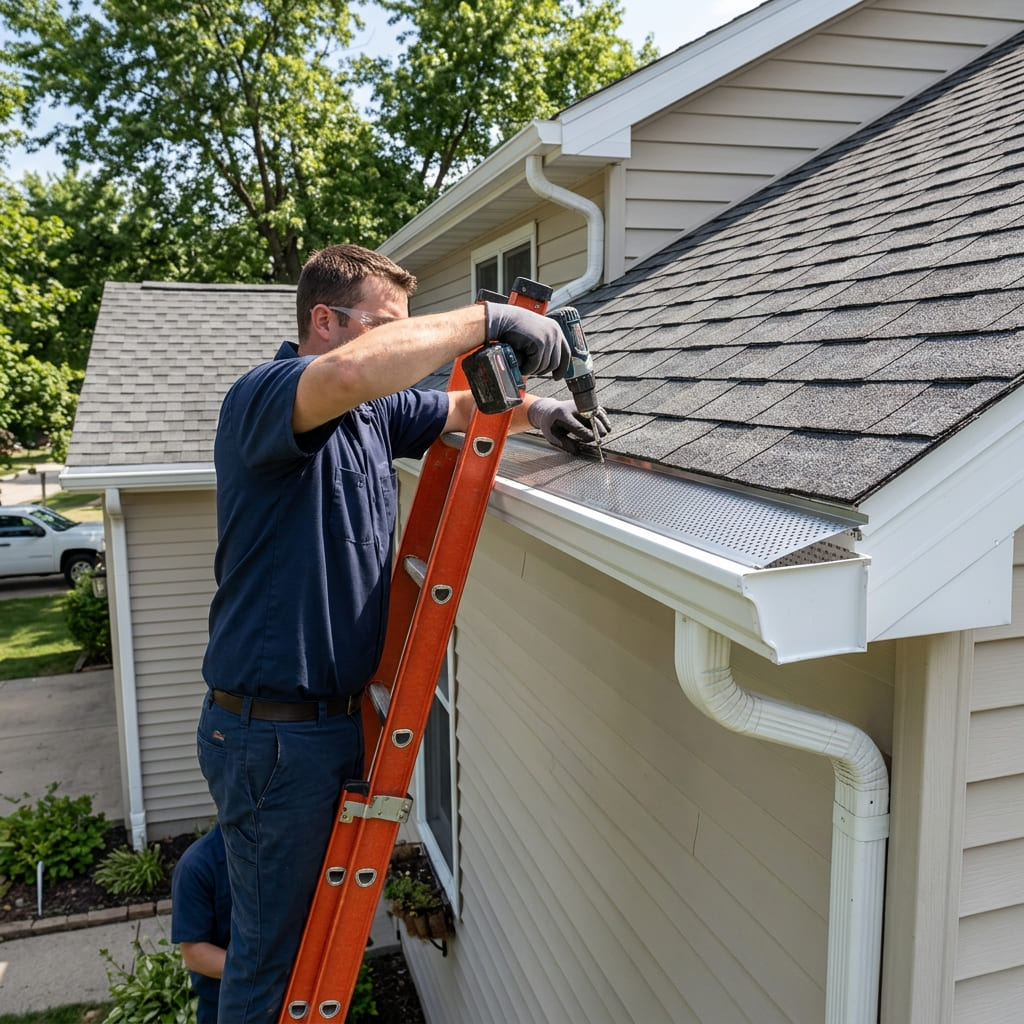
Stainless micro-mesh gutter guard fitted over a gutter beneath heavy pine cover
Free EstimatesAugusta & Richmond CountySeamless Gutter SpecialistsWritten PricingNo-Pressure Quotes

The Short Answer

Gutter guards in Augusta cost $8 to $12 per linear foot for aluminum screen, $15 to $25 for quality stainless micro-mesh, and $25 to $40 for premium branded reverse-curve systems. On a typical 180-foot Augusta roofline, micro-mesh comes to $2,700 to $4,500 installed.

Whether they are worth it is a genuinely different question, and the honest answer is that it depends on one variable more than all the others combined: what is growing over your roof.

Under heavy loblolly pine, where a house needs three or four cleanings a year, guards make sense. On an open lot needing one cleaning a year, they do not, and no framing of the numbers changes that. This guide gives you enough to work out which of those two houses you own.

Installed Cost by Guard Type

Guard type Installed per ft Performance under pine
Stainless micro-mesh $15 – $25 Strong — the only type that reliably excludes needles
Premium branded reverse-curve $25 – $40 Variable — sheds leaves well, needles can ride the curve in
Aluminum screen $8 – $12 Partial — stops leaves, passes needles
Foam insert $4 – $8 Poor — becomes a wick that holds needles and grit
Brush insert $3 – $7 Poor — needles thread into the bristles and stay
Vinyl or plastic screen $3 – $6 Poor — degrades in Georgia UV, sags, then holds debris

The bottom three rows are the reason this market has a reputation problem. They are cheap, they are widely sold, and under Augusta's debris load they make the situation worse rather than better — a trough that holds needles behind a foam insert is harder to clear than one that was left open.

The Payback Maths, Run Honestly

Guard companies tend to present payback as obvious. It is not, and working it through properly is the single most useful thing on this page.

Take a two-story Augusta home with 180 feet of roofline under heavy pine. It currently needs four cleanings a year at roughly $300 each, so $1,200 annually. Fitting quality micro-mesh at $20 per foot costs $3,600. After fitting, it still needs one lighter maintenance visit a year at around $200.

Scenario Cleaning cost per year Annual saving Years to recover $3,600
Heavy pine, two-story, 4 cleans to 1 $1,200 → $200 $1,000 About 3.6 years
Moderate pine, single-story, 3 cleans to 1 $600 → $150 $450 About 8 years
Some hardwood, single-story, 2 cleans to 1 $400 → $150 $250 About 14 years
Open lot, single-story, 1 clean to 1 $200 → $150 $50 Never, in practical terms

Read that table honestly and the conclusion is uncomfortable for anyone selling guards: on cleaning savings alone, guards only clearly pay back on homes with genuinely heavy debris load. Row one works. Row two is marginal against the service life of the gutter underneath. Rows three and four do not work at all.

Any company that tells you guards pay for themselves in two years on an average Augusta home is either using inflated cleaning prices or assuming a cleaning frequency you do not have. Ask them to show you the arithmetic with your actual numbers in it.

What Guards Buy Beyond Savings

The payback table is not the whole argument, and treating it as such undersells guards on the homes where they genuinely belong. Three things sit outside the arithmetic.

  • Nobody goes up a ladder four times a year. For a lot of homeowners this is the actual purchase. Falls from ladders are the serious risk in gutter maintenance, and removing three of four annual ladder events has a value that does not appear in a cost table.
  • The gutter stops carrying standing weight. A trough packed with wet pine straw is heavy, and that weight is what pulls hangers, sags runs, and eventually sends water behind the gutter onto the fascia. A guarded system that never loads up avoids the failure sequence that costs far more than cleaning.
  • Overflow events stop being seasonal. Between cleanings, an unguarded gutter under pine spends part of every year partially blocked. Water going over the front edge during that window lands at the foundation, which is where expensive problems start.

That second point is the strongest case for guards on a house that has already had hangers pull once. The failure is not hypothetical there — it has already happened, and the debris load that caused it has not changed.

Which Designs Survive Loblolly Pine

Most gutter guard marketing is written for markets that deal with leaves. Augusta does not primarily deal with leaves, and that single difference invalidates a lot of otherwise reasonable product claims.

A pine needle is roughly two to three millimetres across and several inches long. It is thin enough to pass through anything with a coarse aperture and long enough to bridge across gaps and build a mat on top of anything finer. Products are effectively sorted by how they handle that geometry.

  • Stainless micro-mesh has an aperture smaller than a needle's diameter, so needles cannot enter. They sit on the surface and are largely shed by wind and rain, with the residue clearing in one maintenance visit. This is the design that works here.
  • Reverse-curve systems rely on surface tension carrying water around a curved nose while debris falls past. It works well with leaves. Needles are light and straight enough to sometimes follow the water around the curve and into the trough, which is the failure mode to ask about specifically.
  • Aluminum screen has an aperture far larger than a needle. It genuinely stops leaves, twigs, and the tennis ball, and it will extend your cleaning interval. It is not a pine solution and honest suppliers do not present it as one.
  • Foam and brush inserts fill the trough with something needles can embed into. Under loblolly they convert an easy clear-out into an awkward one.

Frame material matters as much as mesh. Plastic-framed mesh sags between supports in Georgia summer heat, and a sagged panel holds a pool of needles at every low point. Rigid aluminum or stainless frames do not.

The valley question

Roof valleys concentrate an entire slope's runoff and debris onto a few feet of gutter. Guards do not change that, and a valley discharging directly onto mesh will overwhelm it. A valley diverter, at $60 to $140 each, is what handles it — and its absence from a guard quote on a house with prominent valleys is a sign the roofline was not properly walked.

Five Homes That Should Not Buy Guards

This section exists because the alternative — pretending guards suit everyone — is how this product category earned its reputation.

  1. Open lots with little tree cover. One cleaning a year does not justify a four-figure install. Keep cleaning.
  2. Gutters already at the end of their service life. Fitting guards over aluminum that is cracking along the back edge spends good money protecting something due for replacement. Replace first, guard afterwards if it still makes sense.
  3. Sagging or badly pitched runs. A guard locks in whatever is underneath it. Fix the pitch and hangers first — otherwise the panel has to come off before anyone can reach the real problem.
  4. Homes being sold within a year or two. Guards rarely return their cost in sale price, and the payback periods above assume you are still there to collect the savings.
  5. Undersized gutters. If the trough overflows in heavy rain even when clean, the problem is capacity, not debris. Guards will not fix it and may make it marginally worse. Sizing up to 6-inch is the actual answer — see the installation cost guide for what that costs.

What Has to Happen Before Fitting

Guards go onto a working gutter system. Three things need confirming first, and a quote that skips them is quoting a different job than the one your house needs.

  • A full clear-out and inspection. Whatever is in the trough on fitting day stays there, sealed under a panel. This should be included, not billed as an extra.
  • Hanger condition. Guards add weight and wind load. Spikes that have already worked loose need replacing with hidden hangers first, at $180 to $350 per run.
  • Pitch check. A run holding standing water after clearing is pitched wrong. Guarding it means the standing water becomes permanent and unreachable.

Questions to Ask Any Guard Company

  • What is the mesh aperture, in microns or millimetres?
  • What is the frame made of — aluminum, stainless, or plastic?
  • How does this product handle pine needles specifically?
  • Is the pre-fitting clean-out included in this price?
  • How does the panel come off when maintenance is needed?
  • Are valley diverters included where the roofline needs them?
  • How often will this still need a maintenance visit?
  • What does the fitting workmanship cover, in writing?
  • Does fitting this affect any existing roofing cover?

That fifth question separates serious products from sales pitches. Everything eventually needs reaching, and a guard designed so that it cannot be removed without damage is a guard that will be cut off rather than serviced.

Working Out Whether Guards Fit Your Roof

The variable that decides this is your debris load, and that is genuinely not something you can settle from a web page. It takes someone looking at what is over the roof, what is in the trough, and what the hangers are doing.

Augusta Gutters Pros fits gutter guards across Augusta and the CSRA, and will tell you plainly where the numbers do not support it — the payback table above is the same one we work from. Call (706) 441-1723, read the full gutter guards page for how different systems are fitted, or compare against the ongoing cost in the gutter cleaning cost guide. Homes under the heaviest pine cover tend to be in the newer subdivisions around Evans and the wooded lots out toward Appling.

About the prices on this page

Every range here describes what gutter work generally sells for in the Augusta and CSRA market rather than a national average. They show what to expect, not a final offer — your exact price comes from measuring your roofline. The figures were last checked in August 2026; see our terms of service for the full disclaimer.

Straight answers

Frequently Asked Questions

How much do gutter guards cost in Augusta?

Installed pricing generally runs $8 to $12 per linear foot for aluminum screen, $15 to $25 for quality stainless micro-mesh, and $25 to $40 for premium branded reverse-curve systems.

On a typical Augusta home with 180 feet of roofline, that puts micro-mesh somewhere between $2,700 and $4,500. It is a real investment, which is why it only makes sense on homes with genuinely heavy debris load.

Are gutter guards worth it in Augusta?

On a home under heavy loblolly pine that currently needs three or four cleanings a year, usually yes — though the payback period runs to several years rather than one or two, and the stronger argument is avoided ladder work and avoided water damage rather than pure cleaning savings.

On an open lot with little tree cover that needs one cleaning a year, almost certainly not. The maths does not work, and no amount of sales framing makes it work.

Do gutter guards mean I never have to clean my gutters again?

No. Any company promising that is overselling. Good micro-mesh keeps the trough itself clear, but the mesh surface still collects pine straw and pollen, and roof valleys still concentrate debris onto one point.

The realistic outcome is a move from three or four full cleanings a year down to one lighter maintenance visit. That is a genuine saving, but it is not zero.

Which gutter guards work best for pine needles?

Stainless micro-mesh, by a clear margin. Pine needles are thin enough to pass straight through screen, brush, and most foam inserts, which is why products that perform adequately against oak leaves fail against loblolly.

The specification that matters is the aperture and the frame material. Surgical-grade stainless mesh on a rigid frame sheds needles; plastic mesh sags and eventually holds them.

Can gutter guards be fitted to my existing gutters?

Usually, provided the existing system is sound. The trough needs to be properly pitched, firmly hung, and not already sagging, because fitting guards over a failing gutter locks in the problem behind a panel that now has to come off to reach it.

That is why a condition check comes before any guard quote. Where hangers need replacing first, that runs $180 to $350 per run and is quoted separately.

Do gutter guards cause ice dams?

This is a common warning lifted from northern markets and it has very little relevance in Augusta. Sustained freeze-thaw cycling of the kind that builds genuine ice dams is not a normal part of a CSRA winter.

The local version of the concern is worth knowing though: a hard freeze on a guard already loaded with wet pine straw can hold weight on the front edge of the trough. Keeping the mesh clear going into winter handles it.

What is the cheapest gutter guard that actually works?

Aluminum screen at $8 to $12 per foot is the entry point that is still worth fitting. It stops leaves and larger debris and will not degrade in Georgia UV the way plastic does.

It will not stop pine needles. Under loblolly cover, screen buys you a longer interval between cleanings rather than a solution, and the foam and brush inserts at $3 to $8 per foot buy less than that — foam in particular becomes a wick that holds needles and grit in the trough.

Find Out Whether Guards Make Sense on Your Roof

We will tell you if they do not. A walk of the roofline, an honest read on your debris load, and a written price with no pressure attached.

Call Us Now (706) 441-1723