
Types & materials · Augusta, GA

Half-Round vs K-Style Gutters: Pros and Cons

One profile carries more water. The other clears itself better and is what belongs on a period house. The trade-off is genuine, and on a pine-covered CSRA lot it does not resolve the way most comparisons assume.

  • K-style carries more water at working depth
  • Half-round clears better — no flat bottom, no corners
  • Half-round aluminum: $16 – $26 per ft installed
  • K-style 5-inch aluminum: $8 – $14 per ft installed
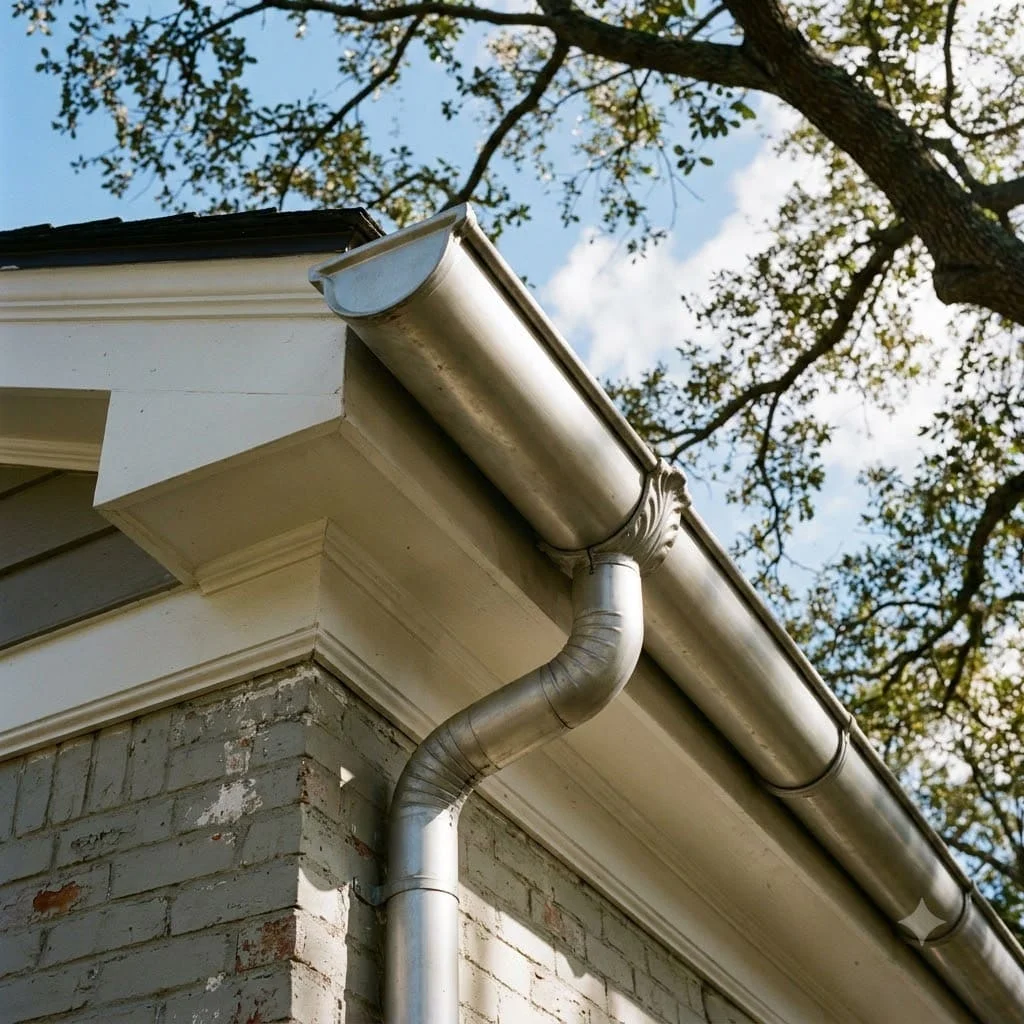
Half-round gutter on decorative brackets with a round downspout at the eave of an older painted-brick home
Free EstimatesAugusta & Richmond CountySeamless Gutter SpecialistsWritten PricingNo-Pressure Quotes

The Short Answer

K-style for almost every conventional Augusta home. Half-round where the building is genuinely period and the eave is part of the architecture.

K-style carries more water at the depths gutters actually run at, hangs directly on the fascia without visible brackets, works with the widest range of gutter guards, and costs roughly half as much — $8 to $14 per foot for 5-inch aluminum against $16 to $26 for half-round.

Half-round has one real functional advantage and it is not the one usually advertised. The semicircular section has no flat bottom and no inside corners, so it holds less residue between clear-outs. On a lot under loblolly pine that is worth something.

It is not worth enough to override the capacity and cost difference on a 1990s subdivision house. It is on a house in Summerville or Olde Town where a bright white ogee profile visually flattens an eave that was designed to be looked at.

What the Two Profiles Are

The names describe the cross-section — what you would see if you cut a length of gutter through and looked at the end.

K-style has a flat back, a flat bottom, and a curved decorative front intended to echo crown moulding. The flat back is the important part: it fastens straight to the fascia board, which is why the profile took over after the war. It is fast to hang, cheap to roll-form, and needs no visible hardware.

Half-round is an open semicircle with a rolled bead at each edge. It has no flat back, so it cannot fasten directly to fascia — it hangs in brackets, either fixed to the fascia or strapped to the roof deck. Those brackets are visible and are part of the look.

Half-round is the older of the two by a long way. It is what was on most American houses before K-style arrived, which is the whole reason it reads as period-correct now.

Both are available in aluminum and in copper, and both can be formed seamlessly, though half-round seamless machines are less common. The seamless versus sectional question is separate from the profile question and applies to either.

The Capacity Question, Properly

You will read in a lot of places that K-style holds roughly twice as much water as half-round of the same size. That is repeated far more confidently than it deserves, because at the brim a 5-inch semicircle is not smaller than a 5-inch K-style section.

The accurate version is more useful, and it explains both of this profile's traits at once.

Gutters do not run full. In ordinary rain a trough carries an inch or two of moving water along the bottom, and it only approaches the brim in the heaviest downpours.

At those working depths, shape decides everything. A K-style section has a flat bottom, so an inch of water in it is an inch deep right across the width. A semicircle tapers away to nothing at both edges, so the same inch of water occupies a narrow band at the lowest point of the curve.

That is why K-style carries more in practice, and it is a genuine functional difference rather than a marketing one. It is also why the sensible comparison is not like-for-like on nominal size.

The sizing rule that follows

Half-round is normally specified one size up. A 6-inch half-round is the fair comparison to a 5-inch K-style, not a 5-inch half-round. If you are moving from K-style to half-round on the same roofline and keeping the nominal size, you are reducing capacity — which on a steep roof or a long run is worth catching before it is installed rather than after the first hard summer storm.

Sizing is driven by roof area per downspout, pitch and run length rather than by profile, and the full method is in the 5-inch versus 6-inch guide. Profile changes what size satisfies it; it does not change the calculation.

Which Sheds Pine Straw Better

Here is where half-round earns something real, and it comes from exactly the same geometry that costs it capacity.

A K-style trough has a flat bottom meeting a vertical back at a right angle, and a second angle where the bottom meets the ogee front. Those two internal corners are where material settles and stays.

Grit, shingle granules, decomposed leaf matter and broken pine needles pack into the angle at the back of a K-style trough and are not easily moved by flowing water. Over a season that becomes a compacted ridge that holds moisture against the back wall of the gutter.

A half-round has no such angle. Water moving through a curved section sweeps the whole wetted surface, so fine material tends to travel to the outlet rather than settle.

The honest limit on that advantage matters as much as the advantage. Loblolly pine straw is stiff, three to nine inches long, and it interlocks into a mat. A mat bridges a semicircle exactly as readily as it bridges a K-style trough, and once it has bridged, neither profile is clearing itself.

So the fair summary is that half-round holds less residue between clear-outs and stays cleaner in the bottom of the trough. It does not extend the interval between clear-outs on a pined lot in Evans or Martinez the way a size increase does. If reducing cleaning frequency is the actual goal, trough size and whether guards pay back are the levers that move it.

What Each Costs Installed

Augusta-market rates, installed, including hangers or brackets, miters and end caps. Downspouts are priced separately on both.

Profile Installed price Typical 180 ft roofline
5-inch K-style aluminum $8 – $14 per ft $1,440 – $2,520
6-inch K-style aluminum $12 – $18 per ft $2,160 – $3,240
Half-round aluminum $16 – $26 per ft $2,880 – $4,680
Half-round copper $30 – $50 per ft $5,400 – $9,000

Roughly double for aluminum half-round, and the reasons are mostly labour rather than metal. Brackets have to be set and aligned individually where hidden hangers are simply screwed through the back of a K-style trough. Round downspouts and round elbows cost more than rectangular and are less widely stocked.

There is also less competition. Fewer installers run half-round regularly, and a crew forming it occasionally is slower at it than one forming K-style every day.

Copper half-round is the combination most people picture on a historic house, and at $30 to $50 a foot it is a serious number. Whether it earns that on your building is worked through in the copper gutters guide, which concludes that on most Augusta homes it does not.

How They Hang, and Why It Matters

The mounting difference has practical consequences beyond appearance, and they are worth knowing before choosing.

K-style Half-round
Mounting Hidden hangers through the back Visible brackets, fascia or roof-mounted
Fascia requirement Sound board, full contact Sound board, or roof-deck straps
Downspouts 2x3 or 3x4 rectangular Round, less widely stocked
Adjusting pitch later Straightforward Bracket by bracket
Repair part availability Everywhere Order-in on some profiles

The roof-deck strap option is the one genuine functional advantage of half-round brackets, and it comes up more than you would expect on older Augusta houses. Where the fascia has gone soft and replacement is being deferred, brackets can carry the gutter off the roof deck instead.

That is a legitimate technique, not a workaround, but it should never be used to avoid dealing with rot. Soft fascia behind a gutter is a problem whether or not the gutter is hanging from it — which is the point made at length on the Thomson page, where the board behind the gutter is usually the real job.

Gutter Guards on Half-Round

This is the practical constraint most people discover after choosing the profile rather than before, and on a CSRA lot it deserves to be part of the decision.

The gutter guard market is built around K-style. Most reverse-curve, micro-mesh and screen products are designed to sit against a flat front lip and tuck under the shingle course at a geometry K-style provides.

Half-round guards do exist. Mesh in aluminum, stainless and copper is available, and solid-cover designs are made for the profile. But the range is narrower, the price is higher, and fewer local installers stock them.

Two things follow. Specify the guard at the same time as the gutter, not two years later — a profile chosen without checking guard availability can leave you with a house that is expensive to protect. And if the plan is guards under heavy pine, that is an argument in favour of K-style unless the architecture genuinely rules it out.

Which guards survive loblolly pine at all, and the payback arithmetic run honestly, are covered on the gutter guards page and in the guard cost guide.

Which Belongs on Your House

The decision comes down to what the eave is doing architecturally, and it is usually not close in either direction.

Choose K-style if:

  • The house is a conventional build — post-war ranch, subdivision two-story, contemporary
  • Capacity is tight: steep pitch, long runs, or few downspout drops
  • Gutter guards are part of the plan
  • Budget is a real constraint and the money does more elsewhere
  • You want repair parts available locally for the next twenty years

Choose half-round if:

  • The house is genuinely period and the eave detail is meant to be seen
  • You are in a historic district where street-facing materials are reviewed, as in Aiken
  • There is existing half-round or copper on the building to match
  • Exposed rafter tails or decorative brackets would be flattened by an ogee front
  • You are willing to size up to keep the capacity you had

One combination worth mentioning because it comes up often on older Augusta and Clearwater housing stock: short eaves with exposed rafter tails. Half-round on visible brackets suits that detail, but the short overhang means the gutter sits close to the wall and discharge management matters more than usual. Get the downspout positions agreed at the same time as the profile.

What to Ask Before You Sign

  • What nominal size, and does it match the capacity of what is there now?
  • If moving to half-round, is the size going up to compensate?
  • Are brackets fascia-mounted or roof-strapped, and why?
  • What is the bracket spacing, in inches?
  • Are the downspouts round, and what size?
  • Which gutter guards fit this profile, and at what price?
  • Are replacement sections and fittings stocked locally?
  • Is the fascia sound, and what happens if rot is found?
  • What workmanship cover comes with the fitting, in writing?

The second question is the one most often missed. A like-for-like nominal swap from K-style to half-round quietly reduces capacity, and the consequence shows up as overshoot in the first heavy storm rather than on the quote.

Getting a Number for Your Own Roofline

Profile is one of the few gutter decisions where the building has more of a say than the calculation. Age, eave detail, what the neighbours on the street have, and whether a review body takes an interest all weigh alongside capacity.

Augusta Gutters Pros installs both profiles across Augusta, Richmond County and the wider CSRA, and will tell you when half-round is the wrong spend on a house that is not period — including when that means quoting the cheaper option. Call (706) 441-1723, or read how our estimates work first.

That completes the types and materials cluster: seamless versus sectional, which material, what size, whether copper is worth it, and this one. For what the finished job costs, see the installation cost guide; for every town covered, the service areas page.

About the prices on this page

Every range here describes what gutter work generally sells for in the Augusta and CSRA market rather than a national average. They show what to expect, not a final offer — your exact price comes from measuring your roofline. The figures were last checked in September 2026; see our terms of service for the full disclaimer.

Straight answers

Frequently Asked Questions

What is the difference between half-round and K-style gutters?

K-style has a flat back that fastens directly to the fascia, a flat bottom, and a decorative ogee front that resembles crown moulding. Half-round is a simple open semicircle, usually hung on visible external brackets.

K-style is the post-war standard because it is cheaper to form, hangs straight onto fascia without brackets, and carries more water at working depth. Half-round is the older profile and is what belongs on most period houses.

Which holds more water, half-round or K-style?

K-style, at the depths gutters actually run at. A gutter is rarely full — it carries a few inches of moving water — and a K-style section has a flat bottom that holds usable depth right across its width. A semicircle tapers away to nothing at the edges, so at the same water level it is carrying less.

That is why half-round is commonly specified one size up. A 6-inch half-round is the sensible comparison to a 5-inch K-style, not a 5-inch half-round.

Do half-round gutters clog less?

They clear better, which is not quite the same thing. The same curve that costs capacity also means there is no flat bottom and no inside corners for debris to pack into, so water moving along the trough tends to carry material with it rather than leaving it behind in the angles.

Under Augusta pine that is a genuine advantage. It does not make half-round self-cleaning — a mat of interlocked pine straw will bridge any profile — but between clear-outs it holds less residue.

How much do half-round gutters cost in Augusta?

Half-round aluminum runs $16 to $26 per linear foot installed in the Augusta market, against $8 to $14 for 5-inch K-style aluminum. Copper half-round runs $30 to $50.

The premium is partly the material and mostly the fabrication and hanging. Half-round needs brackets rather than hidden hangers, round downspouts and elbows rather than rectangular, and more careful alignment because the brackets are visible.

Can you put gutter guards on half-round gutters?

Yes, but the choice is narrower and it is worth confirming before committing to the profile. Most guard products are designed around the flat front lip and shingle-edge geometry of K-style.

Half-round guards exist in mesh and in solid-cover designs, and copper mesh is available for copper half-round. Expect fewer options and a higher price, and get the guard specified at the same time as the gutter rather than afterwards.

Is half-round worth it on an ordinary house?

Usually not. On a conventional subdivision build, half-round costs roughly twice K-style, carries less water per nominal inch, and does not look period-correct because the house is not period.

The money does more in 6-inch K-style trough with 3x4 downspouts, or in proper drainage away from the foundation. Half-round earns its price on buildings where the eave is architecture rather than trim.

Why do half-round gutters use round downspouts?

Partly appearance — a rectangular downspout under a semicircular trough looks wrong on a period house — and partly the same clearing logic. A round pipe has no internal corners for debris to catch in.

Round downspouts do come with a practical trade-off. Sizes and fittings are less widely stocked than rectangular, so a repair years later can take longer to source.

Not Sure Which Profile the House Wants?

On a period building the profile is an architectural decision; on a conventional one it is a capacity decision. We will walk the eave and price both, in writing and with no obligation.

Call Us Now (706) 441-1723